
Scsi hdi30-adapter

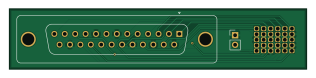
About the Scsi hdi30-adapter PCB
Scsi hdi30-adapter is an open source PCB design by anthony-bernaert, published on GitHub under the CERN-OHL-P-2.0 license. It is a 2-layer board measuring 79 × 16 mm, with 3 components from 3 distinct parts.
By type, the board carries 2 connectors and 1 resistor.
From the project
SCSI HDI30 to DB25 adapter for PowerBooks
This adapter board allows connecting SCSI devices with a DB-25 connector to vintage PowerBook Macintosh computers. While the female DB-25 connector was common as the SCSI port on many Macintosh models of the era, PowerBooks used a more compact proprietary HDI-30 connector for which suitable adapter cables can be hard to find.
Using standard stacking pin headers as contacts and a 3D printer, the connector can be reconstructed with reliable results. A low-cost PCB interconnects the DB-25 and HDI-30 ports.
Scsi hdi30-adapter bill of materials (BOM)
3 components, 3 distinct parts.
| Qty | Part | Footprint | Refs |
|---|---|---|---|
| 1 | ~ | HDI30 | J1 |
| 1 | Conn_01x02_Pin | PinHeader_1x02_P2.54mm_Vertical | J3 |
| 1 | 0R | R_0603_1608Metric | R1 |
Scsi hdi30-adapter design files
The KiCad project lives in the anthony-bernaert/scsi-hdi30-adapter repository on GitHub; these links point at the commit this page was built from.
- LayoutPCB/SCSI-HDI30-DB25.kicad_pcb
- SchematicPCB/SCSI-HDI30-DB25.kicad_sch
Scsi hdi30-adapter: common questions
How big is the Scsi hdi30-adapter PCB?
The Scsi hdi30-adapter measures 79 × 16 mm, has 2 copper layers and is 1.6 mm thick.
How many components are on the Scsi hdi30-adapter?
3 components, from 3 distinct parts. The full bill of materials is listed on this page.
Where can I download the Scsi hdi30-adapter design files?
From the anthony-bernaert/scsi-hdi30-adapter repository on GitHub, which has the KiCad layout and the schematic; the links under Design files point to each one.
Can I use the Scsi hdi30-adapter design in my own project?
Yes, under the terms of its CERN-OHL-P-2.0 license, which anthony-bernaert chose for the repository.