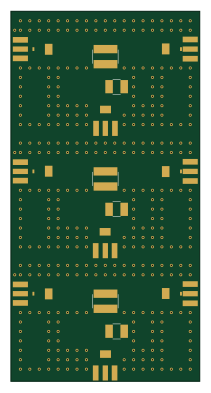
CapCoupler

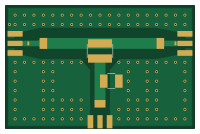
About the CapCoupler PCB
CapCoupler is an open source PCB design by F6ITU, published on GitHub. It is a 2-layer board measuring 50 × 32.5 mm, with 5 components from 4 distinct parts.
By type, the board carries 3 connectors and 2 capacitors.
From the project
Petit coupleur capacitif (ou "tap" en franglais) destiné à prélever une faible portion d'énergie dans un circuit HF de puissance.
Petit coupleur capacitif (ou "tap" en franglais) destiné à prélever une faible portion d'énergie dans un circuit HF de puissance.
Selon la puissance émise, les condensateurs utilisés doivent être capable de supporter entre 500 et 2000V. Capas porcelaine ou mica "cms" vivement conseillées. Caveat emptor
Comparativement aux coupleurs inductifs ou capacitifs, ce genre de montage est "relativement" indépendant de la fréquence de travail. Il est donc utilisable sans grande déterioration des performances entre 1 et 500 MHz.
CapCoupler bill of materials (BOM)
5 components, 4 distinct parts.
| Qty | Part | Footprint | Refs |
|---|---|---|---|
| 2 | N Conn | SMA_EDGE_NRW | J1, J2 |
| 1 | sma | SMA_EDGE_NRW | J3 |
| 1 | 2.2p | ATC_500_Dual_HandSoldering | C1 |
| 1 | 2.2n | ATC_500_HandSoldering | C2 |
CapCoupler design files
The KiCad project lives in the F6ITU/Capacitive_coupler repository on GitHub; these links point at the commit this page was built from.
- LayoutCapCoupler.kicad_pcb
- SchematicCapCoupler.kicad_sch
CapCoupler: common questions
How big is the CapCoupler PCB?
The CapCoupler measures 50 × 32.5 mm, has 2 copper layers and is 1.6 mm thick.
How many components are on the CapCoupler?
5 components, from 4 distinct parts. The full bill of materials is listed on this page.
Where can I download the CapCoupler design files?
From the F6ITU/Capacitive_coupler repository on GitHub, which has the KiCad layout and the schematic; the links under Design files point to each one.
Can I use the CapCoupler design in my own project?
The repository has no license, so all rights stay with F6ITU. Use it as a reference, and ask the author before reusing the design.