
Adjustable dual rail-LDO-regulator

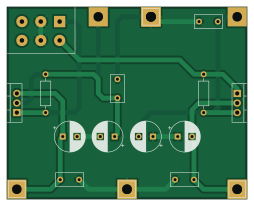
About the Adjustable dual rail-LDO-regulator PCB
Adjustable dual rail-LDO-regulator is an open source PCB design by LTgitspace, published on GitHub. It is a 2-layer board measuring 63.5 × 50.8 mm, with 13 components from 6 distinct parts.
Other key parts include the LM317_TO-220 and LM337_TO220. By type, the board carries 8 capacitors, 2 ICs and 2 resistors.
Main components on the Adjustable dual rail-LDO-regulator
Adjustable dual rail-LDO-regulator bill of materials (BOM)
13 components, 6 distinct parts.
| Qty | Part | Footprint | Refs |
|---|---|---|---|
| 1 | LM317_TO-220 | TO-220-3_Vertical | U1 |
| 1 | LM337_TO220 | TO-220-3_Vertical | U2 |
| 1 | 5k | Potentiometer_Alps_RK163_Dual_Horizontal | RV1 |
| 4 | 0.1uF | C_Rect_L7.2mm_W3.5mm_P5.00mm_FKS2_FKP2_MKS2_MKP2 | C1, C4, C6, C8 |
| 4 | 220uF | CP_Radial_D8.0mm_P3.80mm | C2, C3, C5, C7 |
| 2 | 240 | R_Axial_DIN0207_L6.3mm_D2.5mm_P10.16mm_Horizontal | R1, R2 |
Adjustable dual rail-LDO-regulator design files
The KiCad project lives in the LTgitspace/adjustable-dual-rail-LDO-regulator repository on GitHub; these links point at the commit this page was built from.
- Layoutadjustable dualrail.kicad_pcb
- Schematicadjustable dualrail.kicad_sch
Adjustable dual rail-LDO-regulator: common questions
How big is the Adjustable dual rail-LDO-regulator PCB?
The Adjustable dual rail-LDO-regulator measures 63.5 × 50.8 mm, has 2 copper layers and is 1.6 mm thick.
How many components are on the Adjustable dual rail-LDO-regulator?
13 components, from 6 distinct parts. The full bill of materials is listed on this page.
Where can I download the Adjustable dual rail-LDO-regulator design files?
From the LTgitspace/adjustable-dual-rail-LDO-regulator repository on GitHub, which has the KiCad layout and the schematic; the links under Design files point to each one.
Can I use the Adjustable dual rail-LDO-regulator design in my own project?
The repository has no license, so all rights stay with LTgitspace. Use it as a reference, and ask the author before reusing the design.