
Blinky

About the Blinky PCB
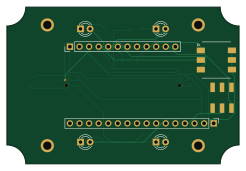
Blinky is an open source PCB design by onolab-tmu, published on GitHub under the MIT license. It is a 2-layer board measuring 61.5 × 41.5 mm, with 20 components from 15 distinct parts.
By type, the board carries 8 resistors, 4 diodes, 2 connectors, 2 microphones, 2 switches and 2 capacitors.
From the project
Hardware design files and software for a flexible and portable sound-to-light conversion device.
This folder contains the hardware description, bill of material, and schematics necessary to build a Blinky.
Kicad project files in the kicad folder. Illustration of the PCB from the bottom in pcb.pdf. Illustration of the PCB together with the location of holes in pcbandholes.pdf. CAD drawings of the enclosure and the holes drilled in it in tw5-4-7markingtop.pdf.
Blinky bill of materials (BOM)
20 components, 15 distinct parts.
| Qty | Part | Footprint | Refs |
|---|---|---|---|
| 1 | Conn_01x12 | Pin_Header_Straight_1x12_Pitch2.54mm | J1 |
| 1 | Conn_01x16 | Pin_Header_Straight_1x16_Pitch2.54mm | J2 |
| 1 | L | MIC_ICS-43432 | MK1 |
| 1 | R | MIC_ICS-43432 | MK2 |
| 1 | SDA03H1SBD | SW_SDA03H1SBD | S1 |
| 1 | JS202011SCQN | SW_JS202011SCQN | S2 |
| 1 | W | LED_D3.0mm | D1 |
| 1 | B | LED_D3.0mm | D2 |
| 1 | G | LED_D3.0mm | D3 |
| 1 | R | LED_D3.0mm | D4 |
| 2 | 0.1u | C_0805 | C1, C2 |
| 2 | 100 | R_0805 | R1, R3 |
| 1 | 75 | R_0805 | R2 |
| 1 | 180 | R_0805 | R4 |
| 4 | 100k | R_0805 | R5, R6, R7, R8 |
Blinky design files
The KiCad project lives in the onolab-tmu/blinky repository on GitHub; these links point at the commit this page was built from.
Blinky: common questions
How big is the Blinky PCB?
The Blinky measures 61.5 × 41.5 mm, has 2 copper layers and is 1.6 mm thick.
How many components are on the Blinky?
20 components, from 15 distinct parts. The full bill of materials is listed on this page.
Where can I download the Blinky design files?
From the onolab-tmu/blinky repository on GitHub, which has the KiCad layout; the links under Design files point to each one.
Can I use the Blinky design in my own project?
Yes, under the terms of its MIT license, which onolab-tmu chose for the repository.