
TRS-80-Model-I-G-E1

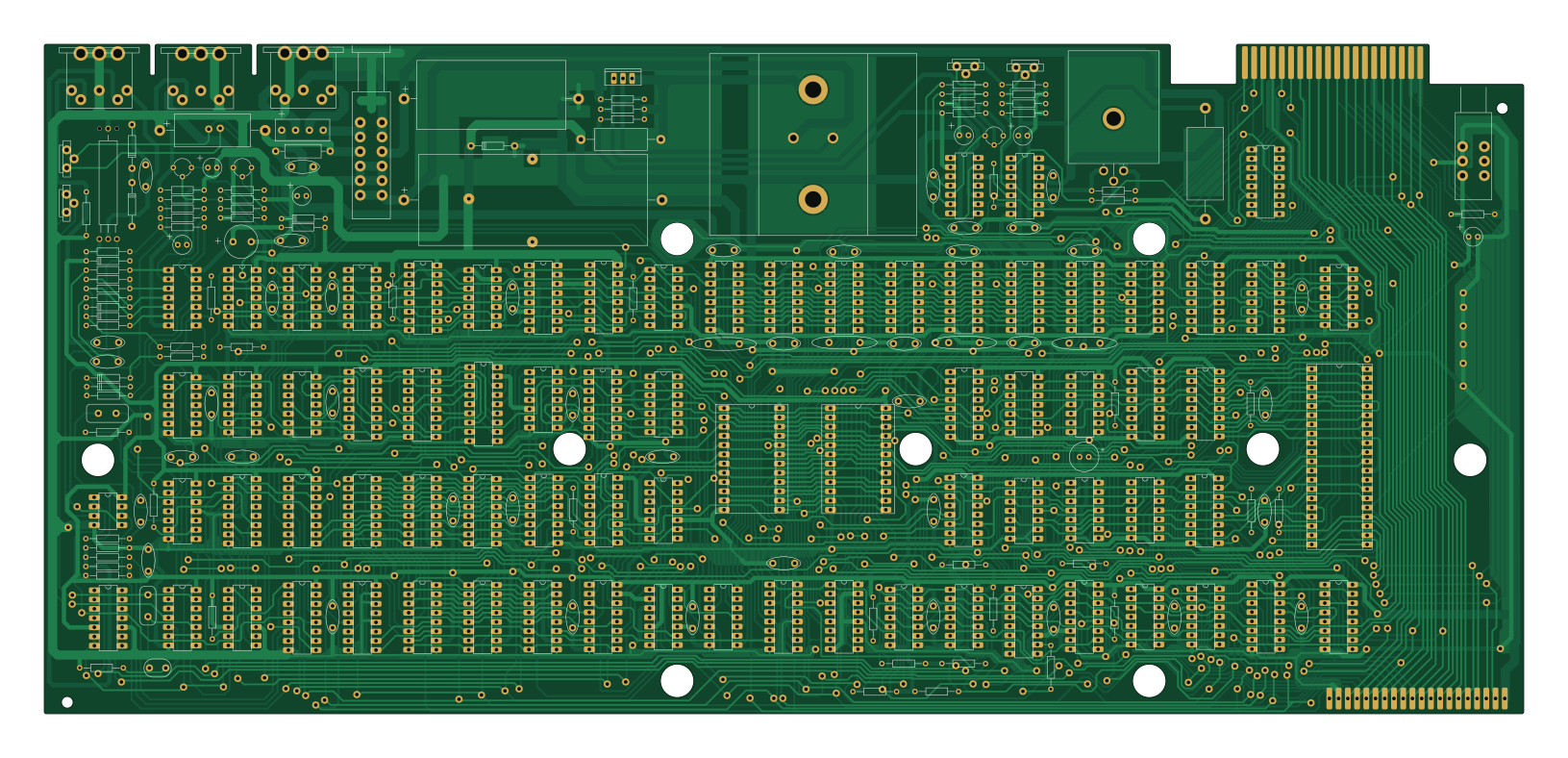
About the TRS-80-Model-I-G-E1 PCB
TRS-80-Model-I-G-E1 is an open source PCB design by RetroStack, published on GitHub under the MIT license. It is a 2-layer board measuring 407 × 184 mm, with 230 components from 98 distinct parts.
By type, the board carries 69 resistors, 58 capacitors, 6 transistors, 5 connectors, 2 switches and 1 crystal.
From the project
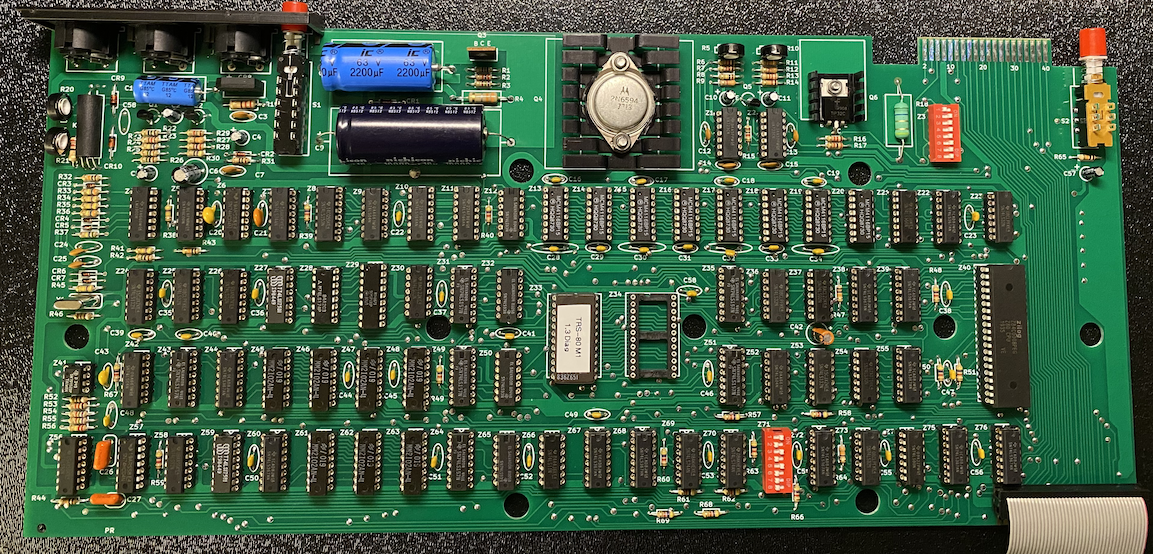
Hardware Replica of the TRS-80 Model I Revision G
This project is a faithful reimplementation of the mainboard of the iconic TRS-80 Model 1 (Revision G) computer. My own revision, the E1, is designed to replicate the original system's functionality by using a PCB design 1-to-1 to the original, including components, interfaces, and even traces. The entire project is available under the MIT license.
In the "Latest" folder, you'll find the most up-to-date design files, including:
TRS-80-Model-I-G-E1 bill of materials (BOM)
230 components, 98 distinct parts — part numbers from the project's BOM.
| Qty | Part | Footprint | Refs |
|---|---|---|---|
| 1 | 2N3904 | TRS80_Model_I_Q_Circle_EBC | Q1 |
| 2 | 2N3906 | TRS80_Model_I_Q_Circle_EBC | Q2, Q5 |
| 1 | TIP29A | TRS80_Model_I_Q_Box_BCE | Q3 |
| 1 | 2N6594 | TRS80_Model_I_Q_Heatsink_Large_BEC | Q4 |
| 1 | MJE34 | TRS80_Model_I_Q_Heatsink_Small_BCE | Q6 |
| 1 | 10.6445 MHz | TRS80_Model_I_Crystal | Y1 |
| 3 | DIN-5_180DEGREE Front View | TRS80_Model_I_DIN5 | J1, J2, J3 |
| 1 | Edge Connector | TRS80_Model_I_Edge_Connector | J4 |
| 1 | CONN_01X20 Connection Mainboard Side | TRS80_Model_I_Keyboard_Connector | J100 |
| 1 | 1N4735 | TRS80_Model_I_D | CR1 |
| 1 | 1N5231 | TRS80_Model_I_D | CR2 |
| 5 | 1N4148 | TRS80_Model_I_D | CR3, CR4, CR5, CR6, CR7 |
| 1 | MDA202 | TRS80_Model_I_D_Bridge | CR8 |
| 2 | 1N982 | TRS80_Model_I_D | CR9, CR10 |
| 1 | 0.1uF 12V | TRS80_Model_I_C_Disc_9.5L_4W_6P_Small | C_C58 |
| 1 | 220 | TRS80_Model_I_R_0.25W | C_R67 |
| 1 | TRS80_MODEL_I_RELAY_NO Relay_SPST-NO | TRS80_Model_I_Relay | K1 |
| 1 | SW_4PST ~ | TRS80_Model_I_Sw_Large | S1 |
| 1 | Reset | TRS80_Model_I_Sw_Small | S2 |
| 2 | LM723C_1 LM723C | TRS80_Model_I_DIP14 | Z1, Z2 |
Show 78 more
| Qty | Part | Footprint | Refs |
|---|---|---|---|
| 2 | TRS80MODELIX71 ~ | TRS80_Model_I_DIP16 | Z3, Z71 |
| 1 | LM3900 | TRS80_Model_I_DIP14 | Z4 |
| 1 | 74LS00 74C00 | TRS80_Model_I_DIP14 | Z5 |
| 2 | 74LS04 74C04 | TRS80_Model_I_DIP14 | Z6, Z57 |
| 3 | 74LS74 | TRS80_Model_I_DIP14 | Z7, Z69, Z70 |
| 1 | 74LS153 | TRS80_Model_I_DIP16 | Z8 |
| 3 | 74LS04 | TRS80_Model_I_DIP14 | Z9, Z42, Z52 |
| 2 | 74LS166 | TRS80_Model_I_DIP16 | Z10, Z11 |
| 4 | 74LS93 | TRS80_Model_I_DIP14 | Z12, Z32, Z50, Z65 |
| 8 | 4116 | TRS80_Model_I_DIP16 | Z13, Z14, Z15, Z16, Z17, Z18, Z19, Z20 |
| 1 | 74LS156 | TRS80_Model_I_DIP16 | Z21 |
| 11 | 74LS367_SPLIT 74LS367 | TRS80_Model_I_DIP16 | Z22, Z38, Z39, Z44, Z55, Z60, Z67, Z68 +3 |
| 4 | 74LS32 | TRS80_Model_I_DIP14 | Z23, Z25, Z36, Z73 |
| 2 | 74LS132 | TRS80_Model_I_DIP14 | Z24, Z53 |
| 1 | 74LS20 | TRS80_Model_I_DIP14 | Z26 |
| 2 | 74LS175 | TRS80_Model_I_DIP16 | Z27, Z59 |
| 1 | 74LS174 | TRS80_Model_I_DIP16 | Z28 |
| 1 | MCM6670P MCM6670 | TRS80_Model_I_DIP18 | Z29 |
| 2 | 74LS02 | TRS80_Model_I_DIP14 | Z30, Z37 |
| 6 | 74LS157 | TRS80_Model_I_DIP16 | Z31, Z35, Z43, Z49, Z51, Z64 |
| 1 | 2364_20L | TRS80_Model_I_DIP24 | Z33 |
| 1 | 2332_20L_21L | TRS80_Model_I_DIP24 | Z34 |
| 1 | Z80 Z80CPU | TRS80_Model_I_DIP40 | Z40 |
| 1 | 75452 | TRS80_Model_I_DIP8 | Z41 |
| 7 | 2102_1 2102 | TRS80_Model_I_DIP16 | Z45, Z46, Z47, Z48, Z61, Z62, Z63 |
| 1 | 74LS30 | TRS80_Model_I_DIP14 | Z54 |
| 2 | 74LS92 | TRS80_Model_I_DIP14 | Z56, Z58 |
| 1 | 74LS11 | TRS80_Model_I_DIP14 | Z66 |
| 1 | 74LS00 | TRS80_Model_I_DIP14 | Z74 |
| 1 | 220uF 16V | TRS80_Model_I_C_Pol_Axial_21L_9W_29P | C1 |
| 6 | 10uF 16V | TRS80_Model_I_C_Pol_Radial_5D_2.5P | C2, C4, C5, C10, C11, C57 |
| 4 | 0.01uF 24V | TRS80_Model_I_C_Disc_9.5L_4W_6P_Small | C3, C7, C14, C15 |
| 1 | 100uF 16V | TRS80_Model_I_C_Pol_Radial_10D_5P | C6 |
| 1 | 2200uF 35V | TRS80_Model_I_C_Pol_Axial_41L_19W_48P | C8 |
| 1 | 10000uF 16V | TRS80_Model_I_C_Pol_Axial_63L_25W_71P | C9 |
| 2 | 470PF 470pF | TRS80_Model_I_C_Disc_9.5L_4W_6P_Small | C12, C13 |
| 30 | 0.1uF 12V | TRS80_Model_I_C_Disc_9.5L_4W_6P_Small | C16, C17, C18, C19, C22, C23, C29, C31 +22 |
| 1 | 330PF 330pF | TRS80_Model_I_C_Disc_9.5L_4W_6P_Small | C20 |
| 1 | 750PF 750pF | TRS80_Model_I_C_Disc_9.5L_4W_6P_Small | C21 |
| 2 | 220PF 220pF | TRS80_Model_I_C_Disc_9.5L_4W_6P_Small | C24, C25 |
| 1 | 0.047UF 0.047uF | TRS80_Model_I_C_Box_11L_5W_6P_Large | C26 |
| 1 | 0.022UF 0.022uF | TRS80_Model_I_C_Box_7.5L_5W_4.5P_Small | C27 |
| 4 | 0.1uF 25V | TRS80_Model_I_C_Disc_18.5L_4W_8.5P_Large | C28, C30, C32, C34 |
| 1 | 22uF 16V | TRS80_Model_I_C_Pol_Radial_6.3D_2.5P | C42 |
| 1 | 47PF 47pF | TRS80_Model_I_C_Disc_9.5L_4W_6P_Small | C43 |
| 1 | 68 | TRS80_Model_I_R_0.25W | R1 |
| 1 | 2.7K 2.7k | TRS80_Model_I_R_0.25W | R2 |
| 1 | 750 | TRS80_Model_I_R_0.25W | R3 |
| 1 | 0.33 | TRS80_Model_I_R_2W | R4 |
| 2 | 1k | TRS80_Model_I_R_Pot | R5, R10 |
| 4 | 1.2K 1.2k | TRS80_Model_I_R_0.25W | R6, R7, R16, R53 |
| 1 | 100K 100k | TRS80_Model_I_R_0.25W | R8 |
| 3 | 3.3K 3.3k | TRS80_Model_I_R_0.25W | R9, R11, R12 |
| 1 | 2.2K 2.2k | TRS80_Model_I_R_0.25W | R13 |
| 1 | 12K 12k | TRS80_Model_I_R_0.25W | R14 |
| 1 | 1.5K 1.5k | TRS80_Model_I_R_0.25W | R15 |
| 1 | 2k | TRS80_Model_I_R_0.25W | R17 |
| 1 | 5.6 | TRS80_Model_I_R_3W | R18 |
| 1 | 220 | TRS80_Model_I_R_0.5W | R19 |
| 2 | 100K 100k | TRS80_Model_I_R_Pot | R20, R21 |
| 1 | 75 | TRS80_Model_I_R_0.25W | R22 |
| 1 | 120 | TRS80_Model_I_R_0.25W | R23 |
| 1 | 680K 680k | TRS80_Model_I_R_0.25W | R24 |
| 1 | 1.6M | TRS80_Model_I_R_0.25W | R25 |
| 2 | 1M | TRS80_Model_I_R_0.25W | R26, R42 |
| 2 | 330 | TRS80_Model_I_R_0.25W | R27, R64 |
| 1 | 270 | TRS80_Model_I_R_0.25W | R28 |
| 1 | 1.8K 1.8k | TRS80_Model_I_R_0.25W | R29 |
| 1 | 47 | TRS80_Model_I_R_0.25W | R30 |
| 1 | 10 | TRS80_Model_I_R_0.25W | R31 |
| 5 | 10K 10k | TRS80_Model_I_R_0.25W | R32, R43, R44, R47, R65 |
| 2 | 360K 360k | TRS80_Model_I_R_0.25W | R33, R36 |
| 5 | 470K 470k | TRS80_Model_I_R_0.25W | R34, R35, R38, R41, R45 |
| 1 | 560K 560k | TRS80_Model_I_R_0.25W | R37 |
| 17 | 4.7K 4.7k | TRS80_Model_I_R_0.25W | R39, R40, R48, R49, R50, R51, R57, R58 +9 |
| 2 | 910 | TRS80_Model_I_R_0.25W | R46, R52 |
| 2 | 7.5K 7.5k | TRS80_Model_I_R_0.25W | R54, R55 |
| 1 | 220K 220k | TRS80_Model_I_R_0.25W | R56 |
TRS-80-Model-I-G-E1 design files
The KiCad project lives in the RetroStack/TRS-80-Model-I-G-E1 repository on GitHub; these links point at the commit this page was built from.
TRS-80-Model-I-G-E1: common questions
How big is the TRS-80-Model-I-G-E1 PCB?
The TRS-80-Model-I-G-E1 measures 407 × 184 mm, has 2 copper layers and is 1.6 mm thick.
How many components are on the TRS-80-Model-I-G-E1?
230 components, from 98 distinct parts, with part numbers taken from the project's own BOM. The full bill of materials is listed on this page.
Where can I download the TRS-80-Model-I-G-E1 design files?
From the RetroStack/TRS-80-Model-I-G-E1 repository on GitHub, which has the KiCad layout, the schematic and the BOM; the links under Design files point to each one.
Can I use the TRS-80-Model-I-G-E1 design in my own project?
Yes, under the terms of its MIT license, which RetroStack chose for the repository.