
Low Pass Filter


About the Low Pass Filter PCB
Low Pass Filter is an open source PCB design by SelvaUx, published on GitHub. It is a 2-layer board measuring 16.5 × 30 mm, with 3 components from 3 distinct parts.
By type, the board carries 1 connector, 1 capacitor and 1 resistor.
From the project
A collection of 10 production-ready schematic & PCB layout designs From fundamental analog circuits to motor control systems — all designed in KiCad
I build for the messy, low-bandwidth, real world — where people need technology that actually functions. My engineering philosophy is simple: offline first, privacy always, real hardware required. I don't trust solutions that work only in ideal conditions.
From custom AI assistants to fiber fault detection engines, from IoT aquaculture platforms to portfolio sites with mini-labs inside — the list doesn't stop because the curiosity doesn't stop.
Low Pass Filter bill of materials (BOM)
3 components, 3 distinct parts.
| Qty | Part | Footprint | Refs |
|---|---|---|---|
| 1 | Screw_Terminal_01x02 | PinHeader_1x02_P2.54mm_Vertical | J1 |
| 1 | 1uf | CP_Radial_D12.5mm_P5.00mm | C1 |
| 1 | 1k | R_Axial_DIN0207_L6.3mm_D2.5mm_P7.62mm_Horizontal | R1 |
Low Pass Filter design files
The KiCad project lives in the SelvaUx/PCB-Design-Internship-Circuit-Portfolio repository on GitHub; these links point at the commit this page was built from.
Low Pass Filter: common questions
How big is the Low Pass Filter PCB?
The Low Pass Filter measures 16.5 × 30 mm, has 2 copper layers and is 1.6 mm thick.
How many components are on the Low Pass Filter?
3 components, from 3 distinct parts. The full bill of materials is listed on this page.
Where can I download the Low Pass Filter design files?
From the SelvaUx/PCB-Design-Internship-Circuit-Portfolio repository on GitHub, which has the KiCad layout and the schematic; the links under Design files point to each one.
Can I use the Low Pass Filter design in my own project?
The repository has no license, so all rights stay with SelvaUx. Use it as a reference, and ask the author before reusing the design.
More boards in PCB-Design-Internship-Circuit-Portfolio
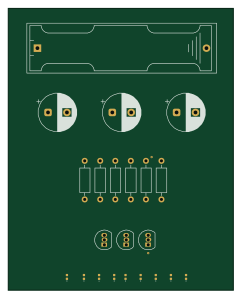
LED Circuit
59.5 × 74.5 mm22 parts2LNo license0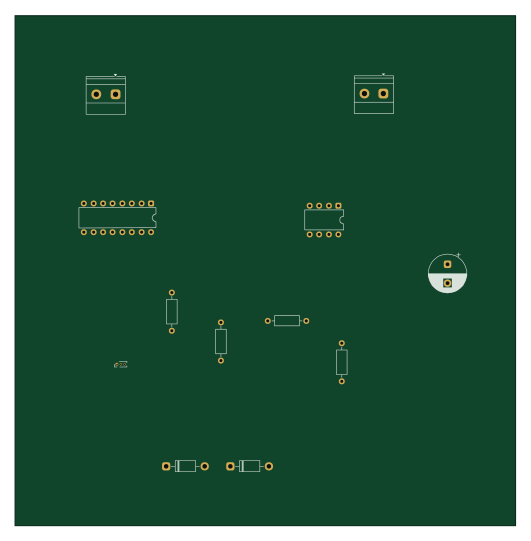
Motor Speed Controller
132.5 × 135 mm12 parts2LNo license0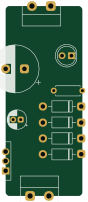
Voltage Regulator
20.4 × 50.5 mm11 parts2LNo license0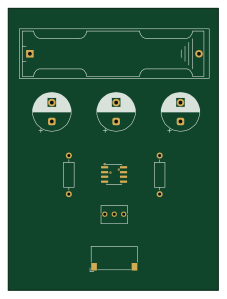
METRONOME
55.5 × 74.5 mm9 parts2LNo license0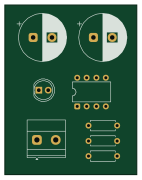
LED Blink Using IC555
35 × 45 mm8 parts2LNo license0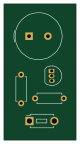
Buzzer Alarm
19 × 36 mm5 parts2LNo license0