
Micro 8088 case

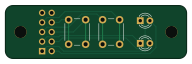
About the Micro 8088 case PCB
Micro 8088 case is an open source PCB design by skiselev, published on GitHub under the GPL-3.0 license. It is a 2-layer board measuring 48 × 14 mm, with 5 components from 5 distinct parts.
By type, the board carries 2 switches, 2 diodes and 1 connector.
From the project
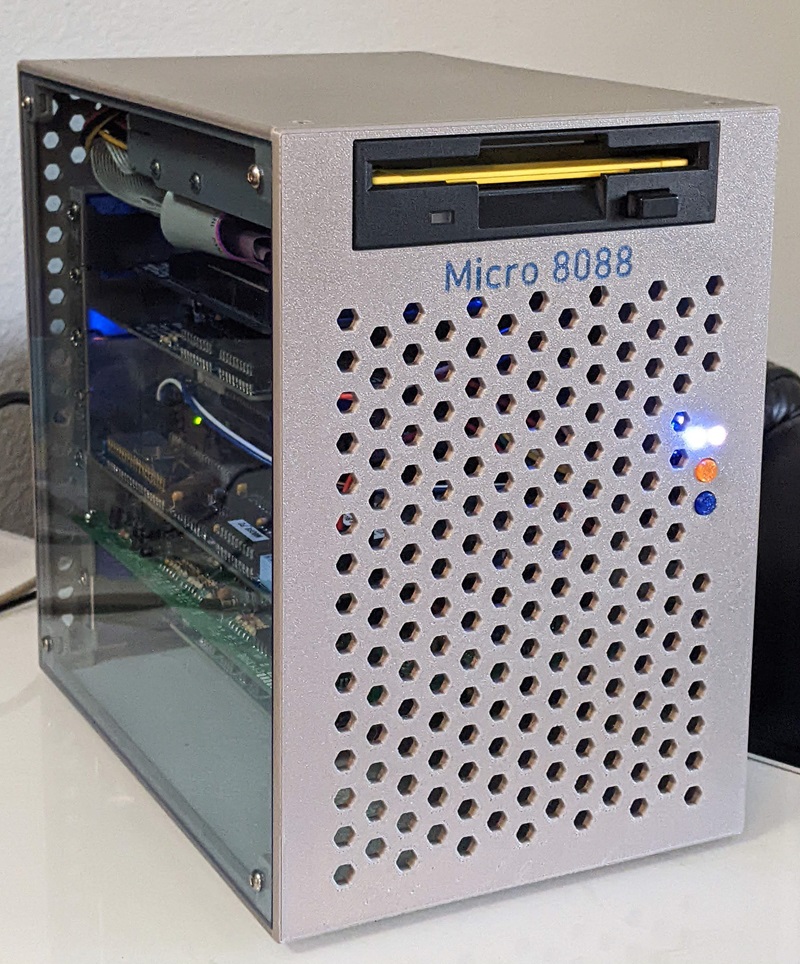
Case for Micro 8088
The front panel features the standard Intel* 9-pin front panel pinout, and can work with other systems as well.
Parts can be printed using PETG or other fillament. The parts are designed to be printed without supports, with the exception of the case back, which needs supports for the DC power connector area.
Part | File | Notes --------------- | -------------------------------------------------------------------------------------------------- | ------------------------------------------------------------------ Case Front | casefront.stl | For the system name in colored letters, print…
Micro 8088 case bill of materials (BOM)
5 components, 5 distinct parts.
| Qty | Part | Footprint | Refs |
|---|---|---|---|
| 1 | Front_Panel | PinHeader_2x05_P2.54mm_Vertical | J1 |
| 1 | Power_Switch | SW_PUSH_6mm_H7.3mm | SW1 |
| 1 | Reset_Switch | SW_PUSH_6mm_H7.3mm | SW2 |
| 1 | Power_LED | LED_D3.0mm | D1 |
| 1 | HDD_LED | LED_D3.0mm | D2 |
Micro 8088 case design files
The KiCad project lives in the skiselev/micro_8088_case repository on GitHub; these links point at the commit this page was built from.
Micro 8088 case: common questions
How big is the Micro 8088 case PCB?
The Micro 8088 case measures 48 × 14 mm, has 2 copper layers and is 1.6 mm thick.
How many components are on the Micro 8088 case?
5 components, from 5 distinct parts. The full bill of materials is listed on this page.
Where can I download the Micro 8088 case design files?
From the skiselev/micro_8088_case repository on GitHub, which has the KiCad layout; the links under Design files point to each one.
Can I use the Micro 8088 case design in my own project?
Yes, under the terms of its GPL-3.0 license, which skiselev chose for the repository.