
HTML Accelerator

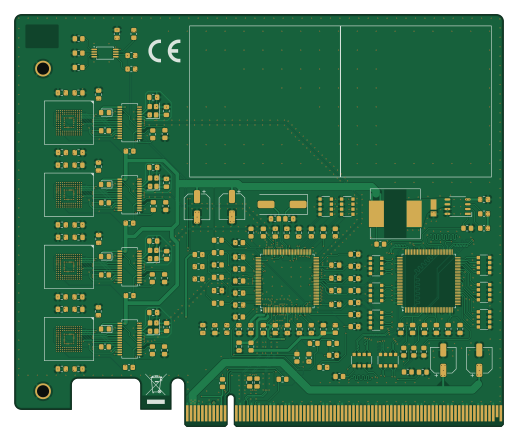
About the HTML Accelerator PCB
HTML Accelerator is an open source PCB design by akaStanley, published on GitHub under the GPL-3.0 license. It is a 4-layer board measuring 129.3 × 109 mm, with 170 components from 36 distinct parts.
Other key parts include the MCS9990, AP1513, CAT24C256YI-GT3, AU6438BS and H26M31003. By type, the board carries 73 resistors, 68 capacitors, 12 ICs, 5 crystals, 5 diodes and 3 inductors.
From the project
A functioning version of the fictional PCIE card
To make a very long story short, this meme showed up on twitter in October 2020 for a fake PCIE add-in card that speeds up your web browser: https://twitter.com/_Ninji/status/1317197426449633281
My friends and I thought it was hilarious, something so meticulously useless. We immediately shared it with each other--hammering the original iMessage thread so much that it became a meme in and of itself. Later, it evolved into an unspoken rule that when someone evidently shared a duplicate meme in our iMessage group we all rushed to reply with pictures of this HTML5 Accelerator to call them out.
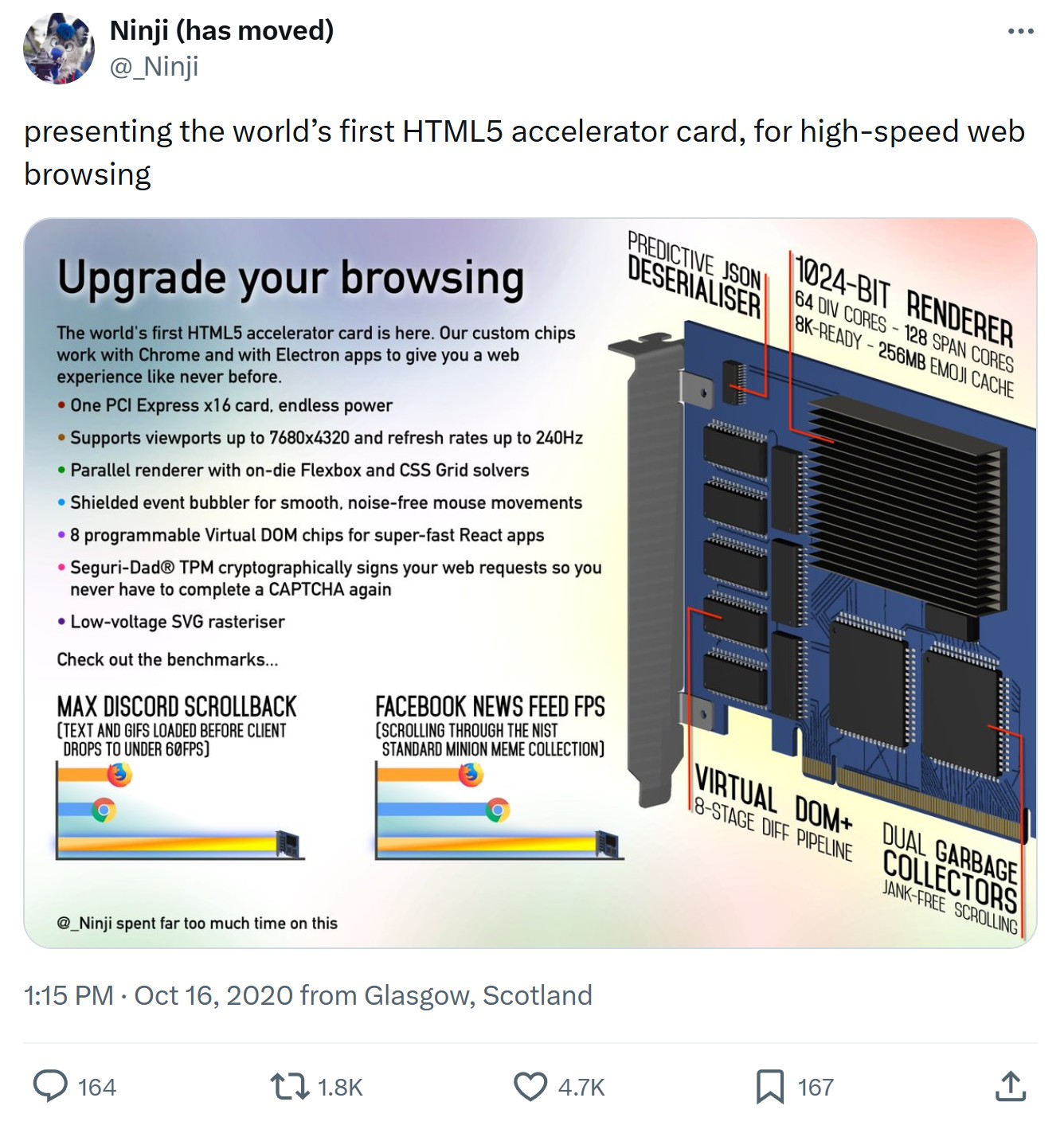
Main components on the HTML Accelerator
HTML Accelerator bill of materials (BOM)
170 components, 36 distinct parts — part numbers from the project's BOM.
| Qty | Part | Footprint | Refs |
|---|---|---|---|
| 2 | MCS9990 | LQFP-128_14x14mm_P0.4mm | U1, U12 |
| 1 | AP1513 | SOP-8L_DIO | U2 |
| 1 | CAT24C256YI-GT3 | TSSOP-8_4.4x3mm_P0.65mm | U3 |
| 4 | AU6438BS | SSOP-28_3.9x9.9mm_P0.635mm | U4, U8, U9, U10 |
| 3 | H26M31003 | EMMC04G-M627-X03U_KNT | U5, U6, U7 |
| 1 | EMMC_4G | EMMC04G-M627-X03U_KNT | U11 |
| 1 | 12MHz | Crystal_SMD_HC49-SD | Y1 |
| 4 | 12MHz | Crystal_SMD_3225-4Pin_3.2x2.5mm | Y2, Y3, Y4, Y5 |
| 1 | Bus_PCI_Express_x16 | BUS_PCIexpress_x16 | J1 |
| 1 | PCIexpress_bracket | PCIexpress_bracket_full | J2 |
| 2 | ~ | Heatsink | HEATSINK1, HEATSINK2 |
| 1 | SBR2U30P1 | DIODE_SBR2U30P1 | D1 |
| 4 | RED | LED_0805_2012Metric_Pad1.15x1.40mm_HandSolder | D2, D3, D4, D5 |
| 2 | BLM21PG121SN1D | R_0805_2012Metric_Pad1.20x1.40mm_HandSolder | FB1, FB2 |
| 1 | SRR1208-330YL | IND_BOURNS_SRR1208 | L1 |
| 32 | 0.1uF | C_0805_2012Metric_Pad1.18x1.45mm_HandSolder | C1, C2, C4, C6, C8, C9, C10, C11 +24 |
| 5 | 10uF | C_0805_2012Metric_Pad1.18x1.45mm_HandSolder | C3, C7, C14, C21, C26 |
| 1 | 3.3uF | C_0805_2012Metric_Pad1.18x1.45mm_HandSolder | C5 |
| 4 | 100uF | CP_Elec_6.3x5.8 | C33, C34, C71, C72 |
| 8 | 20pF | C_0805_2012Metric_Pad1.18x1.45mm_HandSolder | C36, C37, C47, C48, C54, C55, C61, C62 |
Show 16 more
| Qty | Part | Footprint | Refs |
|---|---|---|---|
| 8 | 4.7uF | C_0805_2012Metric_Pad1.18x1.45mm_HandSolder | C38, C39, C45, C46, C52, C53, C59, C60 |
| 2 | 22pF | C_0805_2012Metric_Pad1.18x1.45mm_HandSolder | C40, C41 |
| 8 | 2.2uF | C_0805_2012Metric_Pad1.18x1.45mm_HandSolder | C42, C43, C49, C50, C56, C57, C63, C64 |
| 7 | 4.7k | R_0805_2012Metric_Pad1.20x1.40mm_HandSolder | R1, R2, R3, R22, R23, R24, R27 |
| 1 | 33 | R_0805_2012Metric_Pad1.20x1.40mm_HandSolder | R4 |
| 9 | 0 | R_0805_2012Metric_Pad1.20x1.40mm_HandSolder | R5, R6, R9, R58, R59, R60, R61, R62 +1 |
| 1 | 6.2k | R_0805_2012Metric_Pad1.20x1.40mm_HandSolder | R7 |
| 22 | 1k | R_0805_2012Metric_Pad1.20x1.40mm_HandSolder | R8, R20, R25, R26, R28, R29, R30, R31 +14 |
| 8 | 10k | R_0805_2012Metric_Pad1.20x1.40mm_HandSolder | R10, R11, R12, R13, R42, R46, R50, R54 |
| 4 | 12k | R_0805_2012Metric_Pad1.20x1.40mm_HandSolder | R14, R15, R16, R17 |
| 1 | 3k | R_0805_2012Metric_Pad1.20x1.40mm_HandSolder | R18 |
| 1 | 6.8k | R_0805_2012Metric_Pad1.20x1.40mm_HandSolder | R19 |
| 1 | 1.3k | R_0805_2012Metric_Pad1.20x1.40mm_HandSolder | R21 |
| 4 | 27 | R_0805_2012Metric_Pad1.20x1.40mm_HandSolder | R44, R48, R52, R56 |
| 4 | 680 | R_0805_2012Metric_Pad1.20x1.40mm_HandSolder | R45, R49, R53, R57 |
| 10 | 1k | R_Array_Convex_4x1206 | RN1, RN2, RN3, RN4, RN5, RN6, RN7, RN8 +2 |
HTML Accelerator design files
The KiCad project lives in the akaStanley/HTML_Accelerator repository on GitHub; these links point at the commit this page was built from.
HTML Accelerator: common questions
How big is the HTML Accelerator PCB?
The HTML Accelerator measures 129.3 × 109 mm, has 4 copper layers and is 1.6062 mm thick.
How many components are on the HTML Accelerator?
170 components, from 36 distinct parts, with part numbers taken from the project's own BOM. The full bill of materials is listed on this page.
Where can I download the HTML Accelerator design files?
From the akaStanley/HTML_Accelerator repository on GitHub, which has the KiCad layout, the schematic and the BOM; the links under Design files point to each one.
Can I use the HTML Accelerator design in my own project?
Yes, under the terms of its GPL-3.0 license, which akaStanley chose for the repository.