
AC TO DC

About the AC TO DC PCB
AC TO DC is an open source PCB design by aravind-navadagi, published on GitHub. It is a 4-layer board measuring 41.5 × 22.5 mm, with 8 components from 7 distinct parts.
Other key parts include the LM7805_TO220. By type, the board carries 2 connectors, 2 diodes, 2 capacitors, 1 IC and 1 resistor.
From the project
Designed by: Aravind Navadagi Tool: KiCad 9.0 Board Type: 2-Layer Compact Linear Power Supply
Designed by: Aravind Navadagi Tool: KiCad 9.0 Board Type: 2-Layer Compact Linear Power Supply
This project is a compact, reliable, and high-efficiency linear AC to DC Power Supply Module designed to convert low-voltage AC input (from a step-down transformer) into a steady, ripple-free +5V DC output.
It integrates full-wave bridge rectification, large capacitive ripple filtering, precise linear regulation via the industry-standard LM7805, output transient stabilization, and an LED power indicator.
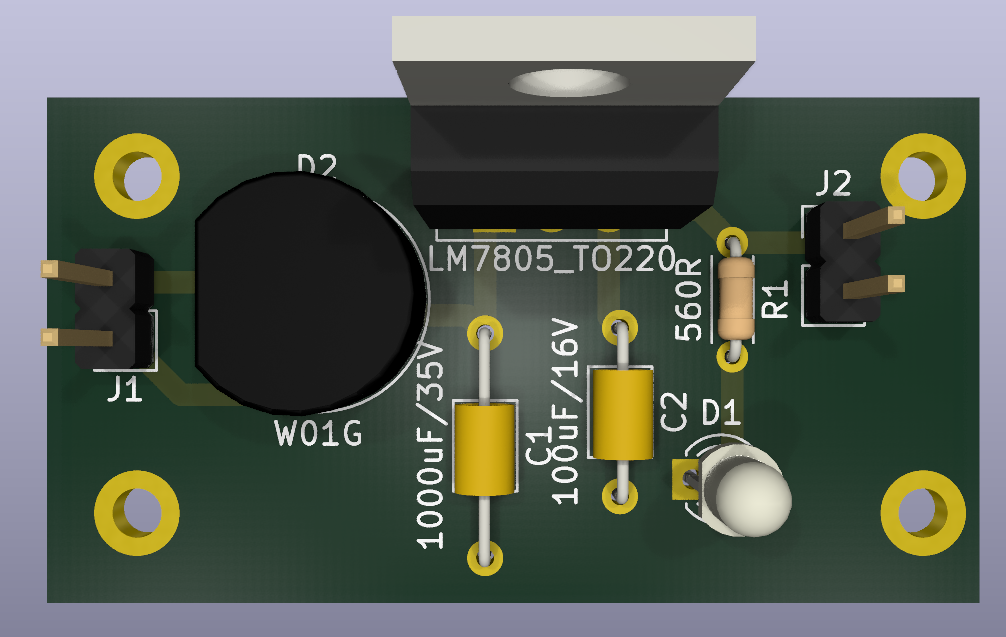
Main components on the AC TO DC
AC TO DC bill of materials (BOM)
8 components, 7 distinct parts.
| Qty | Part | Footprint | Refs |
|---|---|---|---|
| 1 | LM7805_TO220 | TO-220-3_Vertical | U1 |
| 2 | Conn_01x02_Pin | PinHeader_1x02_P2.54mm_Vertical | J1, J2 |
| 1 | LED | LED_D3.0mm_Clear | D1 |
| 1 | W01G | Diode_Bridge_Round_D9.8mm | D2 |
| 1 | 1000uF/35V | C_Axial_L3.8mm_D2.6mm_P10.00mm_Horizontal | C1 |
| 1 | 100uF/16V | C_Axial_L3.8mm_D2.6mm_P7.50mm_Horizontal | C2 |
| 1 | 560R | R_Axial_DIN0204_L3.6mm_D1.6mm_P5.08mm_Horizontal | R1 |
AC TO DC design files
The KiCad project lives in the aravind-navadagi/AC_TO_DC repository on GitHub; these links point at the commit this page was built from.
- LayoutAC_TO_DC.kicad_pcb
- SchematicAC_TO_DC.kicad_sch
AC TO DC: common questions
How big is the AC TO DC PCB?
The AC TO DC measures 41.5 × 22.5 mm, has 4 copper layers and is 1.6 mm thick.
How many components are on the AC TO DC?
8 components, from 7 distinct parts. The full bill of materials is listed on this page.
Where can I download the AC TO DC design files?
From the aravind-navadagi/AC_TO_DC repository on GitHub, which has the KiCad layout and the schematic; the links under Design files point to each one.
Can I use the AC TO DC design in my own project?
The repository has no license, so all rights stay with aravind-navadagi. Use it as a reference, and ask the author before reusing the design.