
Bonsai C

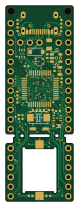
About the Bonsai C PCB
Bonsai C is an open source STM32 PCB design by customMK, published on GitHub under the CERN-OHL-P-2.0 license. It is a 4-layer board measuring 17.8 × 51.6 mm, with 37 components from 27 distinct parts.
Its main chip is the C81523, from the STM32 family. Other key parts include the C370742, C274624 and C78541. By type, the board carries 11 capacitors, 7 connectors, 6 resistors, 4 ICs, 3 diodes and 1 transistor.
It belongs with the keyboards designs in this gallery.
From the project
An open-source ARM-based microcontroller board
- Images - Background - Comparison to Proton C - Build information - License
Bonsai C3 fabricated by JLCPCB (disregard the extra width, 20mm minimum width used to be JLCPCB requirement)
Bonsai C3 is a general-purpose ARM-based microcontroller board. It was designed to help with the protoype and development of mechanical keyboards, but is versatile enough to be used in a variety of other applications. Mechanical keyboards can use Bonsai C3 as a "plug in" microcontroller board to their own designs sans-microcontroller, or they can incorporate the Bonsai C schmatic and layout directly into a…
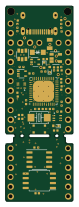
Main components on the Bonsai C
Bonsai C bill of materials (BOM)
37 components, 27 distinct parts — part numbers from the project's BOM.
| Qty | Part | Footprint | Refs |
|---|---|---|---|
| 1 | C370742 AAP2967-33VIR1 | SOT-23-5 | U1 |
| 1 | C274624 NUF2221W1T2G | SOT-363_SC-70-6_SC-88 | U2 |
| 1 | C81523 STM32F303CCT6 | LQFP-48_7x7mm_P0.5mm | U3 |
| 1 | C78541 SN74LV1T34DCKR | SOT-353_SC-70-5 | U4 |
| 1 | C152542 MUN5311DW1T1G | SOT-363_SC-70-6_SC-88 | Q1 |
| 1 | C115962 SMD-CRYSTAL-8MHZ-20PF-10PPM_2P-5.0X3.2MM_ | X2-SMD-5.0X3.2X1.3MM | Y1 |
| 1 | HEADER-VERT_3P-2.54_ | PinHeader_1x03_P2.54mm_Vertical | J1 |
| 1 | HEADER-VERT_1P-2.54_ | PinHeader_1x01_P2.54mm_Vertical | J2 |
| 1 | C165948 TYPE-C-31-M12_13 | TYPE-C-31-M-12 | J3 |
| 2 | HEADER-VERT_12P-2.54_ | PinHeader_1x12_P2.54mm_Vertical | J4, J5 |
| 2 | HEADER-VERT_6P-2.54_ | PinHeader_1x06_P2.54mm_Vertical | J6, J7 |
| 1 | C201047 Buzzer_Mallory | Buzzer_Mallory_AST1109MLTRQ | BZ1 |
| 1 | C66452 SMD-PPTC-500MA_0805_ | F0805 | F1 |
| 1 | C231329 SMD-SWITCH-TACTILE-SPST-NO_2P-2.5MMx3.0MM_ | SW2-SMD-2.5X3.0X1.6MM | K1 |
| 1 | C8598 B5819W | D_SOD-123 | D1 |
| 1 | C68948 1N4148 | D_SOD-523 | D2 |
| 1 | C74342 SMD-LED-WHITE_0402_ | LED_0402 | D3 |
| 1 | C668229 fb_0402_26ohm | R_0402_1005Metric | FB1 |
| 5 | C1525 cap_100nF_16v_0402 | C_0402_1005Metric | C1, C2, C3, C4, C7 |
| 1 | C1779 cap_4.7uF_25v_0805 | C_0805 | C6 |
Show 7 more
| Qty | Part | Footprint | Refs |
|---|---|---|---|
| 2 | C1554 cap_20pF_50v_0402 | C_0402_1005Metric | C8, C9 |
| 2 | C52923 cap_1uF_10v_0402 | C_0402_1005Metric | C10, C11 |
| 1 | C19702 cap_10uF_6v_0402 | C_0402_1005Metric | C12 |
| 1 | C25741 r_100k_0402_1p | R_0402_1005Metric | R1 |
| 2 | C25905 r_5.1k_0402_1p | R_0402_1005Metric | R2, R3 |
| 1 | C25133 r_75_0402_1p | R_0402_1005Metric | R4 |
| 2 | r_0_0402_nopop | R_0402_1005Metric | R5, R6 |
Bonsai C design files
The KiCad project lives in the customMK/Bonsai-C repository on GitHub; these links point at the commit this page was built from.
Bonsai C: common questions
What microcontroller does the Bonsai C use?
The Bonsai C is built around the C81523, from the STM32 family.
How big is the Bonsai C PCB?
The Bonsai C measures 17.8 × 51.6 mm, has 4 copper layers and is 1.6 mm thick.
How many components are on the Bonsai C?
37 components, from 27 distinct parts, with part numbers taken from the project's own BOM. The full bill of materials is listed on this page.
Where can I download the Bonsai C design files?
From the customMK/Bonsai-C repository on GitHub, which has the KiCad layout and the BOM; the links under Design files point to each one.
Can I use the Bonsai C design in my own project?
Yes, under the terms of its CERN-OHL-P-2.0 license, which customMK chose for the repository.
Can I test firmware for the Bonsai C without the hardware?
Yes. HardLabs builds a simulation of the board from its netlist and BOM, so you can run and debug STM32 firmware against it before you order a PCB.
More boards in Bonsai-C
Similar boards
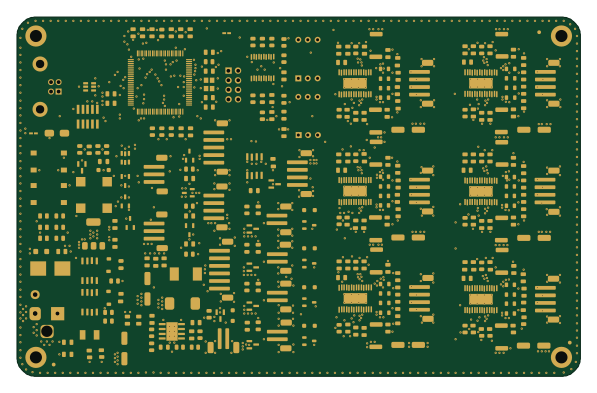 STM32
STM32LumenPnP Motherboard
opulo-inc
149 × 95 mm296 parts4LCC-BY-SA-4.03.7k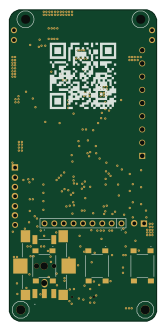 STM32
STM32AxxSolder
AxxAxx
39 × 82.5 mm122 parts2LGPL-3.01.7k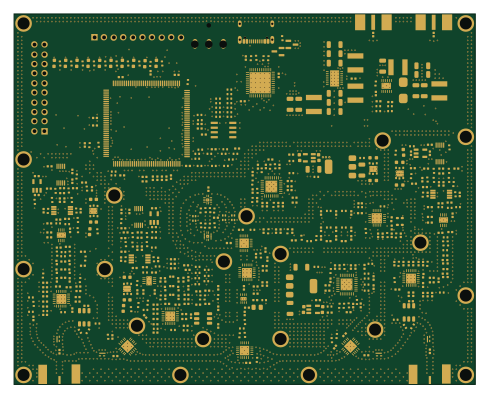 STM32
STM32LibreVNA
jankae
122 × 98 mm592 parts6LGPL-3.01.6k STM32
STM32AIOC
skuep
21 × 31.5 mm47 parts2LMIT1.4k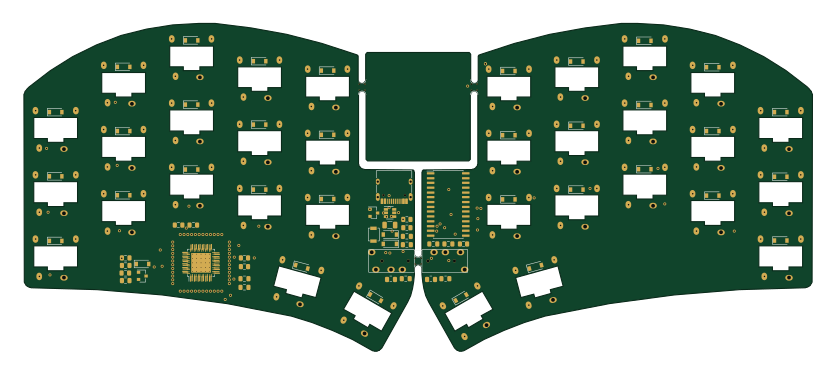 STM32
STM32Ferris
pierrechevalier83
208.8 × 86.8 mm102 parts2LSHL-2.11.3k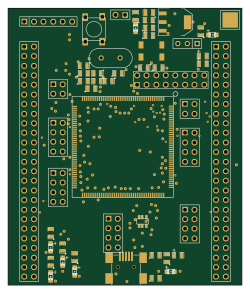 STM32
STM32176 pin board
rusefi
61.8 × 73.2 mm76 parts2LGPL-3.01.2k