
Project-Synthia

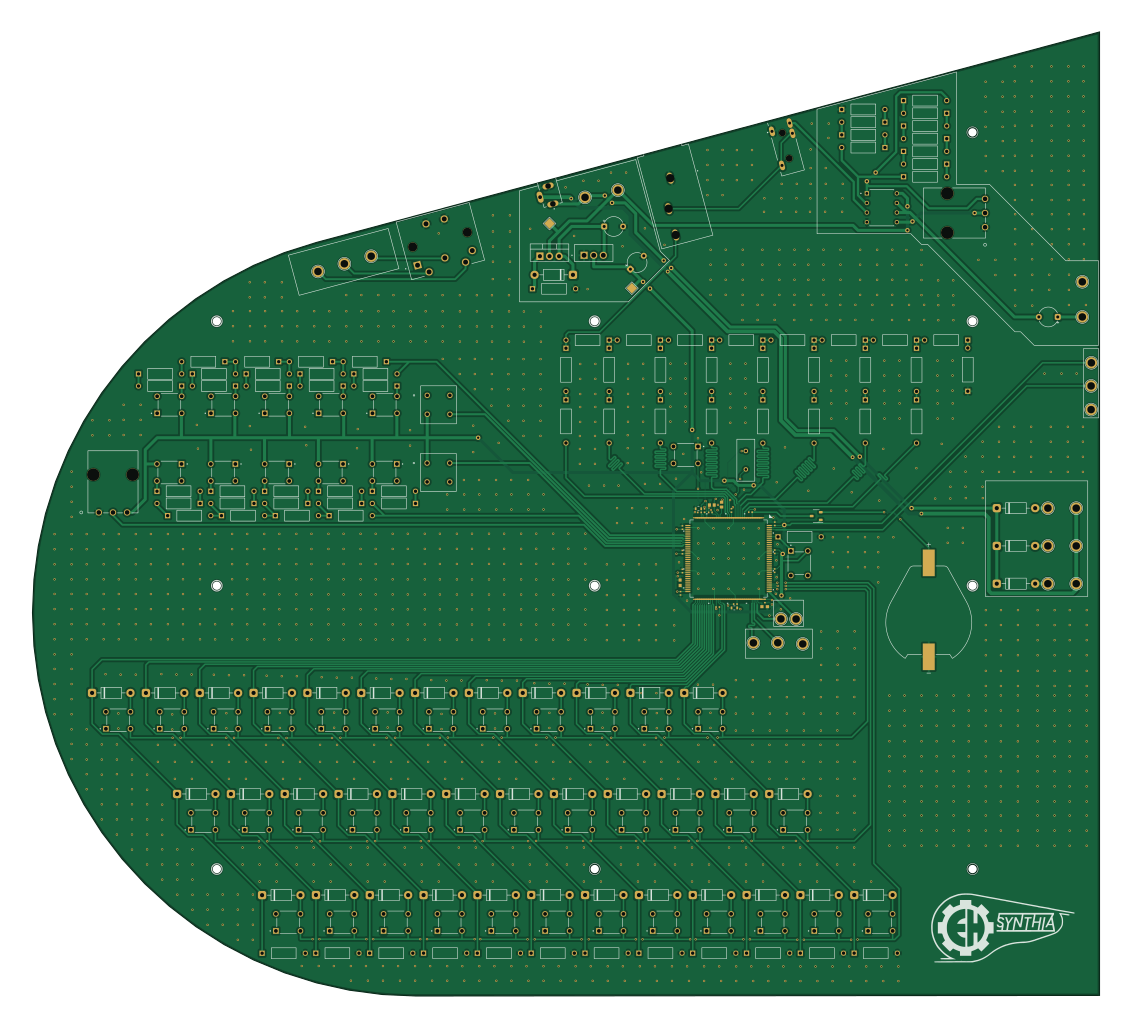
About the Project-Synthia PCB
Project-Synthia is an open source STM32 PCB design by Engineering-House, published on GitHub. It is a 2-layer board measuring 282.4 × 255.2 mm, with 226 components from 48 distinct parts.
Its main chip is the STM32H750ZBT6, from the STM32 family. Other key parts include the TLV272IP, LD1117V33, PVA1EEH31.2NV2 and ATS08A-E. By type, the board carries 80 resistors, 48 switches, 41 diodes, 24 capacitors, 21 test points and 6 ICs.
It belongs with the audio designs in this gallery.
From the project
The programs used are as follows: - STMCube32MX - Visual Studio Code - STM32CubeIDE for Visual Studio Code (Extension Pack)
Main components on the Project-Synthia
Project-Synthia bill of materials (BOM)
226 components, 48 distinct parts.
| Qty | Part | Footprint | Refs |
|---|---|---|---|
| 1 | TLV272IP | DIP794W45P254L959H508Q8 | U1 |
| 1 | STM32H750ZBT6 | LQFP144_STM | U2 |
| 1 | LD1117V33 | TO255P1020X450X1968-3 | U3 |
| 2 | PVA1EEH31.2NV2 | SWITCH_H31.2NV2 | U4, U5 |
| 1 | ATS08A-E | ATS08A-E_CTS | U6 |
| 1 | IRF9540N | TO-220-3_Vertical | Q1 |
| 1 | MJ-63022B | CUI_MJ-63022B | J1 |
| 1 | SJ3-35083C-TR | SAMESKY_SJ3-35083C-TR | J2 |
| 1 | PJ-007 | SAMESKY_PJ-007 | J3 |
| 1 | SDS-50J | CUI_SDS-50J | J4 |
| 1 | 1063 | BAT_1063 | BT1 |
| 46 | TL1105BF160Q | SW_TL1105BF160Q | S1, S2, S3, S4, S5, S6, S7, S8 +38 |
| 1 | RESET | SW_TL1105BF160Q | S42 |
| 1 | DFU BOOT | SW_TL1105BF160Q | S48 |
| 1 | Speaker | TestPoint_Plated_Hole_D2.0mm | TP1 |
| 1 | Battery_2 | TestPoint_Plated_Hole_D2.0mm | TP4 |
| 1 | Battery_3 | TestPoint_Plated_Hole_D2.0mm | TP5 |
| 1 | Battery_1 | TestPoint_Plated_Hole_D2.0mm | TP6 |
| 1 | Battery_1_GND | TestPoint_Plated_Hole_D2.0mm | TP7 |
| 1 | Battery_2_GND | TestPoint_Plated_Hole_D2.0mm | TP8 |
Show 28 more
| Qty | Part | Footprint | Refs |
|---|---|---|---|
| 1 | Battery_3_GND | TestPoint_Plated_Hole_D2.0mm | TP9 |
| 1 | StrumPad Pin #1 | TestPoint_Plated_Hole_D2.0mm | TP10 |
| 1 | StrumPad Pin #2 | TestPoint_Plated_Hole_D2.0mm | TP11 |
| 1 | StrumPad Pin #3 | TestPoint_Plated_Hole_D2.0mm | TP12 |
| 1 | Switch Pin #1 | TestPoint_Plated_Hole_D2.0mm | TP13 |
| 1 | Switch Pin #2 | TestPoint_Plated_Hole_D2.0mm | TP14 |
| 1 | Speaker GND | TestPoint_Plated_Hole_D2.0mm | TP15 |
| 1 | Shield / Ground | TestPoint_Plated_Hole_D2.0mm | TP16 |
| 1 | Sink | TestPoint_Plated_Hole_D2.0mm | TP17 |
| 1 | Source | TestPoint_Plated_Hole_D2.0mm | TP18 |
| 1 | MicroUSB D- Pin | TestPoint_Plated_Hole_D2.0mm | TP19 |
| 1 | MicroUSB D+ Pin | TestPoint_Plated_Hole_D2.0mm | TP20 |
| 1 | MicroUSB GND | TestPoint_Plated_Hole_D2.0mm | TP21 |
| 1 | SWCLK | TestPoint_Plated_Hole_D2.0mm | TP22 |
| 1 | SWDIO | TestPoint_Plated_Hole_D2.0mm | TP23 |
| 1 | 1N4742A | D_DO-41_SOD81_P10.16mm_Horizontal | D1 |
| 39 | 1N4001 | D_DO-41_SOD81_P10.16mm_Horizontal | D2, D3, D4, D5, D6, D7, D8, D9 +31 |
| 1 | BAS70-05 | P200_SOT-23 | D41 |
| 1 | 100 nF | CP_Radial_Tantal_D5.0mm_P5.00mm | C1 |
| 1 | 10 uF | CP_Radial_Tantal_D5.0mm_P5.00mm | C2 |
| 1 | 500 uF | CP_Radial_Tantal_D5.0mm_P5.00mm | C3 |
| 2 | GRM188R71A225KE15D | G-188_MUR | C4, C5 |
| 15 | CL05B104KP5NNNC | CAP_CL05_SAM-L | C6, C7, C8, C9, C10, C11, C13, C14 +7 |
| 2 | CL10B105KA8NNNC | CAP_CL10_SAM-L | C12, C21 |
| 2 | C0603C330J5GACTU | CAPC17595_87N_KEM-L | C23, C24 |
| 11 | 100kΩ | STA_CF14_STP | R1, R12, R41, R42, R43, R44, R45, R46 +3 |
| 67 | 100k | STA_CF14_STP | R2, R3, R4, R5, R6, R7, R8, R9 +59 |
| 2 | P120PK-Y25BR10K | POT_P120PK-x25_TTE | R50, R79 |
Project-Synthia design files
The KiCad project lives in the Engineering-House/Project-Synthia repository on GitHub; these links point at the commit this page was built from.
- Layoutsynthia/synthia.kicad_pcb
- Schematicsynthia/synthia.kicad_sch
Project-Synthia: common questions
What microcontroller does the Project-Synthia use?
The Project-Synthia is built around the STM32H750ZBT6, from the STM32 family.
How big is the Project-Synthia PCB?
The Project-Synthia measures 282.4 × 255.2 mm, has 2 copper layers and is 1.6 mm thick.
How many components are on the Project-Synthia?
226 components, from 48 distinct parts. The full bill of materials is listed on this page.
Where can I download the Project-Synthia design files?
From the Engineering-House/Project-Synthia repository on GitHub, which has the KiCad layout and the schematic; the links under Design files point to each one.
Can I use the Project-Synthia design in my own project?
The repository has no license, so all rights stay with Engineering-House. Use it as a reference, and ask the author before reusing the design.
Can I test firmware for the Project-Synthia without the hardware?
Yes. HardLabs builds a simulation of the board from its netlist and BOM, so you can run and debug STM32 firmware against it before you order a PCB.
Similar boards
 STM32
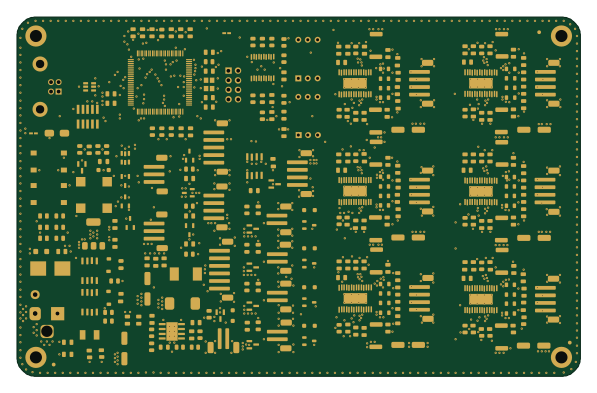
STM32LumenPnP Motherboard
opulo-inc
149 × 95 mm296 parts4LCC-BY-SA-4.03.7k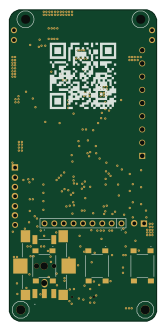 STM32
STM32AxxSolder
AxxAxx
39 × 82.5 mm122 parts2LGPL-3.01.7k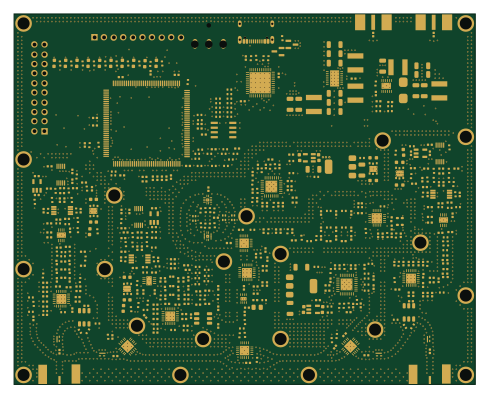 STM32
STM32LibreVNA
jankae
122 × 98 mm592 parts6LGPL-3.01.6k STM32
STM32AIOC
skuep
21 × 31.5 mm47 parts2LMIT1.4k STM32
STM32Ferris
pierrechevalier83
208.8 × 86.8 mm102 parts2LSHL-2.11.3k STM32
STM32176 pin board
rusefi
61.8 × 73.2 mm76 parts2LGPL-3.01.2k