Universal16+4

About the Universal16+4 PCB
Universal16+4 is an open source PCB design by keyaki-namiki, published on GitHub under the MIT license. It is a 2-layer board measuring 99.5 × 99.5 mm, with 76 components from 4 distinct parts.
By type, the board carries 38 diodes, 20 switches and 18 resistors.
From the project
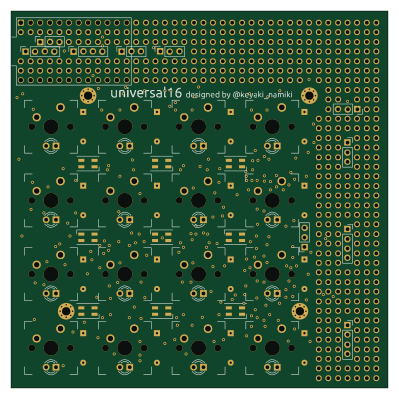
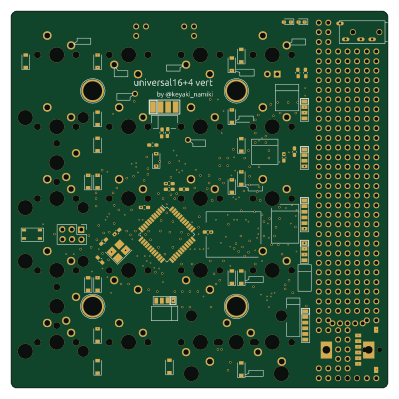
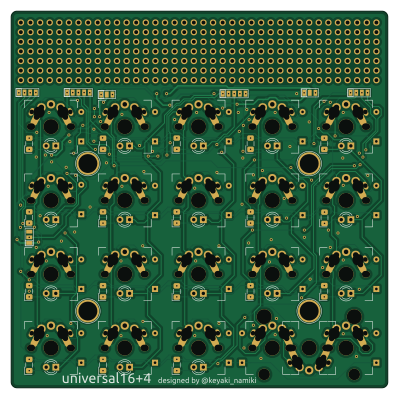
4x4 simple Key-matrix with universal board.
4x4 simple Key-matrix (and some functions) with universal board
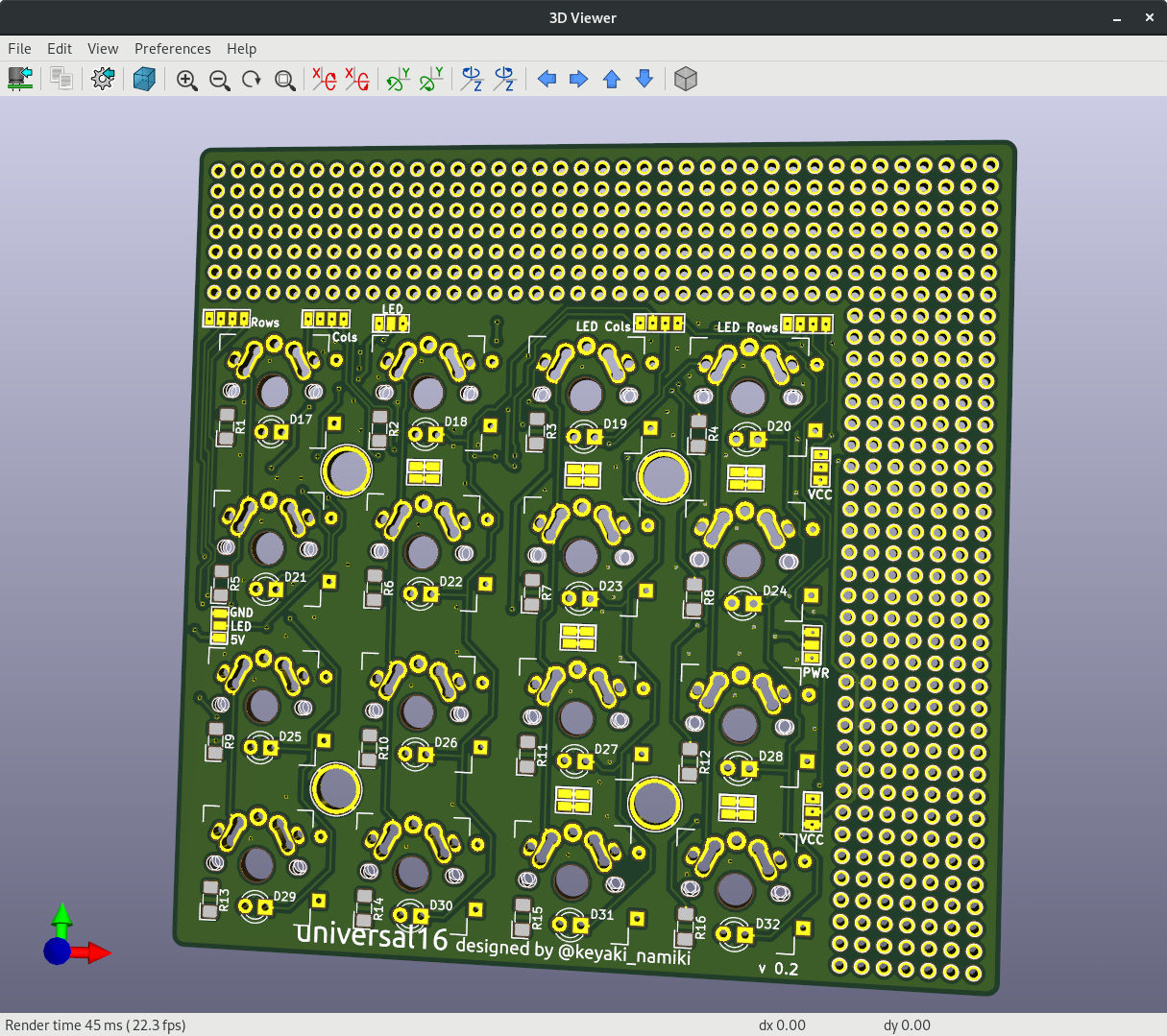
- No wire is there between matrix(es) and controller footprint (for trying new controller such as Arduino, Mbed, PIC,and so on...) - Matrix circuit is been dragged out to pads for hand-wiring - Jumper pads for making 'hand-wiring' easier - The universal board part for making your function (rotary encoder, potentiometer, joystick module, etc...) - You can use universal board part in both left-side and right-side
Universal16+4 bill of materials (BOM)
76 components, 4 distinct parts.
| Qty | Part | Footprint | Refs |
|---|---|---|---|
| 20 | SW_Push | MXonly-1U-flip-kailh_lp | SW1, SW2, SW3, SW4, SW5, SW6, SW7, SW8 +12 |
| 20 | D | D_SOD123_axial | D1, D2, D3, D4, D5, D6, D7, D8 +12 |
| 18 | LED | LED_D3.0mm_Clear | D21, D22, D23, D24, D25, D26, D27, D28 +10 |
| 18 | R | R_1206_3216Metric_Pad1.42x1.75mm_HandSolder | R1, R2, R3, R4, R5, R6, R7, R8 +10 |
Universal16+4 design files
The KiCad project lives in the keyaki-namiki/universal16 repository on GitHub; these links point at the commit this page was built from.
Universal16+4: common questions
How big is the Universal16+4 PCB?
The Universal16+4 measures 99.5 × 99.5 mm, has 2 copper layers and is 1.6 mm thick.
How many components are on the Universal16+4?
76 components, from 4 distinct parts. The full bill of materials is listed on this page.
Where can I download the Universal16+4 design files?
From the keyaki-namiki/universal16 repository on GitHub, which has the KiCad layout; the links under Design files point to each one.
Can I use the Universal16+4 design in my own project?
Yes, under the terms of its MIT license, which keyaki-namiki chose for the repository.