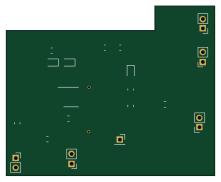
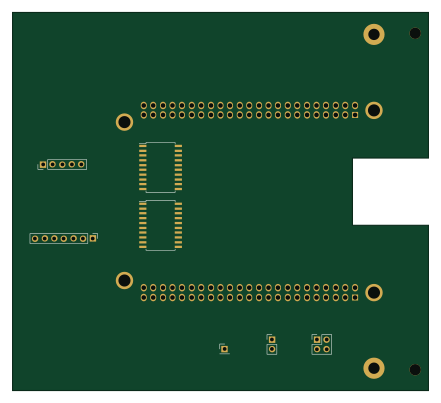
PIAD-18bits

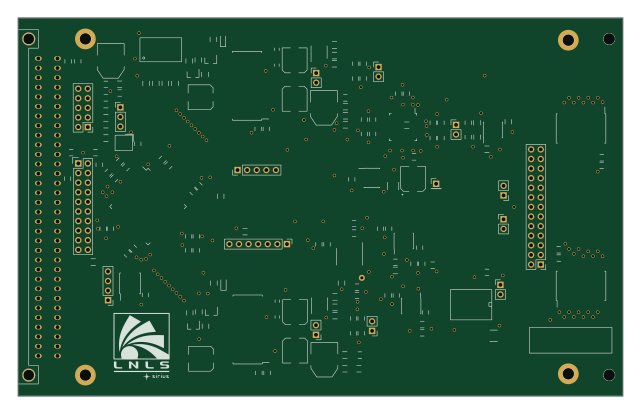
About the PIAD-18bits PCB
PIAD-18bits is an open source PCB design by lnls-sirius, published on GitHub under the MIT license. It is a board measuring 160 × 100 mm, with 173 components from 55 distinct parts.
Other key parts include the 5M80ZT100, LT3080, W25Q64FV, LT3015 and DCP020515DU. By type, the board carries 91 capacitors, 38 resistors, 18 ICs, 17 connectors, 4 transistors and 2 diodes.
From the project
This project consists of an 18-bit analog input (ADC) and output (DAC) within a range of 20 V (± 10 V) and 32 digital pins that can be either as inputs or outputs. This system interfaces with pulsed power electronics hardware in order to control the output voltage for pulsed magn
This project consists of an 18-bit analog input (ADC) and output (DAC) within a range of 20 V (± 10 V) and 32 digital pins that can be either as inputs or outputs. This system interfaces with pulsed power electronics hardware in order to control the output voltage for pulsed magnets as well as read and write status commands to their power supplies. An operator interface (OPI) software based on Qt was also developed for remote control.
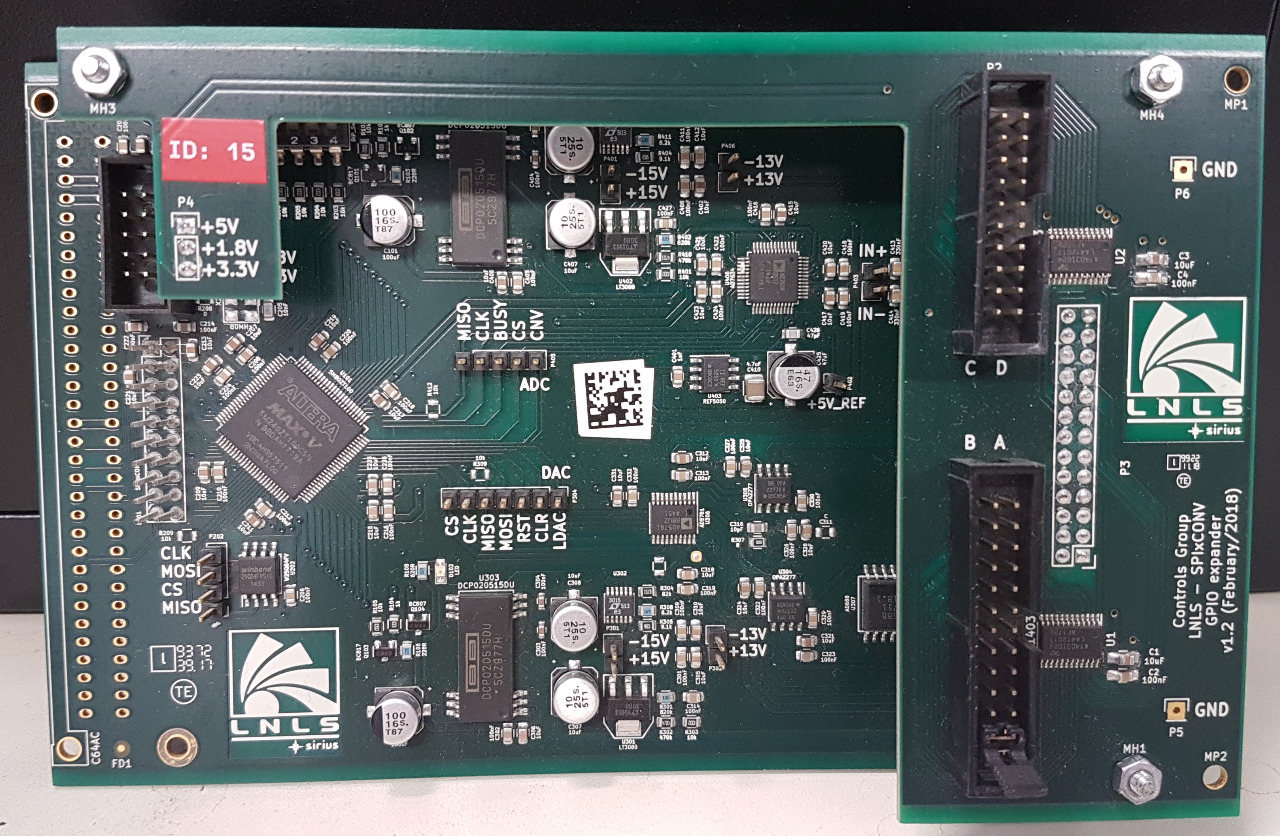
Main components on the PIAD-18bits
PIAD-18bits bill of materials (BOM)
173 components, 55 distinct parts.
| Qty | Part | Footprint | Refs |
|---|---|---|---|
| 1 | 5M80ZT100 | TQFP-100_14x14mm_Pitch0.5mm | U101 |
| 3 | LT3080 | SOT-223 | U201, U301, U402 |
| 1 | W25Q64FV | SOIJ-8_5.3x5.3mm_Pitch1.27mm | U202 |
| 2 | LT3015 | MSOP-12-1EP_3x4mm_Pitch0.65mm | U302, U404 |
| 2 | DCP020515DU | DCR01XXXXU | U303, U405 |
| 3 | OPA2277 | SOIC-8_3.9x4.9mm_Pitch1.27mm | U304, U305, U401 |
| 1 | AD5781 | TSSOP-20_4.4x6.5mm_Pitch0.65mm | U306 |
| 1 | AD688 | AD688_(SO16W) | U307 |
| 1 | REF5050 | SOIC-8_3.9x4.9mm_Pitch1.27mm | U403 |
| 1 | AD7634 | LQFP-48_7x7mm_Pitch0.5mm | U406 |
| 2 | 74LCX245 | SOIC-20W_7.5x12.8mm_Pitch1.27mm | U501, U502 |
| 2 | BC817 | SOT-23 | Q101, Q103 |
| 2 | BC807 | SOT-23 | Q102, Q104 |
| 1 | 80MHz | Oscilador_3.3V_HCMOS_TTL_SMD | X201 |
| 1 | SPIxxCON | SPIxxCON_(only_connector) | B201 |
| 1 | CONN_02X13 | Pin_Header_Straight_2x13_Pitch2.54mm | P101 |
| 1 | C64AC | Eurocard_template | P201 |
| 1 | CONN_01X04 | Pin_Header_Straight_1x04_Pitch2.54mm | P202 |
| 1 | CONN_01X03 | Pin_Header_Straight_1x03_Pitch2.54mm | P203 |
| 6 | CONN_01X02 | Pin_Header_Straight_1x02_Pitch2.54mm | P301, P302, P305, P401, P403, P406 |
Show 35 more
| Qty | Part | Footprint | Refs |
|---|---|---|---|
| 1 | Analog_out | Pin_Header_Straight_1x02_Pitch2.54mm | P303 |
| 1 | DAC_pins | Pin_Header_Straight_1x07_Pitch2.54mm | P304 |
| 1 | CONN_01X01 | ground_plane_via | P306 |
| 1 | CONN_01X01 | Pin_Header_Straight_1x01_Pitch2.54mm | P402 |
| 1 | Analog_in | Pin_Header_Straight_1x02_Pitch2.54mm | P404 |
| 1 | ADC_pins | Pin_Header_Straight_1x05_Pitch2.54mm | P405 |
| 1 | AVR-JTAG-10 | Pin_Header_Straight_2x05_Pitch2.54mm | JTAG201 |
| 1 | DIP_Switch | DIP_switch_SPST_KAE04LGGT | SW201 |
| 2 | LED | LED_0805 | D101, D102 |
| 2 | 100uF | CP_Elec_6.3x5.3 | C101, C102 |
| 4 | 1uF | C_0805 | C201, C203, C317, C401 |
| 38 | 100nF | C_0805 | C202, C204, C206, C208, C210, C212, C214, C216 +30 |
| 1 | 10nF | C_0805 | C205 |
| 30 | 10uF | C_0805 | C207, C209, C211, C213, C215, C217, C219, C221 +22 |
| 4 | 100nF | C_0603 | C303, C304, C404, C405 |
| 4 | 10uF | CP_Elec_6.3x5.3 | C307, C308, C407, C409 |
| 1 | C | C_0805 | C311 |
| 1 | 10pF | C_0805 | C316 |
| 2 | 4.7uF | C_1210 | C320, C410 |
| 2 | 330nF | C_0805 | C413, C414 |
| 1 | 47uF | CP_Elec_6.3x5.3 | C425 |
| 1 | 47pF | C_0805 | C426 |
| 3 | 1k | R_0805 | R101, R104, R202 |
| 13 | 10k | R_0805 | R102, R105, R203, R204, R205, R206, R209, R303 +5 |
| 2 | 220R | R_0805 | R103, R106 |
| 2 | 620R | R_0805 | R107, R108 |
| 1 | 180k | R_0805 | R201 |
| 4 | 0 | R_0805 | R207, R208, R306, R409 |
| 2 | 820k | R_0805 | R301, R402 |
| 2 | 470k | R_0805 | R302, R410 |
| 2 | 82k | R_0805 | R304, R405 |
| 2 | 9.1k | R_0805 | R305, R404 |
| 1 | R | R_0805 | R307 |
| 2 | 6.2k | R_0805 | R308, R411 |
| 2 | 220 | R_0805 | R407, R408 |
PIAD-18bits design files
The KiCad project lives in the lnls-sirius/SPIxCONV repository on GitHub; these links point at the commit this page was built from.
PIAD-18bits: common questions
How big is the PIAD-18bits PCB?
The PIAD-18bits measures 160 × 100 mm and is 1.6002 mm thick.
How many components are on the PIAD-18bits?
173 components, from 55 distinct parts. The full bill of materials is listed on this page.
Where can I download the PIAD-18bits design files?
From the lnls-sirius/SPIxCONV repository on GitHub, which has the KiCad layout; the links under Design files point to each one.
Can I use the PIAD-18bits design in my own project?
Yes, under the terms of its MIT license, which lnls-sirius chose for the repository.