
Xiao pio usb2

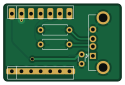
About the Xiao pio usb2 PCB
Xiao pio usb2 is an open source PCB design by okiraku-camera, published on GitHub under the CERN-OHL-P-2.0 license. It is a 2-layer board measuring 31.1 × 20.4 mm, with 8 components from 6 distinct parts.
Other key parts include the xiao_pin. By type, the board carries 4 resistors, 2 capacitors, 1 IC and 1 connector.
From the project
KiCad files for creating a tiny hoboNicola adapter using Seeed studio XIAO RP2040.
This project provides KiCad 6.11 PCB design files for building a hoboNicola adapter using the Seeed Studio XIAO RP2040 and the pico-pio-usb library. By assembling the XIAO, a USB Type-A receptacle, and a few passives, you can convert a standard USB keyboard into an almost-NICOLA (thumb-shift) keyboard. The adapter receives HID input as a USB host, processes it with the hoboNicola firmware, and outputs transformed HID reports to the connected PC.
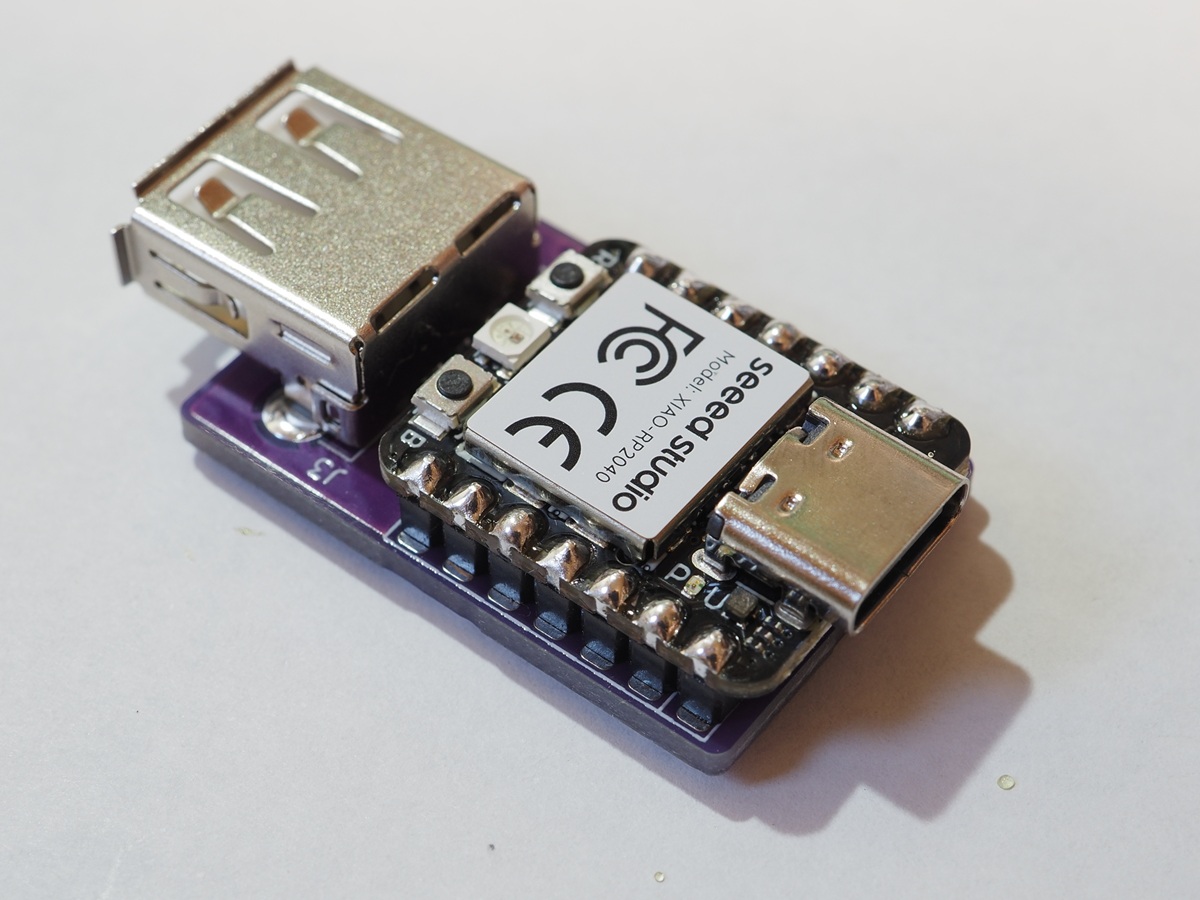
Main components on the Xiao pio usb2
Xiao pio usb2 bill of materials (BOM)
8 components, 6 distinct parts.
| Qty | Part | Footprint | Refs |
|---|---|---|---|
| 1 | xiao_pin | xiao_pin | U1 |
| 1 | USB_A | USB_A_CONNFLY_DS1095-WNR0 | J3 |
| 1 | 100n | C_Disc_D3.0mm_W1.6mm_P2.50mm | C1 |
| 1 | 100n | C_0603_1608Metric_Pad1.08x0.95mm_HandSolder | C10 |
| 2 | 22 | R_Axial_DIN0207_L6.3mm_D2.5mm_P7.62mm_Horizontal | R1, R2 |
| 2 | 22 | R_1206_3216Metric_Pad1.30x1.75mm_HandSolder | R10, R20 |
Xiao pio usb2 design files
The KiCad project lives in the okiraku-camera/xiao_pio_usb2 repository on GitHub; these links point at the commit this page was built from.
- Layoutxiao_pio_usb2.kicad_pcb
- Schematicxiao_pio_usb2.kicad_sch
Xiao pio usb2: common questions
How big is the Xiao pio usb2 PCB?
The Xiao pio usb2 measures 31.1 × 20.4 mm, has 2 copper layers and is 1.6 mm thick.
How many components are on the Xiao pio usb2?
8 components, from 6 distinct parts. The full bill of materials is listed on this page.
Where can I download the Xiao pio usb2 design files?
From the okiraku-camera/xiao_pio_usb2 repository on GitHub, which has the KiCad layout and the schematic; the links under Design files point to each one.
Can I use the Xiao pio usb2 design in my own project?
Yes, under the terms of its CERN-OHL-P-2.0 license, which okiraku-camera chose for the repository.