
Vibe


About the Vibe PCB
Vibe is an open source STM32 PCB design by pOmelchenko, published on GitHub. It is a 2-layer board measuring 68 × 100 mm, with 7 components from 7 distinct parts.
Its main chip is the STM32F411RET6 / LQFP64, from the STM32 family. By type, the board carries 6 connectors and 1 IC.
From the project
KiCad reference project for the ST NUCLEO-F411RE board with STM32F411RET6.
KiCad reference project for the ST NUCLEO-F411RE board with STM32F411RET6.
This is a functional reconstruction for schematic reading, pin planning, and firmware bring-up notes. It is not an official ST KiCad conversion and it is not a finished production PCB.
- NUCLEOF411REreference.kicadpro — KiCad project. - NUCLEOF411REreference.kicadsch — one-sheet functional schematic with MCU pinout, ST-LINK links, power tree, user/reset/clock block, Arduino headers, and ST Morpho headers. - NUCLEOF411REreference.kicadpcb — placeholder board outline only; routing/footprints are intentionally not…
Main components on the Vibe
Vibe bill of materials (BOM)
7 components, 7 distinct parts — part numbers from the project's BOM.
| Qty | Part | Footprint | Refs |
|---|---|---|---|
| 1 | STM32F411RET6 / LQFP64 | LQFP-64_10x10mm_P0.5mm | U1 |
| 1 | Arduino D8-D15 | PinSocket_1x10_P2.54mm_Vertical | CN5 |
| 1 | Arduino POWER | PinSocket_1x08_P2.54mm_Vertical | CN6 |
| 1 | ST Morpho left | PinSocket_2x19_P2.54mm_Vertical | CN7 |
| 1 | Arduino ANALOG | PinSocket_1x06_P2.54mm_Vertical | CN8 |
| 1 | Arduino D0-D7 | PinSocket_1x08_P2.54mm_Vertical | CN9 |
| 1 | ST Morpho right | PinSocket_2x19_P2.54mm_Vertical | CN10 |
Vibe design files
The KiCad project lives in the pOmelchenko/vibepcb repository on GitHub; these links point at the commit this page was built from.
Vibe: common questions
What microcontroller does the Vibe use?
The Vibe is built around the STM32F411RET6 / LQFP64, from the STM32 family.
How big is the Vibe PCB?
The Vibe measures 68 × 100 mm, has 2 copper layers and is 1.6 mm thick.
How many components are on the Vibe?
7 components, from 7 distinct parts, with part numbers taken from the project's own BOM. The full bill of materials is listed on this page.
Where can I download the Vibe design files?
From the pOmelchenko/vibepcb repository on GitHub, which has the KiCad layout, the schematic and the BOM; the links under Design files point to each one.
Can I use the Vibe design in my own project?
The repository has no license, so all rights stay with pOmelchenko. Use it as a reference, and ask the author before reusing the design.
Can I test firmware for the Vibe without the hardware?
Yes. HardLabs builds a simulation of the board from its netlist and BOM, so you can run and debug STM32 firmware against it before you order a PCB.
Similar boards
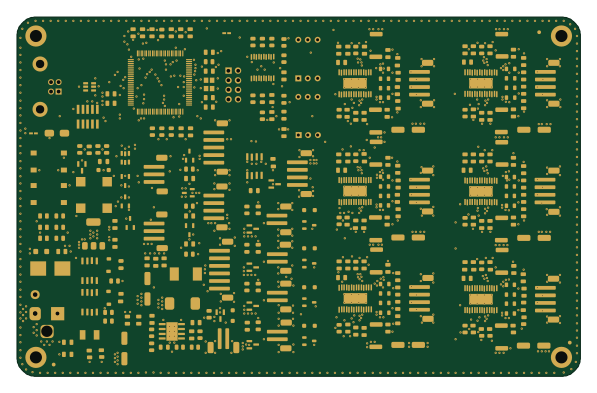 STM32
STM32LumenPnP Motherboard
opulo-inc
149 × 95 mm296 parts4LCC-BY-SA-4.03.7k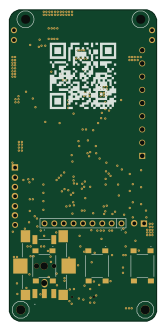 STM32
STM32AxxSolder
AxxAxx
39 × 82.5 mm122 parts2LGPL-3.01.7k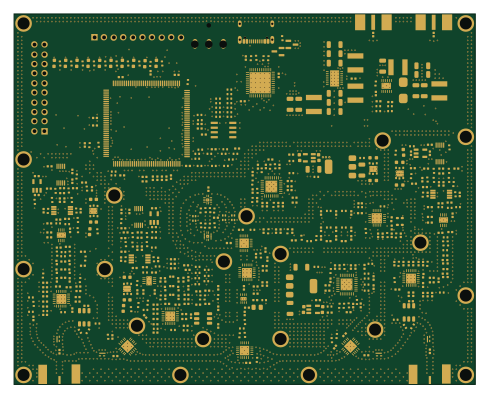 STM32
STM32LibreVNA
jankae
122 × 98 mm592 parts6LGPL-3.01.6k STM32
STM32AIOC
skuep
21 × 31.5 mm47 parts2LMIT1.4k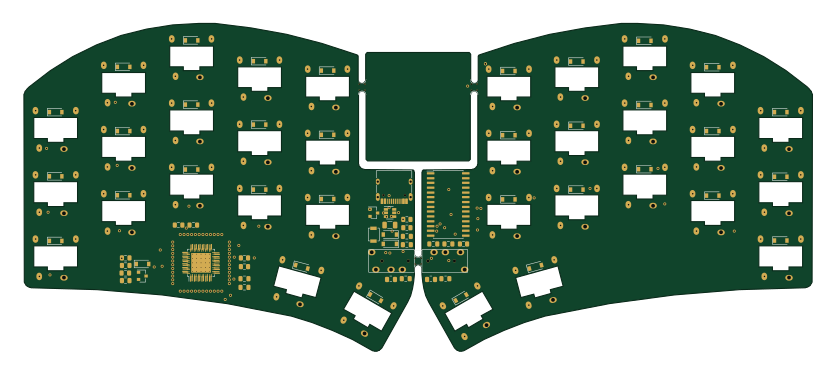 STM32
STM32Ferris
pierrechevalier83
208.8 × 86.8 mm102 parts2LSHL-2.11.3k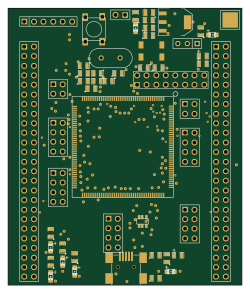 STM32
STM32176 pin board
rusefi
61.8 × 73.2 mm76 parts2LGPL-3.01.2k