
ODJ

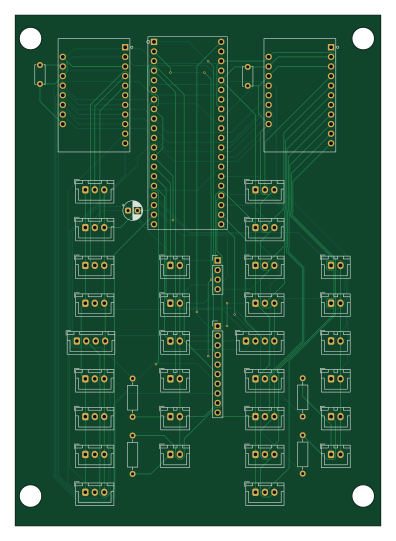
About the ODJ PCB
ODJ is an open source PCB design by primewildy, published on GitHub. It is a 2-layer board measuring 96.6 × 135 mm, with 42 components from 37 distinct parts.
Other key parts include the RPi_Pico and CJMCU_4051. By type, the board carries 32 connectors, 4 resistors, 3 ICs and 3 capacitors.
From the project
Experiments in DJ controller software.
A single-board carrier that drives both decks from one Raspberry Pi Pico. Everything off-board (pots, faders, buttons, encoders, LEDs) lands on JST-XH connectors — locking and polarised, so panel cables can't be plugged in backwards. Bench/expansion points (spare GPIO, I2C) use 2.54 mm pin headers for jumper wires and plug-in modules. The Pico and the two CJMCU-4051 mux modules all socket onto headers — nothing solders to the PCB except the connectors and the decoupling parts.
Main components on the ODJ
ODJ bill of materials (BOM)
42 components, 37 distinct parts.
| Qty | Part | Footprint | Refs |
|---|---|---|---|
| 1 | RPi_Pico | RPi_Pico_THT | U1 |
| 2 | CJMCU_4051 | CJMCU_4051 | U2, U3 |
| 1 | A-EQ_LOW | JST_XH_B3B-XH-A_1x03_P2.50mm_Vertical | J1 |
| 1 | A-EQ_MID | JST_XH_B3B-XH-A_1x03_P2.50mm_Vertical | J2 |
| 1 | A-EQ_HIGH | JST_XH_B3B-XH-A_1x03_P2.50mm_Vertical | J3 |
| 1 | A-VOLUME | JST_XH_B3B-XH-A_1x03_P2.50mm_Vertical | J4 |
| 1 | A-PITCH | JST_XH_B3B-XH-A_1x03_P2.50mm_Vertical | J5 |
| 1 | A-SPARE5 | JST_XH_B3B-XH-A_1x03_P2.50mm_Vertical | J6 |
| 1 | A-SPARE6 | JST_XH_B3B-XH-A_1x03_P2.50mm_Vertical | J7 |
| 1 | A-SPARE7 | JST_XH_B3B-XH-A_1x03_P2.50mm_Vertical | J8 |
| 1 | B-EQ_LOW | JST_XH_B3B-XH-A_1x03_P2.50mm_Vertical | J9 |
| 1 | B-EQ_MID | JST_XH_B3B-XH-A_1x03_P2.50mm_Vertical | J10 |
| 1 | B-EQ_HIGH | JST_XH_B3B-XH-A_1x03_P2.50mm_Vertical | J11 |
| 1 | B-VOLUME | JST_XH_B3B-XH-A_1x03_P2.50mm_Vertical | J12 |
| 1 | B-PITCH | JST_XH_B3B-XH-A_1x03_P2.50mm_Vertical | J13 |
| 1 | B-SPARE5 | JST_XH_B3B-XH-A_1x03_P2.50mm_Vertical | J14 |
| 1 | B-SPARE6 | JST_XH_B3B-XH-A_1x03_P2.50mm_Vertical | J15 |
| 1 | B-SPARE7 | JST_XH_B3B-XH-A_1x03_P2.50mm_Vertical | J16 |
| 1 | A-PLAY | JST_XH_B2B-XH-A_1x02_P2.50mm_Vertical | J17 |
| 1 | A-CUE | JST_XH_B2B-XH-A_1x02_P2.50mm_Vertical | J18 |
Show 17 more
| Qty | Part | Footprint | Refs |
|---|---|---|---|
| 1 | A-HPCUE | JST_XH_B2B-XH-A_1x02_P2.50mm_Vertical | J19 |
| 1 | B-PLAY | JST_XH_B2B-XH-A_1x02_P2.50mm_Vertical | J20 |
| 1 | B-CUE | JST_XH_B2B-XH-A_1x02_P2.50mm_Vertical | J21 |
| 1 | B-HPCUE | JST_XH_B2B-XH-A_1x02_P2.50mm_Vertical | J22 |
| 1 | A-SYNC | JST_XH_B2B-XH-A_1x02_P2.50mm_Vertical | J23 |
| 1 | B-SYNC | JST_XH_B2B-XH-A_1x02_P2.50mm_Vertical | J24 |
| 1 | A-ENCODER | JST_XH_B4B-XH-A_1x04_P2.50mm_Vertical | J25 |
| 1 | B-ENCODER | JST_XH_B4B-XH-A_1x04_P2.50mm_Vertical | J26 |
| 1 | A_PLAY-LED | JST_XH_B2B-XH-A_1x02_P2.50mm_Vertical | J27 |
| 1 | A_HPCUE-LED | JST_XH_B2B-XH-A_1x02_P2.50mm_Vertical | J28 |
| 1 | B_PLAY-LED | JST_XH_B2B-XH-A_1x02_P2.50mm_Vertical | J29 |
| 1 | B_HPCUE-LED | JST_XH_B2B-XH-A_1x02_P2.50mm_Vertical | J30 |
| 1 | SPARE-GPIO | PinHeader_1x10_P2.54mm_Vertical | J31 |
| 1 | I2C-EXP | PinHeader_1x04_P2.54mm_Vertical | J32 |
| 2 | 100nF | C_Disc_D5.0mm_W2.5mm_P5.00mm | C1, C2 |
| 1 | 10uF | CP_Radial_D5.0mm_P2.50mm | C3 |
| 4 | 0R | R_Axial_DIN0207_L6.3mm_D2.5mm_P10.16mm_Horizontal | R1, R2, R3, R4 |
ODJ design files
The KiCad project lives in the primewildy/ODJ repository on GitHub; these links point at the commit this page was built from.
ODJ: common questions
How big is the ODJ PCB?
The ODJ measures 96.6 × 135 mm, has 2 copper layers and is 1.6 mm thick.
How many components are on the ODJ?
42 components, from 37 distinct parts. The full bill of materials is listed on this page.
Where can I download the ODJ design files?
From the primewildy/ODJ repository on GitHub, which has the KiCad layout and the schematic; the links under Design files point to each one.
Can I use the ODJ design in my own project?
The repository has no license, so all rights stay with primewildy. Use it as a reference, and ask the author before reusing the design.