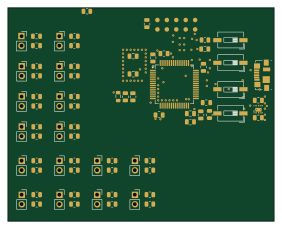
Opamp module

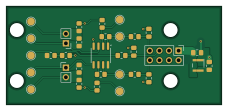
About the Opamp module
Opamp module is an open source PCB design by Qwendu, published on GitHub. It is a 2-layer board measuring 57 × 26 mm, with 23 components from 13 distinct parts.
Other key parts include the OPA2325 and REF3433IDBVR. By type, the board carries 12 resistors, 5 capacitors, 2 ICs and 1 connector.
Main components on the Opamp module
Opamp module bill of materials (BOM)
23 components, 13 distinct parts.
| Qty | Part | Footprint | Refs |
|---|---|---|---|
| 1 | OPA2325 | SOIC-8_3.9x4.9mm_P1.27mm | U1 |
| 1 | REF3433IDBVR | DBV0006A_N | U2 |
| 1 | Conn_02x04_Odd_Even | PinHeader_2x04_P2.54mm_Vertical | J1 |
| 2 | Thermocouple | PinHeader_1x02_P2.54mm_Vertical | TC1, TC2 |
| 1 | Thermistor | R_0805_2012Metric_Pad1.20x1.40mm_HandSolder | TH1 |
| 3 | 47n | C_0805_2012Metric_Pad1.18x1.45mm_HandSolder | C1, C3, C5 |
| 1 | 10u | C_0805_2012Metric_Pad1.18x1.45mm_HandSolder | C2 |
| 1 | 1u | C_0805_2012Metric_Pad1.18x1.45mm_HandSolder | C4 |
| 3 | 10k | R_0805_2012Metric_Pad1.20x1.40mm_HandSolder | R1, R11, R12 |
| 2 | 340k | R_0805_2012Metric_Pad1.20x1.40mm_HandSolder | R2, R4 |
| 3 | 3.4k | R_0805_2012Metric_Pad1.20x1.40mm_HandSolder | R3, R9, R10 |
| 2 | 90.9k | R_0805_2012Metric_Pad1.20x1.40mm_HandSolder | R5, R7 |
| 2 | 499 | R_0805_2012Metric_Pad1.20x1.40mm_HandSolder | R6, R8 |
Opamp module design files
The KiCad project lives in the Qwendu/ThermalKraken repository on GitHub; these links point at the commit this page was built from.
Opamp module: common questions
How big is the Opamp module?
The Opamp module measures 57 × 26 mm, has 2 copper layers and is 1.6 mm thick.
How many components are on the Opamp module?
23 components, from 13 distinct parts. The full bill of materials is listed on this page.
Where can I download the Opamp module design files?
From the Qwendu/ThermalKraken repository on GitHub, which has the KiCad layout and the schematic; the links under Design files point to each one.
Can I use the Opamp module design in my own project?
The repository has no license, so all rights stay with Qwendu. Use it as a reference, and ask the author before reusing the design.