Peak Detector

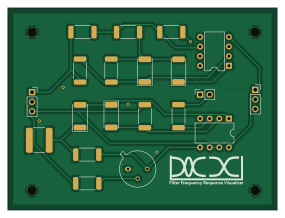
About the Peak Detector PCB
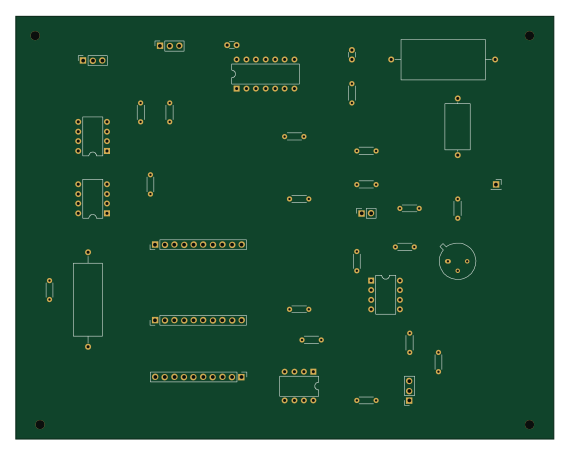
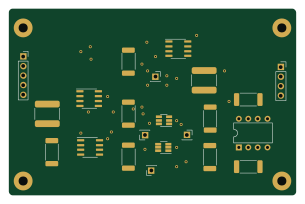
Peak Detector is an open source PCB design by Rowson3D, published on GitHub under the MIT license. It is a 2-layer board measuring 71.1 × 53.3 mm, with 20 components from 11 distinct parts.
Other key parts include the LF353. By type, the board carries 9 resistors, 4 diodes, 3 connectors, 2 ICs, 1 transistor and 1 capacitor.
From the project
Team 18 - SDSU Capstone project - FFRV
The FFRV system will be a test box used for measuring the frequency response of a user-provided passive filter. Once started, the system will apply a frequency sweep across an inputted filter, then measure the filter output gain and phase shift using analog computations, inputted to an Arduino Due microcontroller. Thus, this FFRV system will calculate the Bode plots for a real-world filter. The purpose of the FFRV system is to allow students, hobbyists, and other casual filter-designers a rapid way to gain insight into simple filters, such as what frequencies they pass or reject. As such, the…
Main components on the Peak Detector
Peak Detector bill of materials (BOM)
20 components, 11 distinct parts.
| Qty | Part | Footprint | Refs |
|---|---|---|---|
| 2 | LF353 | DIP-8_W7.62mm | U1, U2 |
| 1 | 2N2219 | TO-39-3 | Q1 |
| 1 | Conn_01x02 | PinSocket_1x02_P2.54mm_Vertical | J1 |
| 2 | Conn_01x03 | PinSocket_1x03_P2.54mm_Vertical | J2, J3 |
| 4 | D | D_2512_6332Metric_Pad1.52x3.35mm_HandSolder | D1, D2, D3, D4 |
| 1 | C | C_2225_5664Metric_Pad1.80x6.60mm_HandSolder | C1 |
| 2 | 1k | R_2512_6332Metric_Pad1.40x3.35mm_HandSolder | R1, R5 |
| 4 | 15k | R_2512_6332Metric_Pad1.40x3.35mm_HandSolder | R2, R3, R4, R9 |
| 1 | 400 | R_2512_6332Metric_Pad1.40x3.35mm_HandSolder | R6 |
| 1 | 7.5k | R_2512_6332Metric_Pad1.40x3.35mm_HandSolder | R7 |
| 1 | 8.8k | R_2512_6332Metric_Pad1.40x3.35mm_HandSolder | R8 |
Peak Detector design files
The KiCad project lives in the Rowson3D/Filter-Frequency-Response-Visualizer repository on GitHub; these links point at the commit this page was built from.
Peak Detector: common questions
How big is the Peak Detector PCB?
The Peak Detector measures 71.1 × 53.3 mm, has 2 copper layers and is 1.6 mm thick.
How many components are on the Peak Detector?
20 components, from 11 distinct parts. The full bill of materials is listed on this page.
Where can I download the Peak Detector design files?
From the Rowson3D/Filter-Frequency-Response-Visualizer repository on GitHub, which has the KiCad layout; the links under Design files point to each one.
Can I use the Peak Detector design in my own project?
Yes, under the terms of its MIT license, which Rowson3D chose for the repository.