
Wide input reg

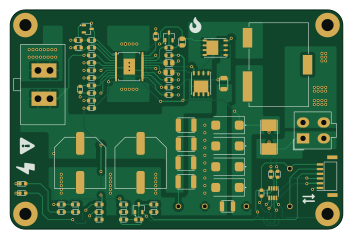
About the Wide input reg PCB
Wide input reg is an open source PCB design by Scottapotamas, published on GitHub under the MIT license. It is a 2-layer board measuring 88 × 58 mm, with 72 components from 44 distinct parts.
Other key parts include the INA219AID** and LM5116. By type, the board carries 30 resistors, 21 capacitors, 5 diodes, 3 connectors, 2 ICs and 2 transistors.
From the project
Very wide input (nearly 100V input), high efficiency step down regulator design
This board is intended as a medium scale (~50-100W) standalone version for use with 12S lipo systems (48Vish) and similar high voltage supplies, as its hard to get a high input voltage regulator from Pololu etc.
Uses a TI regulator, and a reasonably chunky inductor/filtering stage to ensure stability and efficiency. This design isn't designed for low cost, as I don't forsee low runs, and high voltage systems which require a board like this aren't typically cheap to begin with.
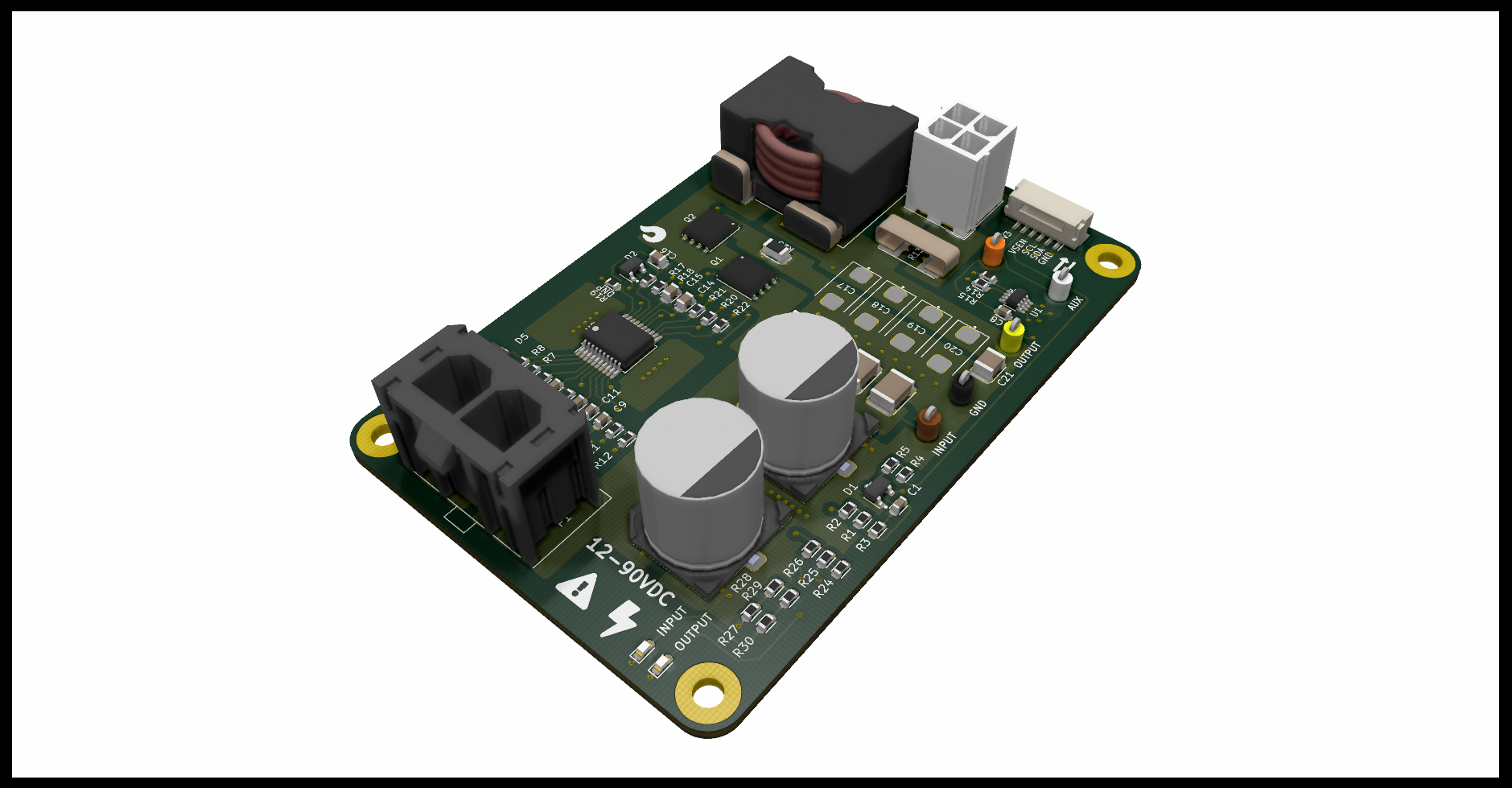
Main components on the Wide input reg
Wide input reg bill of materials (BOM)
72 components, 44 distinct parts.
| Qty | Part | Footprint | Refs |
|---|---|---|---|
| 1 | INA219AID** | SOT23-8P65_280X145L45X30N | U1 |
| 1 | LM5116 | SOP21P65_720X780X200L75X30N | U2 |
| 2 | Si7852DP | SON127P490X575X90-9T313X381M | Q1, Q2 |
| 1 | MOLEX_43160-0102 | Molex_Sabre_43160-0102_VERT | P1 |
| 1 | JST_GH_6_RA | SM06B-GHS-TB | P2 |
| 1 | MOLEX_MINIFIT_JR_2x2_WAY | Molex_Mini-Fit_Jr_5566-04A_2x02_P4.20mm_Vertical | P3 |
| 3 | SOLDER-LINK-3 | SJ1608-3N | SL1, SL2, SL3 |
| 1 | CLIP_HOOK_BROWN | KEYSTONE_5115 | TEST1 |
| 1 | CLIP_HOOK_YELLOW | KEYSTONE_5004 | TEST2 |
| 1 | CLIP_HOOK_WHITE | KEYSTONE_5002 | TEST3 |
| 1 | CLIP_HOOK_ORANGE | KEYSTONE_5003 | TEST4 |
| 1 | CLIP_HOOK_BLACK | KEYSTONE_5001 | TEST5 |
| 1 | BAV99 | SOT95P240X110-3L16N | D1 |
| 2 | 200V_350mW_SOT23 | SOT95P240X110-3L16N | D2, D5 |
| 1 | LED_RED_1608M | LEDC1608X80L40N | D3 |
| 1 | LED_GREEN_1608M | LEDC1608X80L40N | D4 |
| 1 | 10u2_PA2050 | PULSE_PA2050 | L1 |
| 3 | 100n_X7R_1608M | CAPC1608X90N | C1, C8, C12 |
| 2 | 47u_ELEC_100V_1350X1350M | CAPAE1350X1350D1490DD450L470N | C2, C3 |
| 4 | 2u2_X7R_4532M | CAPC4532X180N | C4, C5, C6, C7 |
Show 24 more
| Qty | Part | Footprint | Refs |
|---|---|---|---|
| 1 | 15p_X7R_1608M | CAPC1608X90N | C9 |
| 1 | 1u_X7R_1608M | CAPC1608X90N | C10 |
| 1 | 1n5_X7R_1608M | CAPC1608X90N | C11 |
| 1 | 330p_X7R_1608M | CAPC1608X90N | C13 |
| 3 | 1u_X7R_2012M | CAPC2012X110N | C14, C15, C16 |
| 4 | 47u_TANT_7343M | CAPPM7343X310N | C17, C18, C19, C20 |
| 1 | 22u_X7R_3225M | CAPC3225X170N | C21 |
| 2 | 130K_1608M | RESC1608X50N | R1, R2 |
| 4 | 10K0_1608M | RESC1608X50N | R3, R22, R24, R25 |
| 4 | 0R_1608M | RESC1608X50N | R4, R19, R20, R21 |
| 3 | 1K00_1608M | RESC1608X50N | R5, R14, R15 |
| 1 | 1M_1608M | RESC1608X50N | R6 |
| 1 | 12K7_1608M | RESC1608X50N | R7 |
| 1 | 102K_1608M | RESC1608X50N | R8 |
| 1 | 9K53_1608M | RESC1608X50N | R9 |
| 1 | 39K_1608M | RESC1608X50N | R10 |
| 1 | 1K2_1608M | RESC1608X50N | R11 |
| 1 | 10K7_1608M | RESC1608X50N | R12 |
| 1 | R005_METAL_SHUNT | OARS1-R005FI | R13 |
| 1 | 750K_1608M | RESC1608X50N | R16 |
| 1 | 2R2_1608M | RESC1608X50N | R17 |
| 1 | 1R0_1608M | RESC1608X50N | R18 |
| 1 | R01_3216M | RESC3216X140N | R23 |
| 5 | 2K40_1608M | RESC1608X50N | R26, R27, R28, R29, R30 |
Wide input reg design files
The KiCad project lives in the Scottapotamas/wide-input-reg repository on GitHub; these links point at the commit this page was built from.
- Layoutwide-input-reg.kicad_pcb
Wide input reg: common questions
How big is the Wide input reg PCB?
The Wide input reg measures 88 × 58 mm, has 2 copper layers and is 1.6 mm thick.
How many components are on the Wide input reg?
72 components, from 44 distinct parts. The full bill of materials is listed on this page.
Where can I download the Wide input reg design files?
From the Scottapotamas/wide-input-reg repository on GitHub, which has the KiCad layout; the links under Design files point to each one.
Can I use the Wide input reg design in my own project?
Yes, under the terms of its MIT license, which Scottapotamas chose for the repository.