
BananaHand

About the BananaHand PCB
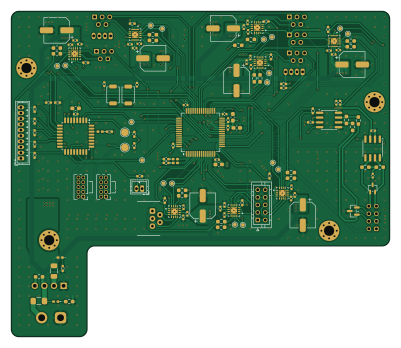
BananaHand is an open source STM32 PCB design by bananaHand-project, published on GitHub. It is a 4-layer board measuring 100 × 86 mm, with 126 components from 39 distinct parts.
Its main chip is the STM32G474RETX, from the STM32 family. Other key parts include the STM32C071K8TX, SN65HVD230DR, SN65HVD1781 and DRV8876GTR. By type, the board carries 48 capacitors, 40 resistors, 15 connectors, 12 ICs, 7 diodes and 2 fuses.
It belongs with the robotics & motion designs in this gallery.
From the project
Building an open-source humanoid robot end effector.
The electrical system for bananaHand is built around the main board. The main board is responsible for the following functions: communication with the controlling device, motor control, and FSR sensing. A simplified block diagram describing the main board can be seen below. It requires a single +12V 24W input source and exposes UART, CAN bus, and half-duplex RS485 options for interfacing. Depending on the device you are trying to interface with, a buck converter may be needed to drop your source voltage down to the required 12V.
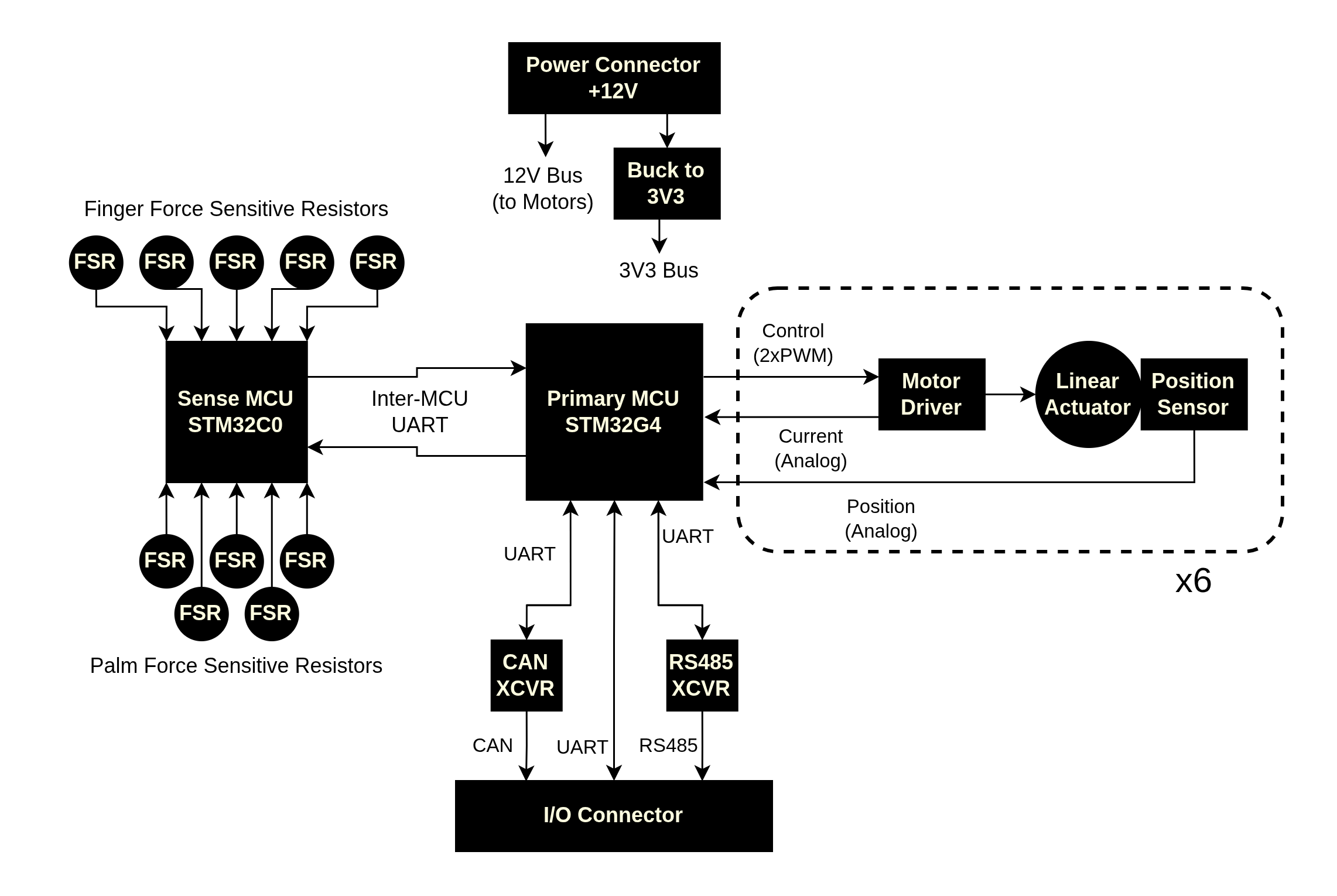
Main components on the BananaHand
BananaHand bill of materials (BOM)
126 components, 39 distinct parts — part numbers from the project's BOM.
| Qty | Part | Footprint | Refs |
|---|---|---|---|
| 1 | STM32G474RETX STM32G474RETx | LQFP-64_10x10mm_P0.5mm | U2 |
| 1 | STM32C071K8TX STM32C071K8Tx | LQFP-32_7x7mm_P0.8mm | U3 |
| 1 | SN65HVD230DR | SOIC-8_3.9x4.9mm_P1.27mm | U4 |
| 1 | SN65HVD1781 | SOIC-8_3.9x4.9mm_P1.27mm | U5 |
| 8 | DRV8876GTR | DRV8876GTR-MFG | U6, U7, U8, U11, U12, U14, U15, U16 |
| 1 | CONN_01X02_PIN Conn_01x02_Pin | AMASS_XT30UPB-M_1x02_P5.0mm_Vertical | J1 |
| 2 | CONN_02X05_TOP_BOTTOM Conn_02x05_Top_Bottom | PinHeader_2x05_P1.27mm_Vertical | J2, J3 |
| 1 | CONN_01X02_PAD Conn_01x02_Pad | JST_ZH_B2B-ZR_1x02_P1.50mm_Vertical | J4 |
| 2 | CONN_01X04_PIN Conn_01x04_Pin | JST_ZH_B4B-ZR_1x04_P1.50mm_Vertical | J5, J6 |
| 1 | CONN_01X10 Conn_01x10 | JST_ZH_B10B-ZR_1x10_P1.50mm_Vertical | J7 |
| 1 | CONN_02X04_TOP_BOTTOM Conn_02x04_Top_Bottom | JST_PHD_B8B-PHDSS_2x04_P2.00mm_Vertical | J8 |
| 5 | HLW5S-2C7LF | HLW5S-2C7LF | J9, J10, J11, J12, J13 |
| 1 | HLW5R-2C7LF | HLW5R-2C7LF | J18 |
| 1 | CONN_02X05_ODD_EVEN Conn_02x05_Odd_Even | JST_PHD_B10B-PHDSS_2x05_P2.00mm_Vertical | J20 |
| 1 | 1A8 33V | Fuse_1206_3216Metric_Pad1.42x1.75mm_HandSolder | F1 |
| 1 | 750mA 36V | Fuse_1206_3216Metric | F2 |
| 2 | SW_Push | SW_SPST_TS-1088-xR025 | SW1, SW2 |
| 5 | LED | LED_0402_1005Metric_Pad0.77x0.64mm_HandSolder | D1, D2, D3, D4, D5 |
| 1 | ESDCAN03-2BWY | SOT-323_SC-70 | D6 |
| 1 | SM712_SOT23 | SOT-23 | D7 |
Show 19 more
| Qty | Part | Footprint | Refs |
|---|---|---|---|
| 26 | 100NF 100nF | C_0402_1005Metric | C1, C2, C3, C6, C7, C8, C9, C12 +18 |
| 2 | 4UF7 4uF7 | C_0603_1608Metric_Pad1.08x0.95mm_HandSolder | C4, C11 |
| 1 | 10NF 10nF | C_0402_1005Metric | C5 |
| 1 | 1UF 1uF | C_0603_1608Metric_Pad1.08x0.95mm_HandSolder | C10 |
| 1 | 4NF7 4nF7 | C_0402_1005Metric | C13 |
| 6 | 47UF 47uF | CP_Elec_6.3x5.8 | C17, C21, C25, C37, C41, C57 |
| 8 | 22NF 22nF | C_0402_1005Metric | C19, C23, C27, C39, C43, C51, C55, C59 |
| 1 | 100nF | C_0402_1005Metric | C28 |
| 1 | 1uF | C_0603_1608Metric_Pad1.08x0.95mm_HandSolder | C29 |
| 1 | 100UF 100uF | CP_Elec_6.3x5.8 | C49 |
| 1 | 100K 100k | R_0603_1608Metric_Pad0.98x0.95mm_HandSolder | R1 |
| 4 | 100 | R_0402_1005Metric_Pad0.72x0.64mm_HandSolder | R2, R4, R5, R11 |
| 1 | 1200 | R_0603_1608Metric_Pad0.98x0.95mm_HandSolder | R3 |
| 12 | 10K 10k | R_0402_1005Metric_Pad0.72x0.64mm_HandSolder | R6, R7, R8, R9, R10, R12, R13, R14 +4 |
| 2 | 60 | R_0603_1608Metric_Pad0.98x0.95mm_HandSolder | R17, R18 |
| 2 | 10 | R_0603_1608Metric_Pad0.98x0.95mm_HandSolder | R20, R23 |
| 8 | 0 | R_0603_1608Metric_Pad0.98x0.95mm_HandSolder | R24, R27, R30, R39, R42, R48, R51, R54 |
| 8 | 11K 11k | R_0402_1005Metric_Pad0.72x0.64mm_HandSolder | R26, R29, R32, R41, R44, R50, R53, R56 |
| 2 | 3300 | R_0402_1005Metric_Pad0.72x0.64mm_HandSolder | R33, R34 |
BananaHand design files
The KiCad project lives in the bananaHand-project/bananaHand repository on GitHub; these links point at the commit this page was built from.
BananaHand: common questions
What microcontroller does the BananaHand use?
The BananaHand is built around the STM32G474RETX, from the STM32 family.
How big is the BananaHand PCB?
The BananaHand measures 100 × 86 mm, has 4 copper layers and is 1.64716 mm thick.
How many components are on the BananaHand?
126 components, from 39 distinct parts, with part numbers taken from the project's own BOM. The full bill of materials is listed on this page.
Where can I download the BananaHand design files?
From the bananaHand-project/bananaHand repository on GitHub, which has the KiCad layout, the schematic and the BOM; the links under Design files point to each one.
Can I use the BananaHand design in my own project?
The repository has no license, so all rights stay with bananaHand-project. Use it as a reference, and ask the author before reusing the design.
Can I test firmware for the BananaHand without the hardware?
Yes. HardLabs builds a simulation of the board from its netlist and BOM, so you can run and debug STM32 firmware against it before you order a PCB.
Similar boards
 STM32
STM32LumenPnP Motherboard
opulo-inc
149 × 95 mm296 parts4LCC-BY-SA-4.03.7k STM32
STM32AxxSolder
AxxAxx
39 × 82.5 mm122 parts2LGPL-3.01.7k STM32
STM32AIOC
skuep
21 × 31.5 mm47 parts2LMIT1.4k STM32
STM32Ferris
pierrechevalier83
208.8 × 86.8 mm102 parts2LSHL-2.11.3k STM32
STM32176 pin board
rusefi
61.8 × 73.2 mm76 parts2LGPL-3.01.2k STM32
STM32Brain board STM32F407
61.8 × 73.2 mm69 parts2LGPL-3.01.2k