
PC-Engine

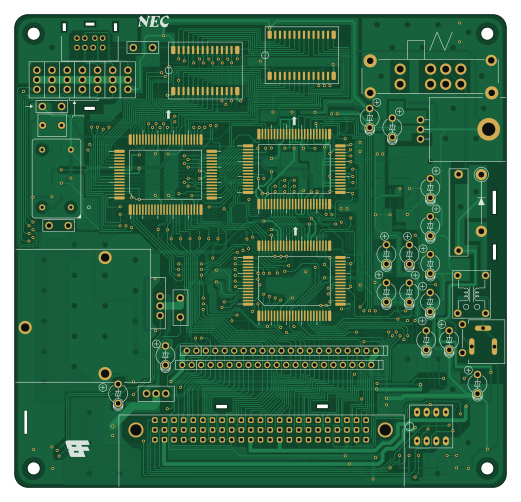
About the PC-Engine PCB
PC-Engine is an open source PCB design by Board-Folk, published on GitHub. It is a 2-layer board measuring 130 × 125 mm, with 127 components from 56 distinct parts.
Other key parts include the HUC6280, HUC6270, HUC6260, M20256 and μPC358C. By type, the board carries 44 resistors, 43 capacitors, 7 ICs, 5 inductors, 4 connectors and 3 jumpers.
From the project
Reproduction main board PCB for NEC's PC Engine console.
This repository contains a recreation of the main board PCB for NEC's PC Engine console. The recreation is based on the available schematics for the TurboGrafx-16 and reverse engineering using scanned images of an original board's copper layers, so should be a reasonably accurate reproduction.
NOTE: In order to use these PCBs sucessfully you will need to be proficient in:
Main components on the PC-Engine
PC-Engine bill of materials (BOM)
127 components, 56 distinct parts.
| Qty | Part | Footprint | Refs |
|---|---|---|---|
| 1 | HUC6280 | HUC62xx | IC101 |
| 1 | HUC6270 | HUC62xx | IC102 |
| 1 | HUC6260 | HUC62xx | IC103 |
| 2 | M20256 | HSRM20256LM | IC105, IC106 |
| 1 | μPC358C | DIP-8 | IC108 |
| 1 | L7805 | IC109 | IC109 |
| 1 | Expansion | CN102-2.54mm | CN102 |
| 1 | RF Modulator | CN103 | CN103 |
| 1 | Power | Barrel_Jack | CN104 |
| 1 | JOY1 | Mini-DIN-8 | CN105 |
| 8 | Filter_EMI_LCL | FL-5.00mm | FL101, FL102, FL103, FL104, FL105, FL106, FL107, FL108 |
| 1 | Filter_EMI_CommonMode | EMI_Dual_coil | FL109 |
| 1 | 1A 125V | Fuse | FS101 |
| 4 | TestPoint | Grounding_pad | G1, G2, G3, G4 |
| 2 | Conn_01x21 | JP101-102-2.5mm | JP101, JP102 |
| 1 | 0 | Jumper_Link | JP103 |
| 1 | 21.4772 MHz | Oscillator | OSC101 |
| 1 | SW_SPDT | SW101 | SW101 |
| 2 | 25C945 | Transistor_SMD | TR103, TR105 |
| 1 | 25A733 | Transistor_SMD | TR104 |
Show 36 more
| Qty | Part | Footprint | Refs |
|---|---|---|---|
| 1 | IS954 | Diode_SMD | D101 |
| 1 | IS954 | Diode | D102 |
| 1 | N/P | 2xTest_Point | L101 |
| 1 | ~ | L-5.00mm | L102 |
| 3 | ~ | L-5.00mm_Small_Silk | L103, L104, L105 |
| 1 | 22uF 16V | Elec_P5.00mm | C101 |
| 1 | 47uF 25V | Elec_P5.00mm | C102 |
| 2 | 47uF 16V | Elec_P5.00mm | C103, C117 |
| 2 | 10uF 16V | Elec_P5.00mm | C105, C116 |
| 8 | 1uF 10V | Elec_P5.00mm | C108, C109, C110, C111, C112, C113, C114, C115 |
| 22 | 0.1uF | SMD_1206_C | C118, C119, C120, C121, C122, C123, C124, C125 +14 |
| 3 | 220pF | SMD_1206 | C137, C138, C152 |
| 1 | 33pF | SMD_1206 | C145 |
| 1 | 10uF 10V | Elec_P5.00mm | C149 |
| 1 | 15000pF | SMD_1206_C | C151 |
| 1 | N/P | SMD_1206_C | C153 |
| 16 | 4.7K | SMD_1206 | R101, R102, R103, R105, R106, R107, R108, R109 +8 |
| 1 | 33K | SMD_1206 | R104 |
| 4 | 56K | SMD_1206 | R115, R116, R117, R118 |
| 3 | 9.1K | SMD_1206 | R125, R128, R158 |
| 1 | 15K | SMD_1206 | R126 |
| 1 | 6.2K | SMD_1206 | R137 |
| 1 | 8.1K | SMD_1206 | R138 |
| 1 | 27K | SMD_1206 | R141 |
| 1 | 3.3K | SMD_1206 | R142 |
| 2 | 1.5K | SMD_1206 | R143, R144 |
| 1 | 20 | SMD_1206 | R145 |
| 2 | 100 | SMD_1206 | R146, R165 |
| 1 | 2.7K | SMD_1206 | R149 |
| 1 | 5.6K | SMD_1206 | R155 |
| 2 | 1K | SMD_1206 | R156, R160 |
| 1 | 13K | SMD_1206 | R157 |
| 1 | 5.1K | SMD_1206 | R159 |
| 1 | 680 | SMD_1206 | R161 |
| 1 | 10K | SMD_1206 | R162 |
| 2 | 1.2K | SMD_1206 | R163, R164 |
PC-Engine design files
The KiCad project lives in the Board-Folk/PC-Engine repository on GitHub; these links point at the commit this page was built from.
- LayoutPCE.kicad_pcb
- SchematicPCE.kicad_sch
PC-Engine: common questions
How big is the PC-Engine PCB?
The PC-Engine measures 130 × 125 mm, has 2 copper layers and is 1.6 mm thick.
How many components are on the PC-Engine?
127 components, from 56 distinct parts. The full bill of materials is listed on this page.
Where can I download the PC-Engine design files?
From the Board-Folk/PC-Engine repository on GitHub, which has the KiCad layout and the schematic; the links under Design files point to each one.
Can I use the PC-Engine design in my own project?
The repository has no license, so all rights stay with Board-Folk. Use it as a reference, and ask the author before reusing the design.