
MotorCAN

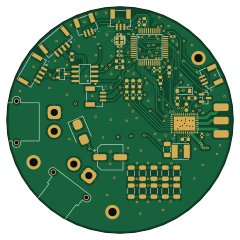
About the MotorCAN PCB
MotorCAN is an open source STM32 PCB design by chairlesengi, published on GitHub under the MIT license. It is a 4-layer board measuring 60 × 60 mm, with 65 components from 31 distinct parts.
Its main chip is the STM32G431CBT6, from the STM32 family. Other key parts include the DRV8316CRRGFR, SN65HVD230DR and MT6816CT-AKD-R. By type, the board carries 29 capacitors, 14 resistors, 8 connectors, 4 ICs, 3 modules and 3 diodes.
It belongs with the robotics & motion designs in this gallery.
From the project
CANBus based FOC motor driver board designed for drone gimbal motors
Features: - STM32G431 processor core for SimpleFOC software and CAN communication - 3.3V CAN communication for easy logic level support - Runs on 20-26V DC - Integrated magnetic absolute encoder (MT6816CT) - Handles up to ~3A of motor current
This driver is designed to be a fully integrated solution that mounts to the back of a gimbal motor with a diametrically magnetized magnet. For that reason, it includes an absoulute magnetic encoder and leverages the current sensing capabilities of the DRV8316C driver to maintain a continous measurement of the position of the rotor of the motor and its…
Main components on the MotorCAN
MotorCAN bill of materials (BOM)
65 components, 31 distinct parts — part numbers from the project's BOM.
| Qty | Part | Footprint | Refs |
|---|---|---|---|
| 1 | STM32G431CBT6 ST(意法半导体) | LQFP-48_L7.0-W7.0-P0.50-LS9.0-BL | U1 |
| 1 | DRV8316CRRGFR TI(德州仪器) | VQFN-40_L7.0-W5.0-P0.50-BL-EP5.7 | U2 |
| 1 | SN65HVD230DR TI(德州仪器) | SOIC-8_L4.9-W3.9-P1.27-LS6.0-BL | U3 |
| 1 | MT6816CT-AKD-R MagnTek(麦歌恩) | SOP-8_L4.9-W3.9-P1.27-LS6.0-BL-1 | U4 |
| 1 | A | SolderWirePad_1x01_SMD_2x4mm | M1 |
| 1 | B | SolderWirePad_1x01_SMD_2x4mm | M2 |
| 1 | C | SolderWirePad_1x01_SMD_2x4mm | M3 |
| 1 | 2N7002 | SOT-23 | Q1 |
| 1 | XL7EL89CKI-111YLC-24M YXC(扬兴晶振) | CRYSTAL-SMD_4P-L2.0-W1.6-BL-A | X1 |
| 4 | ZX-SH1.0-3PWT Megastar(兆星) | CONN-SMD_3P-P1.00_MEGASTAR_ZX-SH1.0-3PWT | CN1, CN4, CN5, CN6 |
| 2 | WAFER-GH1.25-4PWB XUNPU(讯普) | CONN-SMD_4P-P1.25_XUNPU_WAFER-GH1.25-4PWB | CN2, CN3 |
| 1 | PWR IN | AMASS_XT30PW-M_1x02_P2.50mm_Horizontal | J2 |
| 1 | PWR OUT | AMASS_XT30PW-F_1x02_P2.50mm_Horizontal | J3 |
| 1 | 4.7V Zener | D_SOD-123 | D1 |
| 1 | PESD2CANFD24V-K PAKER(派克微) | SOT-23-3_L2.9-W1.3-P1.90-LS2.4-BR | D2 |
| 1 | 26V | D_SMB | D3 |
| 1 | 600@100MHz | R_0603_1608Metric | FB1 |
| 1 | 47UH 47uH | IND-SMD_L4.0-W4.0 | L1 |
| 2 | 10PF 10pF | C_0402_1005Metric | C1, C2 |
| 10 | 10UF 10uF | C_1206_3216Metric | C3, C4, C5, C6, C7, C8, C9, C10 +2 |
Show 11 more
| Qty | Part | Footprint | Refs |
|---|---|---|---|
| 8 | 100NF 100nF | C_0402_1005Metric | C13, C16, C20, C21, C22, C23, C27, C28 |
| 3 | 1UF 1uF | C_0603_1608Metric | C14, C24, C25 |
| 1 | 47NF 47nF | C_0603_1608Metric | C15 |
| 3 | 1NF 1nF | C_0603_1608Metric | C17, C18, C19 |
| 1 | 22UF 22uF | C_1206_3216Metric | C26 |
| 1 | 100UF 100uF | CP_Elec_6.3x7.7 | C29 |
| 1 | 120 | R_0603_1608Metric | R1 |
| 3 | 100K 100k | R_0603_1608Metric | R2, R7, R12 |
| 1 | 22K 22k | R_0603_1608Metric | R3 |
| 4 | 100 | R_0603_1608Metric | R4, R5, R6, R8 |
| 5 | 10K 10k | R_0603_1608Metric | R9, R10, R11, R13, R14 |
MotorCAN design files
The KiCad project lives in the chairlesengi/MotorCAN repository on GitHub; these links point at the commit this page was built from.
MotorCAN: common questions
What microcontroller does the MotorCAN use?
The MotorCAN is built around the STM32G431CBT6, from the STM32 family.
How big is the MotorCAN PCB?
The MotorCAN measures 60 × 60 mm, has 4 copper layers and is 1.6 mm thick.
How many components are on the MotorCAN?
65 components, from 31 distinct parts, with part numbers taken from the project's own BOM. The full bill of materials is listed on this page.
Where can I download the MotorCAN design files?
From the chairlesengi/MotorCAN repository on GitHub, which has the KiCad layout, the schematic and the BOM; the links under Design files point to each one.
Can I use the MotorCAN design in my own project?
Yes, under the terms of its MIT license, which chairlesengi chose for the repository.
Can I test firmware for the MotorCAN without the hardware?
Yes. HardLabs builds a simulation of the board from its netlist and BOM, so you can run and debug STM32 firmware against it before you order a PCB.
Similar boards
 STM32
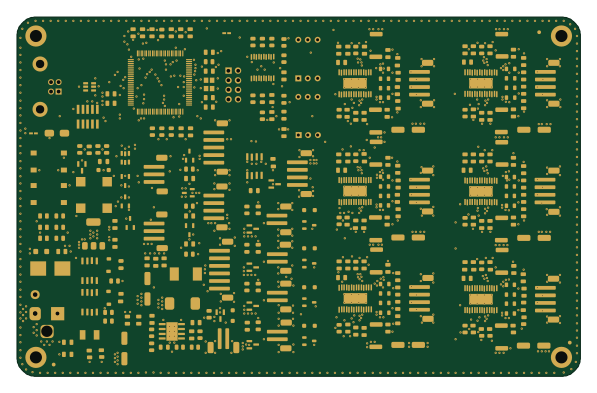
STM32LumenPnP Motherboard
opulo-inc
149 × 95 mm296 parts4LCC-BY-SA-4.03.7k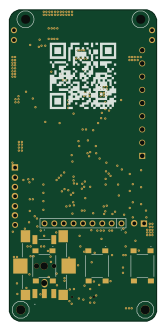 STM32
STM32AxxSolder
AxxAxx
39 × 82.5 mm122 parts2LGPL-3.01.7k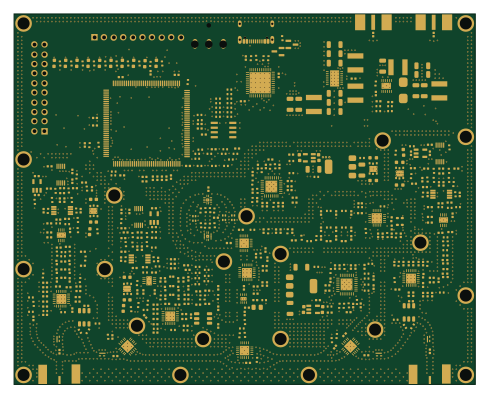 STM32
STM32LibreVNA
jankae
122 × 98 mm592 parts6LGPL-3.01.6k STM32
STM32AIOC
skuep
21 × 31.5 mm47 parts2LMIT1.4k STM32
STM32Ferris
pierrechevalier83
208.8 × 86.8 mm102 parts2LSHL-2.11.3k STM32
STM32176 pin board
rusefi
61.8 × 73.2 mm76 parts2LGPL-3.01.2k