
MinAI

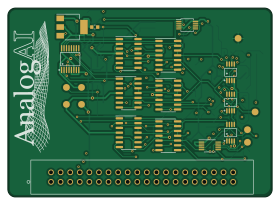
About the MinAI PCB
MinAI is an open source PCB design by essen48183, published on GitHub under the MIT license. It is a 4-layer board measuring 70 × 50 mm, with 63 components from 16 distinct parts.
Other key parts include the MCP4251-103E/SL, SN74HC138PWR, MCP4728A0T-E/UN, ADS1115IDGSR and AMS1117-3.3. By type, the board carries 28 resistors, 20 capacitors, 13 ICs, 1 connector and 1 inductor.
From the project
A single-file C++ transformer built to be read — every mechanism of a modern LLM in ~780 lines, with a textbook companion.
A parallel project that runs MinAI's math on discrete analog hardware instead of digital CPUs/GPUs. PCB-fabbable, home-iterable in hours, and the only reason it is tractable is that MinAI itself is small.
Modern AI is a 2017 neural-network architecture running on 1990s-era graphics hardware, burning megawatts of electricity to simulate physics that any properly-built analog circuit does for free. Every transistor in a GPU spends clock cycles computing a × b + c with floating-point arithmetic, when Ohm's law and Kirchhoff's current law will produce the same answer at the speed of electricity…
Main components on the MinAI
MinAI bill of materials (BOM)
63 components, 16 distinct parts — part numbers from the project's BOM.
| Qty | Part | Footprint | Refs |
|---|---|---|---|
| 6 | MCP4251-103E/SL Microchip | SOIC-14_3.9x8.7mm_P1.27mm | U1, U2, U3, U4, U5, U6 |
| 1 | SN74HC138PWR TI(德州仪器) | easyeda2kicad_TSSOP-16_L5.0-W4.4-P0.65-LS6.4-BL | U7 |
| 1 | MCP4728A0T-E/UN Microchip Technology | Package_SO_MSOP-10_3x3mm_P0.5mm | U8 |
| 1 | ADS1115IDGSR Texas Instruments | Package_SO_VSSOP-10_3x3mm_P0.5mm | U9 |
| 1 | AMS1117-3.3 AMS | Package_TO_SOT_SMD_SOT-223 | U10 |
| 3 | OPA2333AIDGKTG4 TI(德州仪器) | easyeda2kicad_VSSOP-8_L3.0-W3.0-P0.65-LS4.9-BL | U11, U12, U13 |
| 1 | 302-S401 On Shore Technology Inc. | 302-S401 | J1 |
| 1 | BLM18AG601SN1D Murata Electronics | Fuse_0603_1608Metric | FB1 |
| 14 | CL10B104KB8NNNC 100nF Samsung Electro-Mechanics | C_0603_1608Metric | C1, C2, C3, C4, C5, C6, C7, C8 +6 |
| 6 | C2012X5R1A106M085AB 10uF TDK | C_0603_1608Metric | C15, C16, C17, C18, C19, C20 |
| 9 | RC0603FR-1310KL 10k Yageo | R_0603_1608Metric | R1, R2, R3, R4, R5, R6, R8, R9 +1 |
| 2 | RC0603FR-1310KL 10k 0.1% Yageo | R_0603_1608Metric | R7, R10 |
| 12 | PAT0603E4002BST1 40k 0.1% Vishay Dale Thin Film | R_0603_1608Metric | R12, R13, R14, R15, R16, R17, R18, R19 +4 |
| 2 | PAT0603E2564BST1 2.56M 0.1% Vishay Dale Thin Film | R_0603_1608Metric | R24, R25 |
| 2 | RC0603FR-074K7L 4.7k Yageo | R_0603_1608Metric | R26, R27 |
| 1 | RC0603JR-130RL 13Ω 5% Yageo | R_0603_1608Metric | R28 |
MinAI design files
The KiCad project lives in the essen48183/MinAI repository on GitHub; these links point at the commit this page was built from.
MinAI: common questions
How big is the MinAI PCB?
The MinAI measures 70 × 50 mm, has 4 copper layers and is 1.3694 mm thick.
How many components are on the MinAI?
63 components, from 16 distinct parts, with part numbers taken from the project's own BOM. The full bill of materials is listed on this page.
Where can I download the MinAI design files?
From the essen48183/MinAI repository on GitHub, which has the KiCad layout, the schematic and the BOM; the links under Design files point to each one.
Can I use the MinAI design in my own project?
Yes, under the terms of its MIT license, which essen48183 chose for the repository.