
H730duino

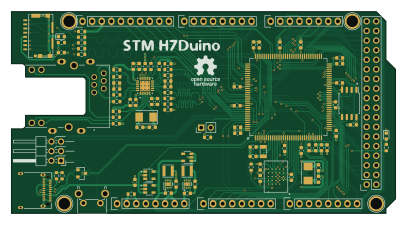
About the H730duino PCB
H730duino is an open source STM32 PCB design by martinribelotta, published on GitHub under the MIT license. It is a 4-layer board measuring 101.6 × 53.3 mm, with 109 components from 41 distinct parts.
Its main chip is the STM32H730ZBT6, from the STM32 family. Other key parts include the IS25LP032D-JBLE, TPS62162DSGT, TPS62163DSGT, MAX40200AUK+T and LAN8742A-CZ. By type, the board carries 43 capacitors, 29 resistors, 15 connectors, 9 ICs, 4 inductors and 3 crystals.
It belongs with the robotics & motion, test & measurement and iot & wireless designs in this gallery.
From the project
STM32H7 Arduino form factor and software compatible board
Arduino form factor and software compatible board with giant cortex-m7 at 550MHz.
- CPU Cortex-M7 at 550MHz. - 128K/1 MB of internal flash (depending on the MCU version). - 500 KB of internal RAM. - 8 MB of external QSPI PSRAM at 133MHz SDR. - 16/32/128 MB of external QSPI Flash at 133MHz SDR. - 10/100Mb Ethernet. - USB 2.0 OTG Type-C with power switch control. - USB CMSIS-DAP Debugger. - micro SD Card slot. - Arduino Due/Mega compatible pin headers (3.3V IO, 5V tolerant on some pins). - Arduino API compatible (via STM32Duino project). - Micropython support. - Protected power inputs with…
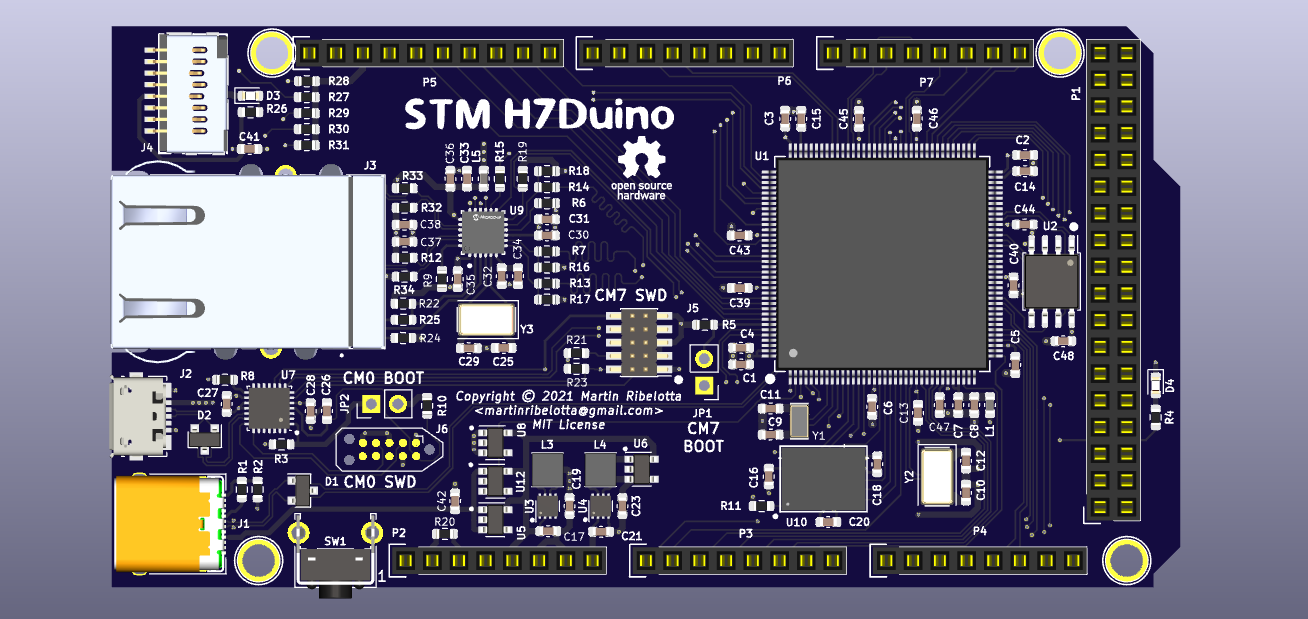
Main components on the H730duino
H730duino bill of materials (BOM)
109 components, 41 distinct parts — part numbers from the project's BOM.
| Qty | Part | Footprint | Refs |
|---|---|---|---|
| 1 | STM32H730ZBT6 STMicroelectronics | STM32H730ZBT6 | U1 |
| 1 | IS25LP032D-JBLE IS25LP032D-JBLE-TR ISSI | SOIC-8_5.23x5.23mm_P1.27mm | U2 |
| 1 | TPS62162DSGT TPS62162DSG Texas Instruments | WSON-8-1EP_2x2mm_P0.5mm_EP0.9x1.6mm_ThermalVias | U3 |
| 1 | TPS62163DSGT TPS62163DSG Texas Instruments | WSON-8-1EP_2x2mm_P0.5mm_EP0.9x1.6mm_ThermalVias | U4 |
| 2 | MAX40200AUK+T MAX40200AUK Maxim Integrated | SOT-23-5 | U5, U6 |
| 1 | LAN8742A-CZ LAN8742A Microchip | Microchip-C04-143B-S4QFN-0-0-MFG | U9 |
| 1 | S27KL0641DABHI020 Cypress Semiconductor | S27KL0641DABHI020 | U10 |
| 1 | AP2161WG-7 AP2161W Diodes Inc. | SOT-23-5 | U12 |
| 1 | VMK3-9005-32K7680000 32.768K Citizen Finetech Miyota | Crystal_SMD_3215-2Pin_3.2x1.5mm | Y1 |
| 1 | ABM7-8.000MHZ-D2Y-T 8M Abracon | Crystal_SMD_5032-2Pin_5.0x3.2mm | Y2 |
| 1 | ABM7-25.000MHZ-D2Y-T 25M Abracon | Crystal_SMD_5032-2Pin_5.0x3.2mm | Y3 |
| 1 | USB_C_Receptacle_USB2.0 Amphenol | USB_C_Receptacle_Amphenol_12401610E4-2A | J1 |
| 1 | 47346-0001 Conn_02x03_Odd_Even Molex | PinHeader_2x03_P2.54mm_Horizontal | J2 |
| 1 | L834-1G1T-91 Bel Fuse | BEL_L834-1G1T-91 | J3 |
| 1 | 105162-0001 Molex | 105162-0001 | J4 |
| 1 | 2044-2X18G00SA CONN_02x18 Oupiin | Socket_Strip_Arduino_2x18 | P1 |
| 5 | 2044-1X08G00SA CONN_01x08 Oupiin | Socket_Strip_Arduino_1x08 | P2, P3, P4, P6, P7 |
| 1 | 2044-1X10G00SA CONN_01x10 Oupiin | Socket_Strip_Arduino_1x10 | P5 |
| 4 | CONN_01X01 | Arduino_1pin | P8, P10, P11, P13 |
| 1 | BOOT | PinHeader_1x02_P2.54mm_Vertical | JP1 |
Show 21 more
| Qty | Part | Footprint | Refs |
|---|---|---|---|
| 1 | https://github.com/martinribelotta/h730duino | url_qr | QR1 |
| 1 | RESET C&K Components | SW_Tactile_SPST_Angled_PTS645Vx39-2LFS | SW1 |
| 1 | SP0502BAHTG SP0502BAHT Littelfuse | SOT-23 | D1 |
| 2 | LEDRED Osram Opto | LED_0603_1608Metric | D3, D4 |
| 2 | BK1608HS220-T ferrite Taiyo Yuden | L_0603_1608Metric | L1, L5 |
| 2 | NR3015T2R2M Taiyo Yuden | L_Taiyo-Yuden_MD-3030 | L3, L4 |
| 1 | CC0603KRX5R5BB475 4.7u Yageo | C_0603_1608Metric | C1 |
| 21 | CC0603KRX7R9BB104 100n Yageo | C_0603_1608Metric | C2, C3, C4, C5, C6, C7, C16, C18 +13 |
| 5 | CC0603JRNPO9BN100 10p Yageo | C_0603_1608Metric | C8, C9, C11, C25, C29 |
| 2 | CC0603CRNPO9BN1R0 20p Yageo | C_0603_1608Metric | C10, C12 |
| 2 | CC0603ZRY5V6BB105 1u Yageo | C_0603_1608Metric | C13, C34 |
| 3 | CC0603ZRY5V6BB225 2.2u Yageo | C_0603_1608Metric | C14, C15, C42 |
| 4 | C0603C106M8PACTU 10u KEMET | C_0603_1608Metric | C17, C21, C30, C36 |
| 2 | GRM187R61A226ME15D 22u Murata | C_0603_1608Metric | C19, C23 |
| 1 | 06035C471KAT2A 470p AVX | C_0603_1608Metric | C32 |
| 2 | 06035C223KAT2A 0.022u AVX | C_0603_1608Metric | C37, C38 |
| 5 | RC0603JR-071K5L 1K5 Yageo | R_0603_1608Metric | R1, R2, R4, R19, R26 |
| 17 | RC0603FR-0710KL 10K Yageo | R_0603_1608Metric | R5, R6, R7, R11, R13, R14, R15, R16 +9 |
| 1 | RT0603BRD0712K1L 12.1K 1% Yageo | R_0603_1608Metric | R9 |
| 4 | RC0603FR-0749R9L 49.9R Yageo | R_0603_1608Metric | R12, R32, R33, R34 |
| 2 | RC0603JR-07220RL 220R Yageo | R_0603_1608Metric | R24, R25 |
H730duino design files
The KiCad project lives in the martinribelotta/h730duino repository on GitHub; these links point at the commit this page was built from.
H730duino: common questions
What microcontroller does the H730duino use?
The H730duino is built around the STM32H730ZBT6, from the STM32 family.
How big is the H730duino PCB?
The H730duino measures 101.6 × 53.3 mm, has 4 copper layers and is 1.6 mm thick.
How many components are on the H730duino?
109 components, from 41 distinct parts, with part numbers taken from the project's own BOM. The full bill of materials is listed on this page.
Where can I download the H730duino design files?
From the martinribelotta/h730duino repository on GitHub, which has the KiCad layout and the BOM; the links under Design files point to each one.
Can I use the H730duino design in my own project?
Yes, under the terms of its MIT license, which martinribelotta chose for the repository.
Can I test firmware for the H730duino without the hardware?
Yes. HardLabs builds a simulation of the board from its netlist and BOM, so you can run and debug STM32 firmware against it before you order a PCB.
Similar boards
 STM32
STM32LumenPnP Motherboard
opulo-inc
149 × 95 mm296 parts4LCC-BY-SA-4.03.7k STM32
STM32AxxSolder
AxxAxx
39 × 82.5 mm122 parts2LGPL-3.01.7k STM32
STM32AIOC
skuep
21 × 31.5 mm47 parts2LMIT1.4k STM32
STM32Ferris
pierrechevalier83
208.8 × 86.8 mm102 parts2LSHL-2.11.3k STM32
STM32Module 16S
stuartpittaway
71.1 × 89.6 mm113 parts4LCC-BY-NC-4.01.1k STM32
STM32Djinn
tzarc
192.3 × 150.5 mm216 parts2LCERN-OHL-S-2.0988