
MAGIC Game - Catch the Gamma!

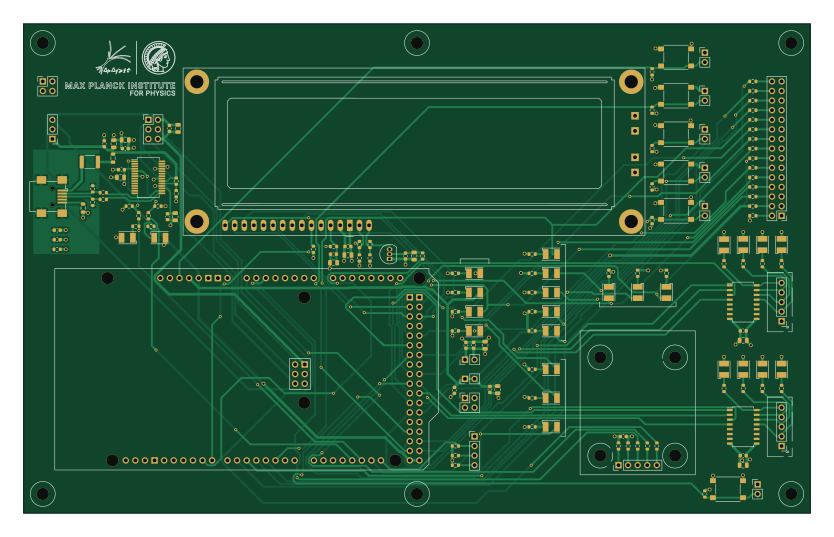
About the MAGIC Game - Catch the Gamma! PCB
MAGIC Game - Catch the Gamma! is an open source AVR/Arduino PCB design by mppmu, published on GitHub under the GPL-3.0 license. It is a 4-layer board measuring 208.3 × 129.5 mm, with 159 components from 41 distinct parts.
Its main chip is the Arduino_ICSP, from the AVR/Arduino family. Other key parts include the FT232RL, ULN2003AD and LCD-016N002L. By type, the board carries 70 resistors, 29 capacitors, 25 diodes, 17 connectors, 6 switches and 4 ICs.
From the project
MAGIC game "Catch the gamma!" for an exhibition on the MS Wissenschaft in 2023
This is project contains resources for the "Catch the Gamma!" game, an exhibit on the MS Wissenshaft in 2023. Visitors have to maneuver a model of the MAGIC telescope via joystick to a specific position within a certain time in order to capture a gamma event. They learn how a gamma quantum from space interacts with the earth's atmosphere. The Cherenkov light that is produced is picked up by the telescope and thus indirectly gives an image of the gamma source in space.

Main components on the MAGIC Game - Catch the Gamma!
MAGIC Game - Catch the Gamma! bill of materials (BOM)
159 components, 41 distinct parts — part numbers from the project's BOM.
| Qty | Part | Footprint | Refs |
|---|---|---|---|
| 1 | FT232RL | SSOP-28_5.3x10.2mm_P0.65mm | U1 |
| 2 | ULN2003AD | SOIC-16W_5.3x10.2mm_P1.27mm | U2, U3 |
| 1 | LCD-016N002L | LCD-016N002L | U4 |
| 1 | 2N3904 | TO-92_Inline | Q1 |
| 1 | USB_B_Mini | USB_Mini-B_Wuerth_65100516121_Horizontal | J1 |
| 1 | I2C header | PinHeader_1x04_P2.54mm_Vertical | J2 |
| 1 | Arduino_ICSP | PinHeader_2x03_P2.54mm_Vertical | J3 |
| 2 | Stepper Motor | PinHeader_1x05_P2.54mm_Vertical | J4, J5 |
| 1 | Joystick | PinHeader_1x05_P2.54mm_Vertical | J6 |
| 1 | CON_LED | PinHeader_2x15_P2.54mm_Vertical | J7 |
| 6 | Switch | PinHeader_1x02_P2.54mm_Vertical | J8, J9, J10, J11, J12, J13 |
| 2 | CON_GND | PinHeader_2x02_P2.54mm_Vertical | J14, J15 |
| 1 | CON_+5V | PinHeader_1x02_P2.54mm_Vertical | J16 |
| 1 | CON_+3.3V | PinHeader_1x02_P2.54mm_Vertical | J17 |
| 1 | MF-MSMF125-2 | Fuse_1812_4532Metric | F1 |
| 1 | JUMPER_3_OPEN Jumper_3_Open | PinHeader_1x03_P2.54mm_Vertical | JP1 |
| 2 | CG0603MLC-05E | R_0603_1608Metric | RV1, RV2 |
| 6 | SW_Push | SW_Push_1P1T_NO_6x6mm_H9.5mm | SW1, SW2, SW3, SW4, SW5, SW6 |
| 1 | ARDUINO_MEGA2560_SHIELD Arduino_Mega2560_Shield | Arduino_Mega2560_Shield | XA1 |
| 3 | yellow | LED_PLCC-2_3.4x3.0mm_KA | D1, D2, D21 |
Show 21 more
| Qty | Part | Footprint | Refs |
|---|---|---|---|
| 13 | green | LED_PLCC-2_3.4x3.0mm_KA | D3, D4, D5, D6, D7, D8, D9, D10 +5 |
| 5 | red | LED_PLCC-2_3.4x3.0mm_KA | D14, D15, D17, D18, D20 |
| 1 | orange | LED_PLCC-2_3.4x3.0mm_KA | D22 |
| 1 | amber | LED_PLCC-2_3.4x3.0mm_KA | D23 |
| 1 | white | LED_PLCC-2_3.4x3.0mm_KA | D24 |
| 1 | blue | LED_PLCC-2_3.4x3.0mm_KA | D25 |
| 2 | BLM21PG221SN1D | L_0805_2012Metric | L1, L2 |
| 1 | 3N3 3n3 | C_0603_1608Metric | C1 |
| 16 | 100N 100n | C_0603_1608Metric | C2, C4, C6, C8, C10, C11, C12, C14 +8 |
| 12 | 10U 10u | C_0805_2012Metric | C3, C5, C7, C9, C13, C15, C17, C19 +4 |
| 1 | 1M | R_0603_1608Metric | R1 |
| 2 | 22 | R_0603_1608Metric | R2, R3 |
| 4 | 4K7 4k7 | R_0603_1608Metric | R4, R13, R14, R69 |
| 1 | 10K 10k | R_0603_1608Metric | R5 |
| 2 | 100K 100k | R_0603_1608Metric | R6, R7 |
| 11 | 0 | R_0603_1608Metric | R8, R9, R12, R15, R16, R17, R26, R27 +3 |
| 39 | 1K5 1k5 | R_0603_1608Metric | R10, R11, R18, R19, R20, R21, R22, R23 +31 |
| 1 | 680 | R_0603_1608Metric | R29 |
| 6 | 1k | R_0603_1608Metric | R58, R59, R60, R61, R62, R63 |
| 2 | DNP | R_0603_1608Metric | R65, R68 |
| 1 | 470 | R_0603_1608Metric | R70 |
MAGIC Game - Catch the Gamma! design files
The KiCad project lives in the mppmu/magic-game repository on GitHub; these links point at the commit this page was built from.
MAGIC Game - Catch the Gamma!: common questions
What microcontroller does the MAGIC Game - Catch the Gamma! use?
The MAGIC Game - Catch the Gamma! is built around the Arduino_ICSP, from the AVR/Arduino family.
How big is the MAGIC Game - Catch the Gamma! PCB?
The MAGIC Game - Catch the Gamma! measures 208.3 × 129.5 mm, has 4 copper layers and is 1.446 mm thick.
How many components are on the MAGIC Game - Catch the Gamma!?
159 components, from 41 distinct parts, with part numbers taken from the project's own BOM. The full bill of materials is listed on this page.
Where can I download the MAGIC Game - Catch the Gamma! design files?
From the mppmu/magic-game repository on GitHub, which has the KiCad layout, the schematic and the BOM; the links under Design files point to each one.
Can I use the MAGIC Game - Catch the Gamma! design in my own project?
Yes, under the terms of its GPL-3.0 license, which mppmu chose for the repository.
Can I test firmware for the MAGIC Game - Catch the Gamma! without the hardware?
Yes. HardLabs builds a simulation of the board from its netlist and BOM, so you can run and debug AVR/Arduino firmware against it before you order a PCB.
More boards in magic-game
Similar boards
 AVR/Arduino
Magspoof
samyk
35 × 29 mm11 parts2LNo license4.2k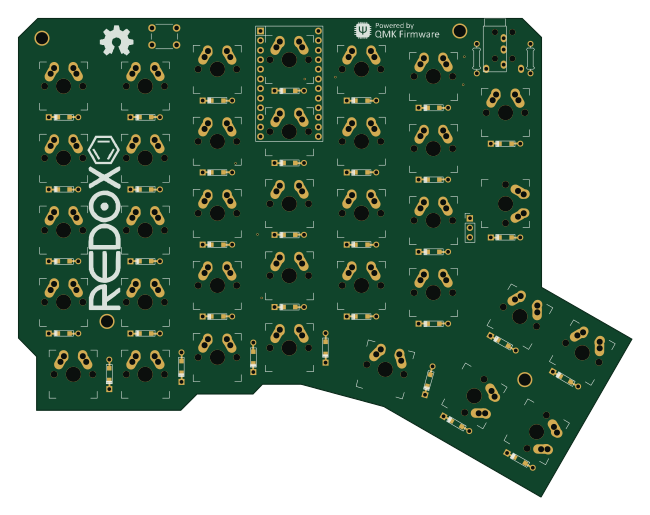 AVR/Arduino
Redox keyboard
mattdibi
162.2 × 126.5 mm77 parts2LMIT2.0k AVR/Arduino
Labrador
espotek-org
36.8 × 34.7 mm75 parts2LNo license1.2k AVR/Arduino
ModuleV450
stuartpittaway
30 × 61.4 mm39 parts2LCC-BY-NC-4.01.1k AVR/Arduino
V4
30 × 50 mm38 parts2LCC-BY-NC-4.01.1k AVR/Arduino
Discipline
coseyfannitutti
304.9 × 122.8 mm170 parts2LCC-BY-NC-4.01.0k