
Cosmic key

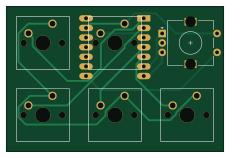
About the Cosmic key PCB
Cosmic key is an open source PCB design by phantom-ascii, published on GitHub. It is a 2-layer board measuring 57.3 × 38.3 mm, with 7 components from 3 distinct parts.
Other key parts include the MOUDLE-SEEEDUINO-XIAO. By type, the board carries 6 switches and 1 IC.
From the project
This project was posted on stardance: https://stardance.hackclub.com/projects/52857 go check it NOW. This porject was also created for Hackpad. THANKS SO MUCH TO THE HACK CLUB TEAM!
This project was posted on stardance: https://stardance.hackclub.com/projects/52857 go check it NOW. This porject was also created for Hackpad. THANKS SO MUCH TO THE HACK CLUB TEAM!
This project taught me alot. I now know much more about 3d modelling pcbs firmware python onshape kicad and much more than i did before and i highly recomend other people to do this project.
Main components on the Cosmic key
Cosmic key bill of materials (BOM)
7 components, 3 distinct parts — part numbers from the project's BOM.
| Qty | Part | Footprint | Refs |
|---|---|---|---|
| 1 | MOUDLE-SEEEDUINO-XIAO | XIAO-Generic-Hybrid-14P-2.54-21X17.8MM | U1 |
| 5 | SW_Push | SW_Cherry_MX_1.00u_PCB | SW1, SW2, SW3, SW4, SW5 |
| 1 | RotaryEncoder_Switch | RotaryEncoder_Alps_EC11E-Switch_Vertical_H20mm | SW6 |
Cosmic key design files
The KiCad project lives in the phantom-ascii/cosmic-key repository on GitHub; these links point at the commit this page was built from.
- LayoutPCB/CosmicKey.kicad_pcb
- SchematicPCB/CosmicKey.kicad_sch
- BOMbom.csv
Cosmic key: common questions
How big is the Cosmic key PCB?
The Cosmic key measures 57.3 × 38.3 mm, has 2 copper layers and is 1.6 mm thick.
How many components are on the Cosmic key?
7 components, from 3 distinct parts, with part numbers taken from the project's own BOM. The full bill of materials is listed on this page.
Where can I download the Cosmic key design files?
From the phantom-ascii/cosmic-key repository on GitHub, which has the KiCad layout, the schematic and the BOM; the links under Design files point to each one.
Can I use the Cosmic key design in my own project?
The repository has no license, so all rights stay with phantom-ascii. Use it as a reference, and ask the author before reusing the design.