
Quantrng.github.io

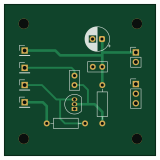
About the Quantrng.github.io PCB
Quantrng.github.io is an open source PCB design by quantrng, published on GitHub. It is a 2-layer board measuring 40 × 40 mm, with 12 components from 11 distinct parts.
By type, the board carries 6 connectors, 3 capacitors, 2 resistors and 1 transistor.
It belongs with the usb & debug tools designs in this gallery.
From the project
Hardware Quantum Random Number Generator (QRNG) based on avalanche transistor noise and FT232H / MCU interface. Open-source hardware, KiCad schematics, and Python entropy testing scripts.
Quantrng.github.io bill of materials (BOM)
12 components, 11 distinct parts.
| Qty | Part | Footprint | Refs |
|---|---|---|---|
| 1 | 2N3904 | TO-92_Inline | Q1 |
| 1 | 12V_VCC_IN | PinHeader_1x02_P2.54mm_Vertical | J1 |
| 1 | SG10_VCC_OUT | PinHeader_1x01_P2.54mm_Vertical | J2 |
| 1 | SG10_NOISE_IN | PinHeader_1x01_P2.54mm_Vertical | J3 |
| 1 | Common_Ground | PinHeader_1x03_P2.54mm_Vertical | J4 |
| 1 | FT232H_3V3 | PinHeader_1x01_P2.54mm_Vertical | J5 |
| 1 | FT232H_AD2 | PinHeader_1x01_P2.54mm_Vertical | J6 |
| 1 | 220uF | CP_Radial_D6.3mm_P2.50mm | C1 |
| 2 | 100nF | C_Disc_D5.0mm_W2.5mm_P2.50mm | C2, C3 |
| 1 | 100k | R_Axial_DIN0207_L6.3mm_D2.5mm_P10.16mm_Horizontal | R1 |
| 1 | 4.7k | R_Axial_DIN0207_L6.3mm_D2.5mm_P10.16mm_Horizontal | R2 |
Quantrng.github.io design files
The KiCad project lives in the quantrng/quantrng.github.io repository on GitHub; these links point at the commit this page was built from.
Quantrng.github.io: common questions
How big is the Quantrng.github.io PCB?
The Quantrng.github.io measures 40 × 40 mm, has 2 copper layers and is 1.6 mm thick.
How many components are on the Quantrng.github.io?
12 components, from 11 distinct parts. The full bill of materials is listed on this page.
Where can I download the Quantrng.github.io design files?
From the quantrng/quantrng.github.io repository on GitHub, which has the KiCad layout and the schematic; the links under Design files point to each one.
Can I use the Quantrng.github.io design in my own project?
The repository has no license, so all rights stay with quantrng. Use it as a reference, and ask the author before reusing the design.
Similar boards
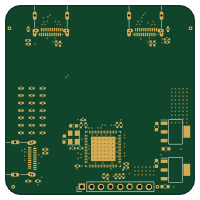
USB Hub Test
osy
50 × 50 mm85 parts4LCC-BY-4.0703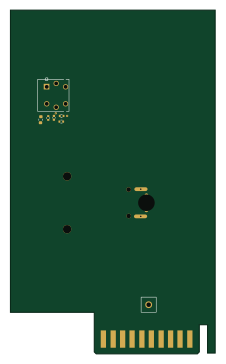
XG Station Power
54.3 × 91 mm9 parts2LCC-BY-4.0703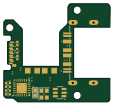
FW-EC-DongleHiderPlus
LeoDJ
28.2 × 26.1 mm14 parts4LCERN-OHL-W-2.0490
Adapter tsop48
bbogush
48 × 33 mm3 parts2LGPL-3.0389
Adapter tsop48 solder
48 × 33 mm3 parts2LGPL-3.0389
Adapter soic8 solder
48 × 20 mm3 parts2LGPL-3.0389