
DiveCAN Head2

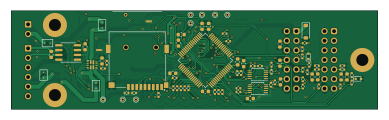
About the DiveCAN Head2 PCB
DiveCAN Head2 is an open source STM32 PCB design by QuickRecon, published on GitHub under the MIT license. It is a 4-layer board measuring 97.1 × 26 mm, with 135 components from 35 distinct parts.
Its main chip is the STM32L431RCTx, from the STM32 family. Other key parts include the C2871143, C2867820, C468235, ADS1115IDGS and C140321. By type, the board carries 68 resistors, 32 capacitors, 14 diodes, 10 ICs, 3 transistors and 2 connectors.
It belongs with the power & battery and sensors designs in this gallery.
From the project
An open source rebreather head controller
Constructive criticism, suggestions, and pull requests are always welcome.
Documentation for building and flashing firmware can be found under /Documentation/
The board has a battery onboard which can provide full functionality, and can also be provided with power from the CAN bus (1.8-5.5v). The VCC rail will prioritize CAN power and revert to battery if that is unavailable, the VBUS rail can have its power source controlled via the firmware. The VBUS rail can also be fed onto the CAN bus, allowing the board to act as a CAN power source, supplementing the bus power of the shearwater (which…
Main components on the DiveCAN Head2
DiveCAN Head2 bill of materials (BOM)
135 components, 35 distinct parts.
| Qty | Part | Footprint | Refs |
|---|---|---|---|
| 1 | STM32L431RCTx | LQFP-64_10x10mm_P0.5mm | U1 |
| 1 | C2871143 TCAN334 | SOIC-8_3.9x4.9mm_P1.27mm | U2 |
| 2 | C2867820 TPS7A2533DRVR | WSON-6-1EP_2x2mm_P0.65mm_EP1x1.6mm_ThermalVias | U3, U4 |
| 1 | C468235 LMR62014XMF | SOT-23-5 | U5 |
| 2 | ADS1115IDGS | TSSOP-10_3x3mm_P0.5mm | U6, U7 |
| 2 | C140321 TPS2115 | VSON-8_3.3x3.3mm_P0.65mm_NexFET | U8, U9 |
| 1 | TPS2121 | Texas_VQFN-HR-12_2x2.5mm_P0.5mm | U10 |
| 2 | C181087 SI2302 | SOT-23 | Q1, Q2 |
| 1 | C8545 2N7000 | SOT-23 | Q3 |
| 1 | C963524 8MHz | Crystal_SMD_HC49-SD | Y1 |
| 1 | C5155564 Micro_SD_Card_Det1 | CONN9_0185-02_GSW | J1 |
| 1 | C448647 JTAG | CON10_2X5_DUK_FTSH_SAI | J5 |
| 2 | C108518 2A | Fuseholder_Littelfuse_Nano2_154x | F1, F2 |
| 2 | C2915176 RST | SW_SPST_EVQPE1 | SW1, SW2 |
| 2 | C5204745 MBR0520 | D_SOD-123 | D1, D12 |
| 2 | C968191 BZX584C2V4 | D_SOD-523 | D2, D3 |
| 8 | C84256 LED | LED_0805_2012Metric | D4, D5, D6, D7, D8, D9, D10, D11 |
| 2 | C178259 SMF12A | D_SOD-123F | D13, D14 |
| 1 | C325966 10u | L_SunItech_SLO0530H | L1 |
| 2 | C325469 20p | C_0603_1608Metric | C1, C2 |
Show 15 more
| Qty | Part | Footprint | Refs |
|---|---|---|---|
| 22 | C14663 100n | C_0603_1608Metric | C3, C4, C5, C6, C7, C8, C9, C10 +14 |
| 6 | C96446 10u | C_0603_1608Metric | C13, C15, C16, C18, C20, C24 |
| 2 | C1546 100p | C_0402_1005Metric | C22, C23 |
| 25 | C25744 10k | R_0402_1005Metric | R1, R4, R7, R8, R9, R10, R11, R12 +17 |
| 3 | C25752 12k | R_0402_1005Metric | R2, R3, R47 |
| 2 | C25798 75k | R_0402_1005Metric | R5, R6 |
| 7 | C25741 100k | R_0402_1005Metric | R14, R46, R50, R51, R60, R61, R69 |
| 5 | C25768 22k | R_0402_1005Metric | R20, R22, R52, R54, R56 |
| 3 | C25879 2.2k | R_0402_1005Metric | R21, R23, R67 |
| 5 | C25087 200 | R_0402_1005Metric | R24, R25, R53, R55, R57 |
| 7 | C25130 680 | R_0402_1005Metric | R26, R27, R28, R29, R30, R31, R63 |
| 1 | C23204 560 | R_0603_1608Metric | R35 |
| 8 | C25905 5.1k | R_0402_1005Metric | R36, R37, R38, R39, R40, R41, R42, R43 |
| 1 | C25862 1.2k | R_0402_1005Metric | R48 |
| 1 | C25756 15k | R_0402_1005Metric | R49 |
DiveCAN Head2 design files
The KiCad project lives in the QuickRecon/DiveCANHead repository on GitHub; these links point at the commit this page was built from.
DiveCAN Head2: common questions
What microcontroller does the DiveCAN Head2 use?
The DiveCAN Head2 is built around the STM32L431RCTx, from the STM32 family.
How big is the DiveCAN Head2 PCB?
The DiveCAN Head2 measures 97.1 × 26 mm, has 4 copper layers and is 1.6 mm thick.
How many components are on the DiveCAN Head2?
135 components, from 35 distinct parts. The full bill of materials is listed on this page.
Where can I download the DiveCAN Head2 design files?
From the QuickRecon/DiveCANHead repository on GitHub, which has the KiCad layout and the schematic; the links under Design files point to each one.
Can I use the DiveCAN Head2 design in my own project?
Yes, under the terms of its MIT license, which QuickRecon chose for the repository.
Can I test firmware for the DiveCAN Head2 without the hardware?
Yes. HardLabs builds a simulation of the board from its netlist and BOM, so you can run and debug STM32 firmware against it before you order a PCB.
More boards in DiveCANHead
Similar boards
 STM32
STM32LumenPnP Motherboard
opulo-inc
149 × 95 mm296 parts4LCC-BY-SA-4.03.7k STM32
STM32Type c
google
188 × 30 mm17 parts2LApache-2.02.9k STM32
STM32Main panel
234 × 84 mm26 parts4LApache-2.02.9k STM32
STM32Base
52.3 × 52.3 mm36 parts2LApache-2.02.9k STM32
STM32Type a
150 × 30 mm14 parts2LApache-2.02.9k STM32
STM32Type e
140.5 × 30 mm13 parts2LApache-2.02.9k