
Pico pocket gameboy

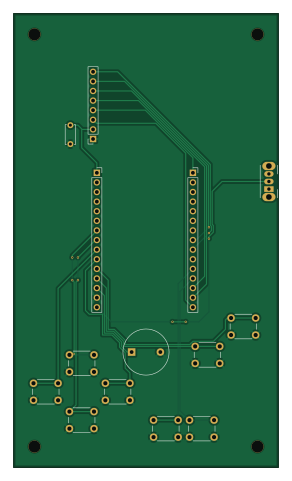
About the Pico pocket gameboy PCB
Pico pocket gameboy is an open source PCB design by rorotaggf-ctrl, published on GitHub. It is a 2-layer board measuring 70 × 120 mm, with 14 components from 7 distinct parts.
By type, the board carries 9 switches, 3 connectors, 1 buzzer and 1 capacitor.
It belongs with the retro computing designs in this gallery.
From the project
A small retro handheld console built with an ESP32 for Hack Club Half-Life (Week 1).
A small retro handheld console built with an ESP32 for Hack Club Half-Life (Week 1).
I designed a custom PCB in KiCad and everything uses through-hole parts so it's super easy to solder by hand.
CPU:** ESP32 NodeMCU (USB-C, dual-core, plenty of speed)
Display:** 1.3" IPS color display ($240 \times 240$, ST7789)
Buttons:** 8 clicky buttons (D-Pad, A/B, Start/Select)
Pico pocket gameboy bill of materials (BOM)
14 components, 7 distinct parts.
| Qty | Part | Footprint | Refs |
|---|---|---|---|
| 1 | Display | PinSocket_1x08_P2.54mm_Vertical | J1 |
| 1 | ESP-links | PinSocket_1x15_P2.54mm_Vertical | J2 |
| 1 | ESP-rechts | PinSocket_1x15_P2.54mm_Vertical | J3 |
| 1 | Buzzer | Buzzer_12x9.5RM7.6 | BZ1 |
| 8 | SW_Push | SW_PUSH_6mm_H5mm | SW1, SW2, SW3, SW4, SW5, SW6, SW7, SW8 |
| 1 | SW_SPDT | SW_Slide_SPDT_Angled_CK_OS102011MA1Q | SW9 |
| 1 | 100nF | C_Disc_D5.0mm_W2.5mm_P5.00mm | C1 |
Pico pocket gameboy design files
The KiCad project lives in the rorotaggf-ctrl/pico-pocket-gameboy repository on GitHub; these links point at the commit this page was built from.
Pico pocket gameboy: common questions
How big is the Pico pocket gameboy PCB?
The Pico pocket gameboy measures 70 × 120 mm, has 2 copper layers and is 1.6 mm thick.
How many components are on the Pico pocket gameboy?
14 components, from 7 distinct parts. The full bill of materials is listed on this page.
Where can I download the Pico pocket gameboy design files?
From the rorotaggf-ctrl/pico-pocket-gameboy repository on GitHub, which has the KiCad layout and the schematic; the links under Design files point to each one.
Can I use the Pico pocket gameboy design in my own project?
The repository has no license, so all rights stay with rorotaggf-ctrl. Use it as a reference, and ask the author before reusing the design.
Similar boards
Expansion Card Retrofit
FrameworkComputer
24 × 27.3 mm5 parts2LCC-BY-4.01.1k
Videoslotadapter
hoglet67
152 × 57.6 mm13 parts2LGPL-3.01.0k
Amiga External
21.9 × 76.7 mm6 parts2LGPL-3.01.0k
Buffer
53.9 × 23.2 mm13 parts2LGPL-3.01.0k
X1
121.9 × 81.3 mm51 parts2LGPL-3.01.0k
Rgb to hdmi
77 × 97 mm67 parts2LGPL-3.01.0k