
SinESC

About the SinESC PCB
SinESC is an open source STM32 PCB design by SAR-mango, published on GitHub under the GPL-3.0 license. It is a 4-layer board measuring 30 × 15 mm, with 84 components from 26 distinct parts.
Its main chip is the STM32F303CBT7, from the STM32 family. Other key parts include the MAX4239AUT, TMC6100-LA and TPS560430XDBVR. By type, the board carries 35 capacitors, 25 resistors, 6 ICs, 6 transistors, 6 connectors and 3 test points.
It belongs with the robotics & motion and test & measurement designs in this gallery.
From the project
SinESC brings sensorless field-oriented motor control to the RC drone and fixed-wing communities without common downsides.
After studying electrical engineering for four years, I have realized that the true problem to solve – and the key to SinESC's success – is developing a sensorless FOC algorithm that operates reliably, without manual tuning, across a wide range of motors.
Accordingly, I have shifted away from ST's motor control library in favor of my own software, developed from scratch. For now, I am using evaluation boards to perform testing. Building robust, high-performance hardware is a secondary focus, since this has already been done by others. Nevertheless, I plan to eventually revamp the hardware.
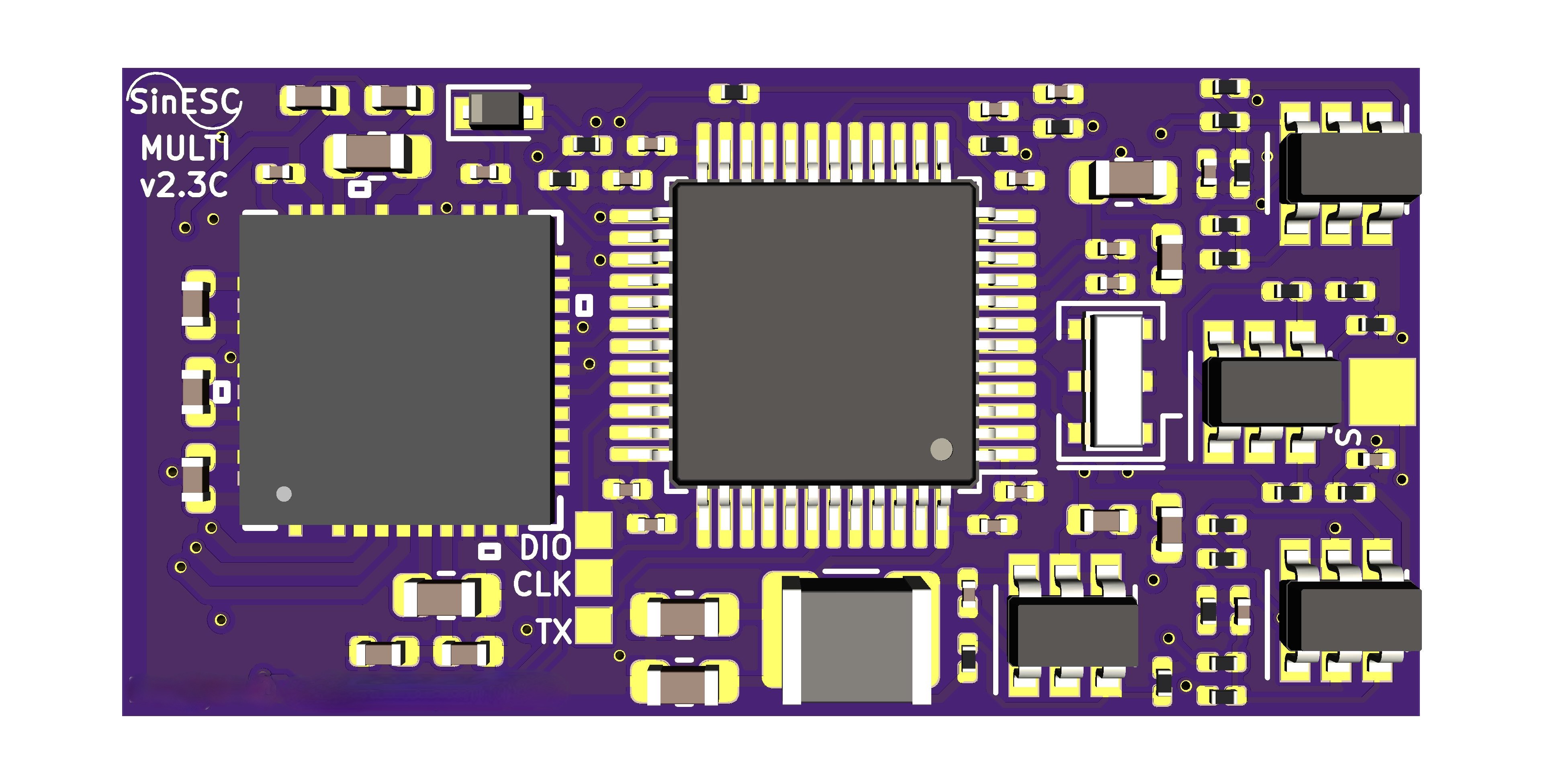
Main components on the SinESC
SinESC bill of materials (BOM)
84 components, 26 distinct parts — part numbers from the project's BOM.
| Qty | Part | Footprint | Refs |
|---|---|---|---|
| 1 | STM32F303CBT7 | LQFP-48_7x7mm_P0.5mm | U1 |
| 3 | MAX4239AUT | SOT-23-6 | U2, U3, U5 |
| 1 | TMC6100-LA | TMC6100-LA | U4 |
| 1 | TPS560430XDBVR | SOT-23-6 | U6 |
| 6 | BSC010N04LSI | TDSON-8-1 | Q1, Q2, Q3, Q4, Q5, Q6 |
| 1 | 8MHz | Resonator_SMD_muRata_CSTxExxV-3Pin_3.0x1.1mm | Y1 |
| 5 | Pad_3x2mm | Pad_3x2mm | J1, J2, J3, J4, J5 |
| 1 | Pad_1.5mm_Square | Pad_1.5mm_Square | J6 |
| 3 | Pad_0.8mm_Square | Pad_0.8mm_Square | TP1, TP2, TP3 |
| 1 | BAT30KFILM | D_SOD-523 | D1 |
| 1 | 10µH | L_1210_3225Metric | L1 |
| 7 | 100nF | C_0201_0603Metric | C1, C2, C4, C8, C20, C23, C30 |
| 10 | 6.8nF | C_0201_0603Metric | C3, C5, C6, C7, C9, C10, C12, C14 +2 |
| 12 | 1µF | C_0402_1005Metric | C11, C16, C17, C18, C21, C22, C26, C28 +4 |
| 4 | 10µF | C_0603_1608Metric | C13, C25, C34, C35 |
| 1 | 22nF | C_0603_1608Metric | C24 |
| 1 | 100nF | C_0402_1005Metric | C27 |
| 3 | 86.6Ω | R_0201_0603Metric | R1, R10, R19 |
| 3 | 1.5kΩ | R_0201_0603Metric | R2, R6, R11 |
| 3 | 1mΩ | R_1206_3216Metric | R3, R7, R12 |
Show 6 more
| Qty | Part | Footprint | Refs |
|---|---|---|---|
| 3 | 5.1kΩ | R_0201_0603Metric | R4, R13, R20 |
| 3 | 976Ω | R_0201_0603Metric | R5, R14, R21 |
| 4 | 15kΩ | R_0201_0603Metric | R8, R16, R17, R22 |
| 3 | 470Ω | R_0201_0603Metric | R9, R18, R23 |
| 2 | 120kΩ | R_0201_0603Metric | R15, R25 |
| 1 | 52.3kΩ | R_0201_0603Metric | R24 |
SinESC design files
The KiCad project lives in the SAR-mango/SinESC repository on GitHub; these links point at the commit this page was built from.
SinESC: common questions
What microcontroller does the SinESC use?
The SinESC is built around the STM32F303CBT7, from the STM32 family.
How big is the SinESC PCB?
The SinESC measures 30 × 15 mm, has 4 copper layers and is 1.6 mm thick.
How many components are on the SinESC?
84 components, from 26 distinct parts, with part numbers taken from the project's own BOM. The full bill of materials is listed on this page.
Where can I download the SinESC design files?
From the SAR-mango/SinESC repository on GitHub, which has the KiCad layout and the BOM; the links under Design files point to each one.
Can I use the SinESC design in my own project?
Yes, under the terms of its GPL-3.0 license, which SAR-mango chose for the repository.
Can I test firmware for the SinESC without the hardware?
Yes. HardLabs builds a simulation of the board from its netlist and BOM, so you can run and debug STM32 firmware against it before you order a PCB.
Similar boards
 STM32
STM32LumenPnP Motherboard
opulo-inc
149 × 95 mm296 parts4LCC-BY-SA-4.03.7k STM32
STM32AxxSolder
AxxAxx
39 × 82.5 mm122 parts2LGPL-3.01.7k STM32
STM32AIOC
skuep
21 × 31.5 mm47 parts2LMIT1.4k STM32
STM32Ferris
pierrechevalier83
208.8 × 86.8 mm102 parts2LSHL-2.11.3k STM32
STM32Module 16S
stuartpittaway
71.1 × 89.6 mm113 parts4LCC-BY-NC-4.01.1k STM32
STM32Djinn
tzarc
192.3 × 150.5 mm216 parts2LCERN-OHL-S-2.0988