
Stm32-robot brain

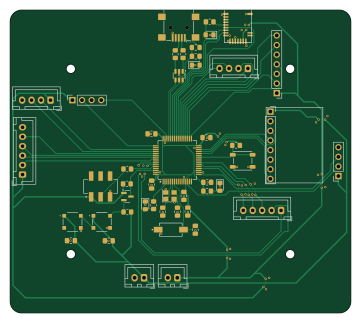
About the Stm32-robot brain PCB
Stm32-robot brain is an open source STM32 PCB design by Sebastian-S-Posada, published on GitHub. It is a 2-layer board measuring 90 × 80 mm, with 47 components from 31 distinct parts.
Its main chip is the STM32F103RCTX, from the STM32 family. Other key parts include the USBLC6-2SC6. By type, the board carries 11 connectors, 11 capacitors, 10 resistors, 4 diodes, 3 switches and 2 ICs.
It belongs with the robotics & motion, iot & wireless and sensors designs in this gallery.
From the project
A custom controller board for a small mobile robot, designed in KiCad. It's built around an STM32F103RCT6 microcontroller and brings together motor drive, sensor, Bluetooth, and programming connections on one 2-layer board.
A custom controller board for a small mobile robot, designed in KiCad. It's built around an STM32F103RCT6 microcontroller and brings together motor drive, sensor, Bluetooth, and programming connections on one 2-layer board.
- MCU: STM32F103RCT6 (ARM Cortex-M3, LQFP-64) with a 16 MHz crystal - Bluetooth: MDBT42T-AT module (nRF52-based BLE) - USB: Mini-B connector with USBLC6-2SC6 ESD protection and a resettable PTC fuse - Programming: SWD header, plus BOOT and RESET switches - Sensor headers: MPU6050 IMU and ultrasonic distance sensor - Robot I/O: motor driver, Hall-effect encoders, track…
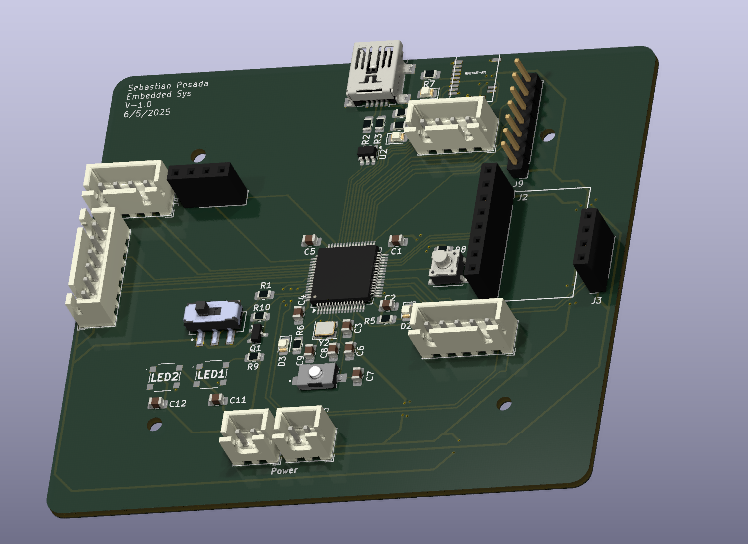
Main components on the Stm32-robot brain
Stm32-robot brain bill of materials (BOM)
47 components, 31 distinct parts — part numbers from the project's BOM.
| Qty | Part | Footprint | Refs |
|---|---|---|---|
| 1 | STM32F103RCTX STM32F103RCTx | LQFP-64_10x10mm_P0.5mm | U1 |
| 1 | USBLC6-2SC6 | SOT-23-6 | U2 |
| 1 | BSS138 | SOT-23 | Q1 |
| 1 | 16MHZ 16MHz | Crystal_SMD_Abracon_ABM8G-4Pin_3.2x2.5mm | Y2 |
| 1 | USB_B_Mini | USB_Mini-B_Lumberg_2486_01_Horizontal | J1 |
| 1 | CONN_MPU6050 | PinSocket_1x08_P2.54mm_Vertical | J2 |
| 1 | CONN_ULTRA | PinSocket_1x04_P2.54mm_Vertical | J3 |
| 1 | CONN_SWD | PinSocket_1x04_P2.54mm_Vertical | J4 |
| 1 | CONN_5V | JST_XH_B2B-XH-A_1x02_P2.50mm_Vertical | J5 |
| 1 | CONN_3V3 | JST_XH_B2B-XH-A_1x02_P2.50mm_Vertical | J6 |
| 1 | CONN_DRIVE | JST_XH_B4B-XH-A_1x04_P2.50mm_Vertical | J7 |
| 1 | CONN_HAL | JST_XH_B5B-XH-A_1x05_P2.50mm_Vertical | J8 |
| 1 | CONN_PS2 | PinHeader_1x07_P2.54mm_Vertical | J9 |
| 1 | CONN_TRACK | JST_XH_B6B-XH-A_1x06_P2.50mm_Vertical | J10 |
| 1 | CONN_UART | JST_XH_B4B-XH-A_1x04_P2.50mm_Vertical | J11 |
| 1 | PTCSMD | Fuse_0805_2012Metric_Pad1.15x1.40mm_HandSolder | F1 |
| 1 | MDBT42T-AT | MDBT42T | MDBT42T-AT1 |
| 1 | JS202011SCQN | SW_uP_Boot | S1 |
| 1 | SW_uP_Reset | SW_uP_Reset | SW1 |
| 1 | SW_USER | SW_SPST_PTS647_Sx50 | SW2 |
Show 11 more
| Qty | Part | Footprint | Refs |
|---|---|---|---|
| 2 | IN-PI55TATPRPGPB | INPI55TATPRPGPB | LED1, LED2 |
| 1 | USB_PWR_LED | LED_0805_2012Metric_Pad1.15x1.40mm_HandSolder | D1 |
| 1 | uP_PWR_LED | LED_0805_2012Metric_Pad1.15x1.40mm_HandSolder | D2 |
| 1 | USER_LED | LED_0805_2012Metric_Pad1.15x1.40mm_HandSolder | D3 |
| 1 | BL_IND_LED | LED_0805_2012Metric_Pad1.15x1.40mm_HandSolder | D4 |
| 7 | 0.1UF 0.1uF | C_0805_2012Metric_Pad1.18x1.45mm_HandSolder | C1, C2, C3, C4, C5, C11, C12 |
| 1 | 10UF 10uF | C_0805_2012Metric_Pad1.18x1.45mm_HandSolder | C6 |
| 1 | 0.01UF 0.01uF | C_0805_2012Metric_Pad1.18x1.45mm_HandSolder | C7 |
| 2 | 22PF 22pF | C_0805_2012Metric_Pad1.18x1.45mm_HandSolder | C8, C9 |
| 8 | 10K 10k | R_0805_2012Metric_Pad1.20x1.40mm_HandSolder | R1, R4, R5, R6, R7, R8, R9, R10 |
| 2 | 22 | R_0805_2012Metric_Pad1.20x1.40mm_HandSolder | R2, R3 |
Stm32-robot brain design files
The KiCad project lives in the Sebastian-S-Posada/stm32-robot-brain-pcb repository on GitHub; these links point at the commit this page was built from.
Stm32-robot brain: common questions
What microcontroller does the Stm32-robot brain use?
The Stm32-robot brain is built around the STM32F103RCTX, from the STM32 family.
How big is the Stm32-robot brain PCB?
The Stm32-robot brain measures 90 × 80 mm, has 2 copper layers and is 1.6 mm thick.
How many components are on the Stm32-robot brain?
47 components, from 31 distinct parts, with part numbers taken from the project's own BOM. The full bill of materials is listed on this page.
Where can I download the Stm32-robot brain design files?
From the Sebastian-S-Posada/stm32-robot-brain-pcb repository on GitHub, which has the KiCad layout, the schematic and the BOM; the links under Design files point to each one.
Can I use the Stm32-robot brain design in my own project?
The repository has no license, so all rights stay with Sebastian-S-Posada. Use it as a reference, and ask the author before reusing the design.
Can I test firmware for the Stm32-robot brain without the hardware?
Yes. HardLabs builds a simulation of the board from its netlist and BOM, so you can run and debug STM32 firmware against it before you order a PCB.
Similar boards
 STM32
STM32LumenPnP Motherboard
opulo-inc
149 × 95 mm296 parts4LCC-BY-SA-4.03.7k STM32
STM32AxxSolder
AxxAxx
39 × 82.5 mm122 parts2LGPL-3.01.7k STM32
STM32AIOC
skuep
21 × 31.5 mm47 parts2LMIT1.4k STM32
STM32Ferris
pierrechevalier83
208.8 × 86.8 mm102 parts2LSHL-2.11.3k STM32
STM32176 pin board
rusefi
61.8 × 73.2 mm76 parts2LGPL-3.01.2k STM32
STM32Brain board STM32F407
61.8 × 73.2 mm69 parts2LGPL-3.01.2k