
Ohmsprint energy meter

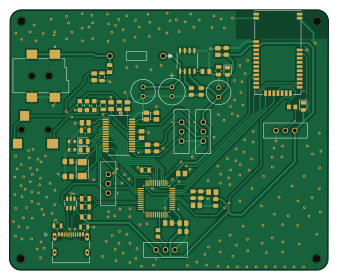
About the Ohmsprint energy meter PCB
Ohmsprint energy meter is an open source STM32 PCB design by vojinvukcevic, published on GitHub. It is a 2-layer board measuring 84.5 × 68.9 mm, with 66 components from 31 distinct parts.
Its main chip is the STM32F373CCTX, from the STM32 family. Other key parts include the ATM90E26-YU-R, USBLC6-2SC6, AP2213M-3.3TRG1 and BM70BLES1FC2-0B03AA. By type, the board carries 27 capacitors, 19 resistors, 5 ICs, 5 switches, 5 diodes and 3 connectors.
It belongs with the iot & wireless designs in this gallery.
From the project
2-layer energy meter PCB in KiCad (ATM90E26, STM32F373, BLE, USB-C) - OhmSprint 2026 competition
Hardware design of a single-phase energy meter with Bluetooth Low Energy and USB, built around the Microchip ATM90E26 metering IC and an STM32F373 microcontroller. Designed in KiCad by a team for OhmSprint 2026, a student hardware competition organized by Meter&Control in Belgrade.
Result: out of about 40 teams, the design was selected as one of the 10 finalists whose boards were manufactured and assembled by the organizer. The final stage was board bring-up, firmware testing and verification of measurement accuracy on site.
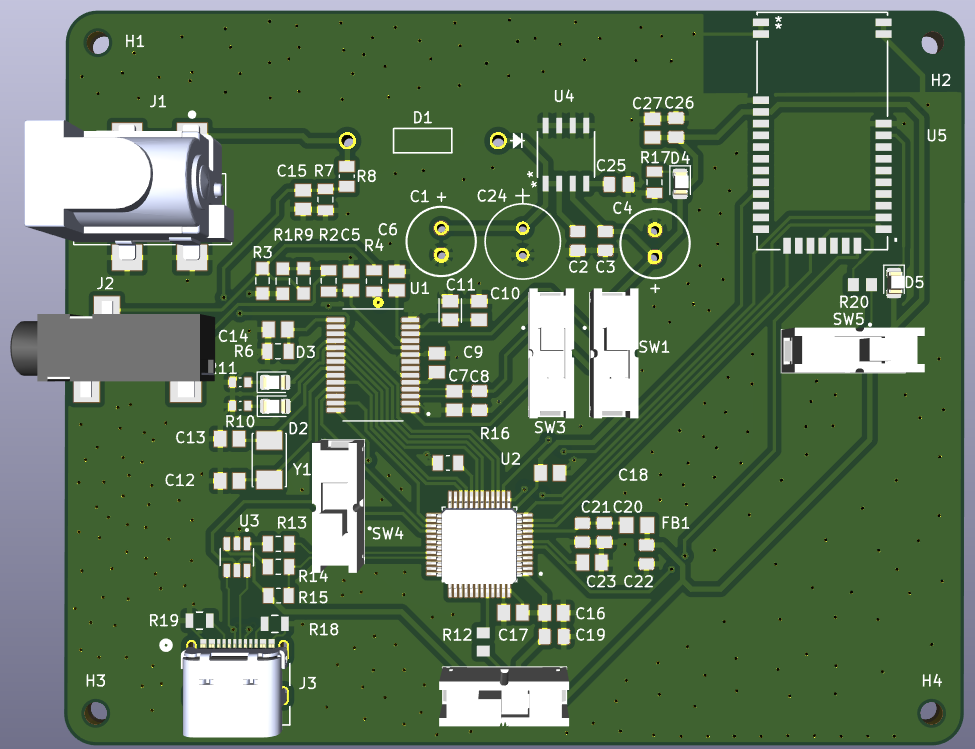
Main components on the Ohmsprint energy meter
Ohmsprint energy meter bill of materials (BOM)
66 components, 31 distinct parts — part numbers from the project's BOM.
| Qty | Part | Footprint | Refs |
|---|---|---|---|
| 1 | ATM90E26-YU-R Microchip Technology | ATM90E26 | U1 |
| 1 | STM32F373CCTX STM32F373CCTx STMicroelectronics | STM32F373CCT6 | U2 |
| 1 | USBLC6-2SC6 STMicroelectronics | USBLC6-25C6 | U3 |
| 1 | AP2213M-3.3TRG1 Diodes Incorporated | AP2213M-3.3TRG1 | U4 |
| 1 | BM70BLES1FC2-0B03AA Microchip Technology | BM70BLES1FC2_MCH | U5 |
| 1 | 8.192MHZ 8.192MHz TXC CORPORATION | CRYSTAL-AA-8.192MAGE | Y1 |
| 1 | PJ-002AH-SMT PJ-002AH-SMT-TR Same Sky (Formerly CUI Devices) | CUI_PJ-002AH-SMT-TR | J1 |
| 1 | SJ-3523-SMT SJ-3523-SMT-TR Same Sky (Formerly CUI Devices) | CUI_SJ-3523-SMT-TR | J2 |
| 1 | USB4105-GF-A GCT | USB4105_GCT | J3 |
| 5 | SW_NIDEC_CAS-120A1 SW_Nidec_CAS-120A1 E-Switch | SW_EG1218 | SW1, SW2, SW3, SW4, SW5 |
| 1 | 1N4007 MCC (Micro Commercial Components) | DIO_N4007-T_DIO | D1 |
| 4 | LED XINGLIGHT | LED_0805_2012Metric | D2, D3, D4, D5 |
| 1 | 120R Laird-Signal Integrity Products | FB_LI0805H121R-10 | FB1 |
| 2 | 100UF 100uF Würth Elektronik | 100uF_Polarized_Cap | C1, C4 |
| 5 | 1UF 1uF Samsung Electro-Mechanics | 1uF_Cap | C2, C3, C21, C22, C25 |
| 4 | 33NF 33nF TDK | 33nF_Cap | C5, C6, C14, C15 |
| 10 | 0.1UF 0.1uF KEMET | 0.1uF_Cap | C7, C9, C10, C12, C13, C16, C17, C18 +2 |
| 3 | 10UF 10uF Samsung Electro-Mechanics | 10uF_Cap | C8, C19, C26 |
| 1 | 10NF 10nF KEMET | 10nF_Cap | C11 |
| 1 | 10NF 10nF KEMET | 10uF_Cap | C20 |
Show 11 more
| Qty | Part | Footprint | Refs |
|---|---|---|---|
| 1 | 220UF 220uF Rubycon | 220uF_Polarized_Cap | C24 |
| 2 | 2R4 Panasonic Industry | 2R4_Resistor | R1, R3 |
| 5 | 1K Vishay Dale | 1K_Resistor | R2, R4, R6, R7, R17 |
| 1 | 25K TE Connectivity Passive Product | 25K_Resistor | R8 |
| 1 | 51R Panasonic Industry | 51R_Resistor | R9 |
| 2 | 510R Panasonic Industry | 510R_Resistor | R10, R11 |
| 2 | 10K YAGEO | 10K_Resistor | R12, R20 |
| 2 | 22R Vishay Dale | 22R_Resistor | R13, R14 |
| 1 | 1K5 YAGEO | 1K5_Resistor | R15 |
| 1 | 10K YAGEO | 1K5_Resistor | R16 |
| 2 | 5K1 KOA Speer Electronics, Inc. | 5K1_Resistor | R18, R19 |
Ohmsprint energy meter design files
The KiCad project lives in the vojinvukcevic/ohmsprint-energy-meter-pcb repository on GitHub; these links point at the commit this page was built from.
Ohmsprint energy meter: common questions
What microcontroller does the Ohmsprint energy meter use?
The Ohmsprint energy meter is built around the STM32F373CCTX, from the STM32 family.
How big is the Ohmsprint energy meter PCB?
The Ohmsprint energy meter measures 84.5 × 68.9 mm, has 2 copper layers and is 1.6 mm thick.
How many components are on the Ohmsprint energy meter?
66 components, from 31 distinct parts, with part numbers taken from the project's own BOM. The full bill of materials is listed on this page.
Where can I download the Ohmsprint energy meter design files?
From the vojinvukcevic/ohmsprint-energy-meter-pcb repository on GitHub, which has the KiCad layout, the schematic and the BOM; the links under Design files point to each one.
Can I use the Ohmsprint energy meter design in my own project?
The repository has no license, so all rights stay with vojinvukcevic. Use it as a reference, and ask the author before reusing the design.
Can I test firmware for the Ohmsprint energy meter without the hardware?
Yes. HardLabs builds a simulation of the board from its netlist and BOM, so you can run and debug STM32 firmware against it before you order a PCB.
Similar boards
 STM32
LumenPnP Motherboard
opulo-inc
149 × 95 mm296 parts4LCC-BY-SA-4.03.7k STM32
Type g
google
169 × 30 mm24 parts2LApache-2.02.9k STM32
Base
52.3 × 52.3 mm36 parts2LApache-2.02.9k STM32
Main panel
234 × 84 mm26 parts4LApache-2.02.9k STM32
Type a
150 × 30 mm14 parts2LApache-2.02.9k STM32
Type c
188 × 30 mm17 parts2LApache-2.02.9k