
Emg gesture board

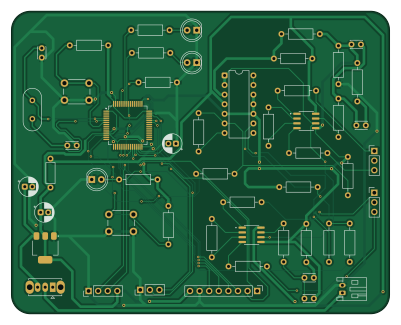
About the Emg gesture board
Emg gesture board is an open source STM32 PCB design by AhmedDoesCS, published on GitHub. It is a 2-layer board measuring 100 × 80 mm, with 53 components from 29 distinct parts.
Its main chip is the STM32F401RETx, from the STM32 family. Other key parts include the TL074, AMS1117-3.3 and AD8226BRZ. By type, the board carries 25 resistors, 9 capacitors, 5 ICs, 5 connectors, 3 switches and 3 diodes.
From the project
This is a hand-solderable, two-channel surface EMG board I've been building, the kind of thing you'd use to read muscle activity from the forearm and turn it into something a microcontroller can actually work with. Started this after my first wearable project ran into assembly-co
This is a hand-solderable, two-channel surface EMG board I've been building, the kind of thing you'd use to read muscle activity from the forearm and turn it into something a microcontroller can actually work with. Started this after my first wearable project ran into assembly-cost walls I couldn't get past on my own. Wanted the next thing to be something I could build entirely with a soldering iron, my own two hands, and parts I could actually source and understand end to end.
Main components on the Emg gesture board
Emg gesture board bill of materials (BOM)
53 components, 29 distinct parts.
| Qty | Part | Footprint | Refs |
|---|---|---|---|
| 1 | STM32F401RETx | LQFP-64_10x10mm_P0.5mm | U1 |
| 1 | TL074 | DIP-14_W7.62mm | U2 |
| 1 | AMS1117-3.3 | SOT-223-3_TabPin2 | U3 |
| 2 | AD8226BRZ | SOIC127P600X175-8N | U4, U5 |
| 1 | 8MHz | Crystal_HC49-4H_Vertical | Y1 |
| 2 | Conn_01x03 | PinHeader_1x03_P2.54mm_Vertical | J1, J2 |
| 1 | SWD_PROGRAMMING | PinHeader_1x04_P2.54mm_Vertical | J3 |
| 1 | ST7789 | PinHeader_1x08_P2.54mm_Vertical | J4 |
| 1 | UART_DEBUG | PinHeader_1x03_P2.54mm_Vertical | J5 |
| 1 | 6V | JST_PH_S2B-PH-K_1x02_P2.00mm_Horizontal | BT1 |
| 2 | SW_Push | SW_PUSH_6mm | SW1, SW3 |
| 1 | SW_SPDT | SW_Slide_SPDT_Straight_CK_OS102011MS2Q | SW2 |
| 3 | LED | LED_D5.0mm | D1, D2, D3 |
| 1 | L_Ferrite | L_Axial_L5.3mm_D2.2mm_P7.62mm_Horizontal_Vishay_IM-1 | L1 |
| 2 | 20pF | C_Disc_D3.0mm_W2.0mm_P2.50mm | C1, C2 |
| 2 | 10uF | CP_Radial_D5.0mm_P2.00mm | C3, C4 |
| 2 | 47nF | C_Disc_D3.0mm_W2.0mm_P2.50mm | C5, C8 |
| 2 | 100nF | C_Disc_D3.0mm_W2.0mm_P2.50mm | C6, C7 |
| 1 | 2.2uF | CP_Radial_D5.0mm_P2.00mm | C9 |
| 4 | 10k | R_Axial_DIN0207_L6.3mm_D2.5mm_P10.16mm_Horizontal | R1, R2, R5, R6 |
Show 9 more
| Qty | Part | Footprint | Refs |
|---|---|---|---|
| 3 | 330 | R_Axial_DIN0207_L6.3mm_D2.5mm_P10.16mm_Horizontal | R3, R24, R25 |
| 1 | 0 | R_Axial_DIN0207_L6.3mm_D2.5mm_P10.16mm_Horizontal | R4 |
| 2 | 2.05k | R_Axial_DIN0207_L6.3mm_D2.5mm_P10.16mm_Horizontal | R7, R12 |
| 2 | 3.3k | R_Axial_DIN0207_L6.3mm_D2.5mm_P10.16mm_Horizontal | R8, R13 |
| 2 | 160k | R_Axial_DIN0207_L6.3mm_D2.5mm_P10.16mm_Horizontal | R9, R15 |
| 6 | 1k | R_Axial_DIN0207_L6.3mm_D2.5mm_P10.16mm_Horizontal | R10, R14, R19, R20, R21, R22 |
| 2 | 39k | R_Axial_DIN0207_L6.3mm_D2.5mm_P10.16mm_Horizontal | R11, R16 |
| 2 | 100 | R_Axial_DIN0207_L6.3mm_D2.5mm_P10.16mm_Horizontal | R17, R18 |
| 1 | R_US | R_Axial_DIN0207_L6.3mm_D2.5mm_P10.16mm_Horizontal | R23 |
Emg gesture board design files
The KiCad project lives in the AhmedDoesCS/emg_gesture_board repository on GitHub; these links point at the commit this page was built from.
Emg gesture board: common questions
What microcontroller does the Emg gesture board use?
The Emg gesture board is built around the STM32F401RETx, from the STM32 family.
How big is the Emg gesture board?
The Emg gesture board measures 100 × 80 mm, has 2 copper layers and is 1.6 mm thick.
How many components are on the Emg gesture board?
53 components, from 29 distinct parts. The full bill of materials is listed on this page.
Where can I download the Emg gesture board design files?
From the AhmedDoesCS/emg_gesture_board repository on GitHub, which has the KiCad layout and the schematic; the links under Design files point to each one.
Can I use the Emg gesture board design in my own project?
The repository has no license, so all rights stay with AhmedDoesCS. Use it as a reference, and ask the author before reusing the design.
Can I test firmware for the Emg gesture board without the hardware?
Yes. HardLabs builds a simulation of the board from its netlist and BOM, so you can run and debug STM32 firmware against it before you order a PCB.
Similar boards
 STM32
LumenPnP Motherboard
opulo-inc
149 × 95 mm296 parts4LCC-BY-SA-4.03.7k STM32
Type g
google
169 × 30 mm24 parts2LApache-2.02.9k STM32
Main panel
234 × 84 mm26 parts4LApache-2.02.9k STM32
Base
52.3 × 52.3 mm36 parts2LApache-2.02.9k STM32
Type a
150 × 30 mm14 parts2LApache-2.02.9k STM32
Type c
188 × 30 mm17 parts2LApache-2.02.9k