
Power glitcher

About the Power glitcher PCB
Power glitcher is an open source PCB design by cpey, published on GitHub under the MIT license. It is a 2-layer board measuring 46.3 × 40.2 mm, with 66 components from 31 distinct parts.
Other key parts include the AD9708AR, Opamp_Dual, TL081H, ICL7660 and LM2735XMF. By type, the board carries 25 capacitors, 23 resistors, 7 connectors, 5 ICs, 3 diodes and 2 transistors.
From the project
Board for injecting voltage glitches
Power glitcher circuit for voltage fault injection. Similar to [1], it includes a DAC, a non-inverting amplification stage, and a push-pull follower output circuit.
The board can function as ON/OFF switch, bypassing the DAC, by connecting a GPIO output to the J5 connector and short-circuiting JP1. Refer to the schematic for more details.
[1] D. Oswald, A Versatile Framework for Implementation Attacks on Cryptographic RFIDs and Embedded Devices, 2010.
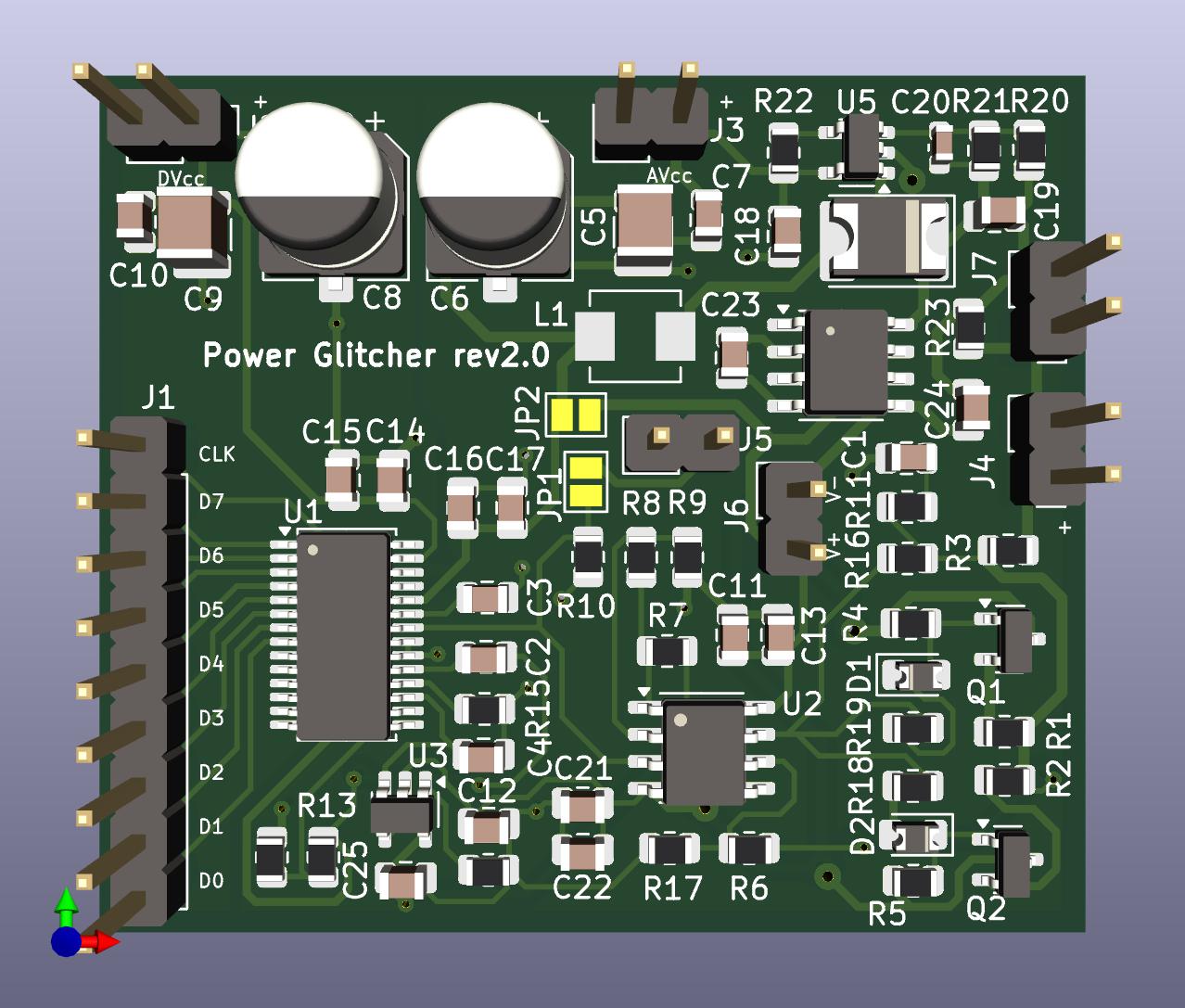
Main components on the Power glitcher
Power glitcher bill of materials (BOM)
66 components, 31 distinct parts — part numbers from the project's BOM.
| Qty | Part | Footprint | Refs |
|---|---|---|---|
| 1 | AD9708AR | TSSOP-28_4.4x9.7mm_P0.65mm | U1 |
| 1 | Opamp_Dual | SOIC-8_3.9x4.9mm_P1.27mm | U2 |
| 1 | TL081H | SOT-23-5 | U3 |
| 1 | ICL7660 | SO-8_3.9x4.9mm_P1.27mm | U4 |
| 1 | LM2735XMF | SOT-23-5 | U5 |
| 1 | BC817 | SOT-23 | Q1 |
| 1 | BC807 | SOT-23 | Q2 |
| 1 | Conn_01x09 | PinHeader_1x09_P2.54mm_Vertical | J1 |
| 6 | Conn_01x02 | PinHeader_1x02_P2.54mm_Vertical | J2, J3, J4, J5, J6, J7 |
| 2 | D | D_0805_2012Metric_Pad1.15x1.40mm_HandSolder | D1, D2 |
| 1 | D_Schottky | D_2114_3652Metric | D3 |
| 1 | 5.6uH | L_Vishay_IHLP-1616 | L1 |
| 1 | 1pF | C_0805_2012Metric | C1 |
| 11 | 0.1uF | C_0805_2012Metric | C2, C3, C4, C7, C10, C11, C12, C14 +3 |
| 2 | 10uF | C_1210_3225Metric | C5, C9 |
| 2 | 100uF | CP_Elec_6.3x5.8 | C6, C8 |
| 4 | 1uF | C_0805_2012Metric | C13, C15, C17, C22 |
| 1 | 2.2uF | C_0805_2012Metric | C18 |
| 3 | 10uF | C_0805_2012Metric | C19, C23, C24 |
| 1 | 1nF | C_0603_1608Metric | C20 |
Show 11 more
| Qty | Part | Footprint | Refs |
|---|---|---|---|
| 3 | 1 | R_0805_2012Metric | R1, R2, R23 |
| 3 | R | R_0805_2012Metric | R3, R12, R13 |
| 5 | 1K | R_0805_2012Metric | R4, R5, R6, R8, R17 |
| 1 | 64.9 | R_0805_2012Metric | R7 |
| 1 | 270 | R_0805_2012Metric | R9 |
| 2 | 100 | R_0805_2012Metric | R10, R16 |
| 1 | 4K7 | R_0805_2012Metric | R11 |
| 3 | 0 | R_0805_2012Metric | R14, R18, R19 |
| 1 | 2K | R_0805_2012Metric | R15 |
| 2 | 10K | R_0805_2012Metric | R20, R22 |
| 1 | 49.9K | R_0805_2012Metric | R21 |
Power glitcher design files
The KiCad project lives in the cpey/power-glitcher repository on GitHub; these links point at the commit this page was built from.
Power glitcher: common questions
How big is the Power glitcher PCB?
The Power glitcher measures 46.3 × 40.2 mm, has 2 copper layers and is 1.6 mm thick.
How many components are on the Power glitcher?
66 components, from 31 distinct parts, with part numbers taken from the project's own BOM. The full bill of materials is listed on this page.
Where can I download the Power glitcher design files?
From the cpey/power-glitcher repository on GitHub, which has the KiCad layout, the schematic and the BOM; the links under Design files point to each one.
Can I use the Power glitcher design in my own project?
Yes, under the terms of its MIT license, which cpey chose for the repository.