
Piadcio

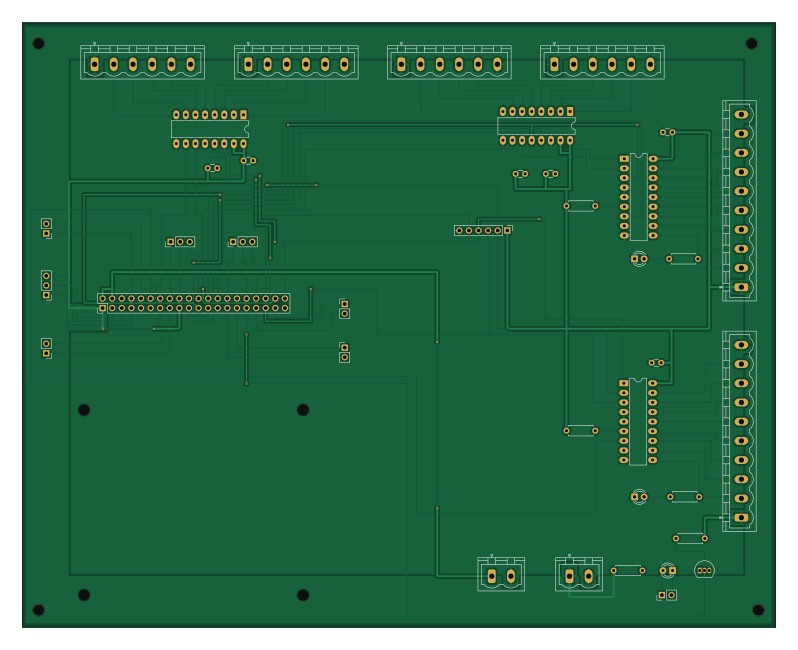
About the Piadcio PCB
Piadcio is an open source Raspberry Pi PCB design by DouniaBoudefla, published on GitHub under the Custom license license. It is a 2-layer board measuring 199.3 × 160 mm, with 39 components from 17 distinct parts.
Its main chip is the Raspberry_Pi_2_3, from the Raspberry Pi family. Other key parts include the MCP23S08-E/P and MCP3208-ADC. By type, the board carries 19 connectors, 6 capacitors, 6 resistors, 4 ICs, 3 diodes and 1 transistor.
From the project
PIADC-IO is a versatile and I/O expansion project designed to enhance the GPIO capabilities of the Raspberry Pi. The project integrates the MCP23S08 I/O expander and the MCP3208 ADC (Analog-to-Digital Converter) with the Raspberry Pi, enabling efficient control of multiple device
PIADC-IO is a versatile and I/O expansion project designed to enhance the GPIO capabilities of the Raspberry Pi. The project integrates the MCP23S08 I/O expander and the MCP3208 ADC (Analog-to-Digital Converter) with the Raspberry Pi, enabling efficient control of multiple devices and precise analog signal measurements via the SPI protocol. This repository contains all the necessary resources, including schematics, PCB designs, code, and documentation, to set up and use the PIADC-IO system for various applications, such as slow control in experimental setups and monitoring analog inputs.
Main components on the Piadcio
Piadcio bill of materials (BOM)
39 components, 17 distinct parts.
| Qty | Part | Footprint | Refs |
|---|---|---|---|
| 2 | MCP23S08-E/P MCP23S08-I/O Expander | DIP-18_W7.62mm_LongPads | U1, U5 |
| 2 | MCP3208-ADC | DIP-16_W7.62mm_LongPads | U2, U3 |
| 1 | BS170 | TO-92_Inline | Q1 |
| 3 | Conn_01x03 | PinHeader_1x03_P2.54mm_Vertical | J1, J6, J17 |
| 1 | Raspberry_Pi_2_3 | raspberrypi_NOCONNECTOR | J2 |
| 5 | Conn_01x02 | PinHeader_1x02_P2.54mm_Vertical | J3, J4, J18, J19, J22 |
| 2 | Conn_01x10 | PhoenixContact_MSTBVA_2,5_10-G-5,08_1x10_P5.08mm_Vertical | J5, J13 |
| 4 | Conn_01x06 | PhoenixContact_MSTBVA_2,5_6-G-5,08_1x06_P5.08mm_Vertical | J8, J9, J10, J11 |
| 1 | RPI conn | PinHeader_2x20_P2.54mm_Vertical | J15 |
| 1 | Raspberry Pi USB Power | PhoenixContact_MSTBVA_2,5_2-G-5,08_1x02_P5.08mm_Vertical | J16 |
| 1 | Conn_01x06 | PinHeader_1x06_P2.54mm_Vertical | J20 |
| 1 | 5V | PhoenixContact_MSTBVA_2,5_2-G-5,08_1x02_P5.08mm_Vertical | J21 |
| 3 | LED Red | LED_D3.0mm | D1, D2, D3 |
| 2 | 10nF | C_Disc_D3.0mm_W1.6mm_P2.50mm | C1, C3 |
| 4 | 100nF | C_Disc_D3.0mm_W1.6mm_P2.50mm | C2, C4, C5, C6 |
| 3 | 4.7K | R_Axial_DIN0207_L6.3mm_D2.5mm_P7.62mm_Horizontal | R1, R3, R5 |
| 3 | 470R | R_Axial_DIN0207_L6.3mm_D2.5mm_P7.62mm_Horizontal | R2, R4, R6 |
Piadcio design files
The KiCad project lives in the DouniaBoudefla/piadcio repository on GitHub; these links point at the commit this page was built from.
- Layoutrsrc/kicad/PiADC-IO.kicad_pcb
- Schematicrsrc/kicad/PiADC-IO.kicad_sch
Piadcio: common questions
What microcontroller does the Piadcio use?
The Piadcio is built around the Raspberry_Pi_2_3, from the Raspberry Pi family.
How big is the Piadcio PCB?
The Piadcio measures 199.3 × 160 mm, has 2 copper layers and is 1.6 mm thick.
How many components are on the Piadcio?
39 components, from 17 distinct parts. The full bill of materials is listed on this page.
Where can I download the Piadcio design files?
From the DouniaBoudefla/piadcio repository on GitHub, which has the KiCad layout and the schematic; the links under Design files point to each one.
Can I use the Piadcio design in my own project?
It is published under Custom license, which limits how it may be reused; read the license before building on it.
Can I test firmware for the Piadcio without the hardware?
Yes. HardLabs builds a simulation of the board from its netlist and BOM, so you can run and debug Raspberry Pi firmware against it before you order a PCB.
Similar boards
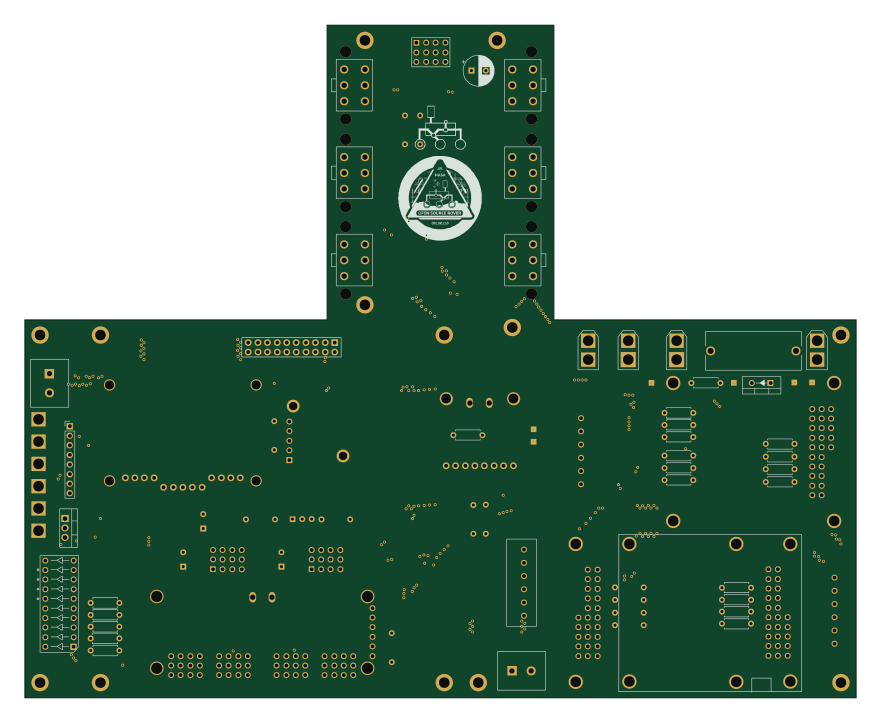 Raspberry Pi
Open source rover
nasa-jpl
220 × 178 mm144 parts2LApache-2.09.7k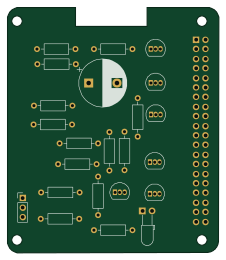 Raspberry Pi
Iot
dotnet
56 × 65 mm24 parts2LMIT2.4k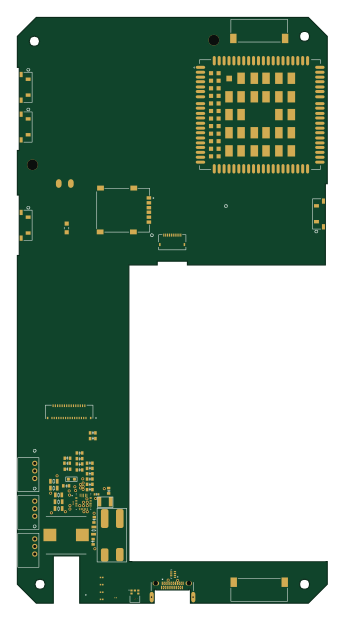 Raspberry Pi
SPIRIT
SPIRIT-org
82 × 155 mm130 parts6LCERN-OHL-S-2.01.3k Raspberry Pi
CM5RevEng
schlae
55 × 40 mm417 parts10LNo license1.0k Raspberry Pi
Haxo hw
cardonabits
102.4 × 211.3 mm38 parts2LCustom license672 Raspberry Pi
Phased
Neumi
75 × 100 mm71 parts2LNo license507