
Openprog aio

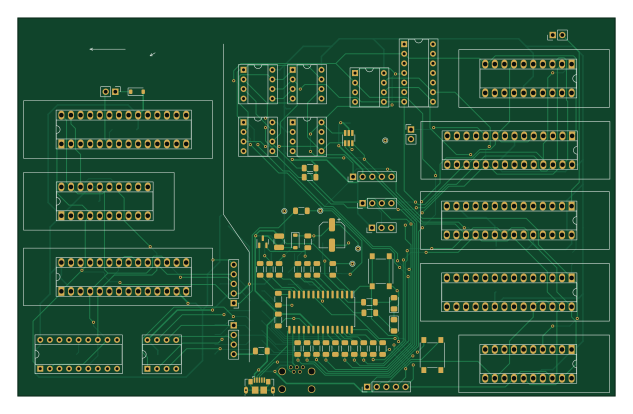
About the Openprog aio PCB
Openprog aio is an open source PIC PCB design by gordoste, published on GitHub under the GPL-3.0 license. It is a 2-layer board measuring 158 × 100 mm, with 110 components from 57 distinct parts.
Its main chip is the PIC18F25K50, from the PIC family. Other key parts include the AMS1117-3.3, uWire, 10F20x SOT-23, SPI and PIC12/16/18@5V 28p. By type, the board carries 37 resistors, 20 capacitors, 19 ICs, 11 diodes, 5 test points and 4 transistors.
It belongs with the usb & debug tools designs in this gallery.
From the project
All-in-one variant of Openprog PIC/AVR programmer
For low-voltage programming, the big advantage of this programmer over something like the MPLAB Snap is that it can provide power to the target device, and all of the surrounding circuitry (bypass caps, etc.) is built onto the board. You just plug in a device and program it.
The programmer is also fully capable of high-voltage programming. This is essential if you need to program an older device, and it also means you can use the MCLR pin as an extra I/O, which can be very handy on low-pin-count devices.
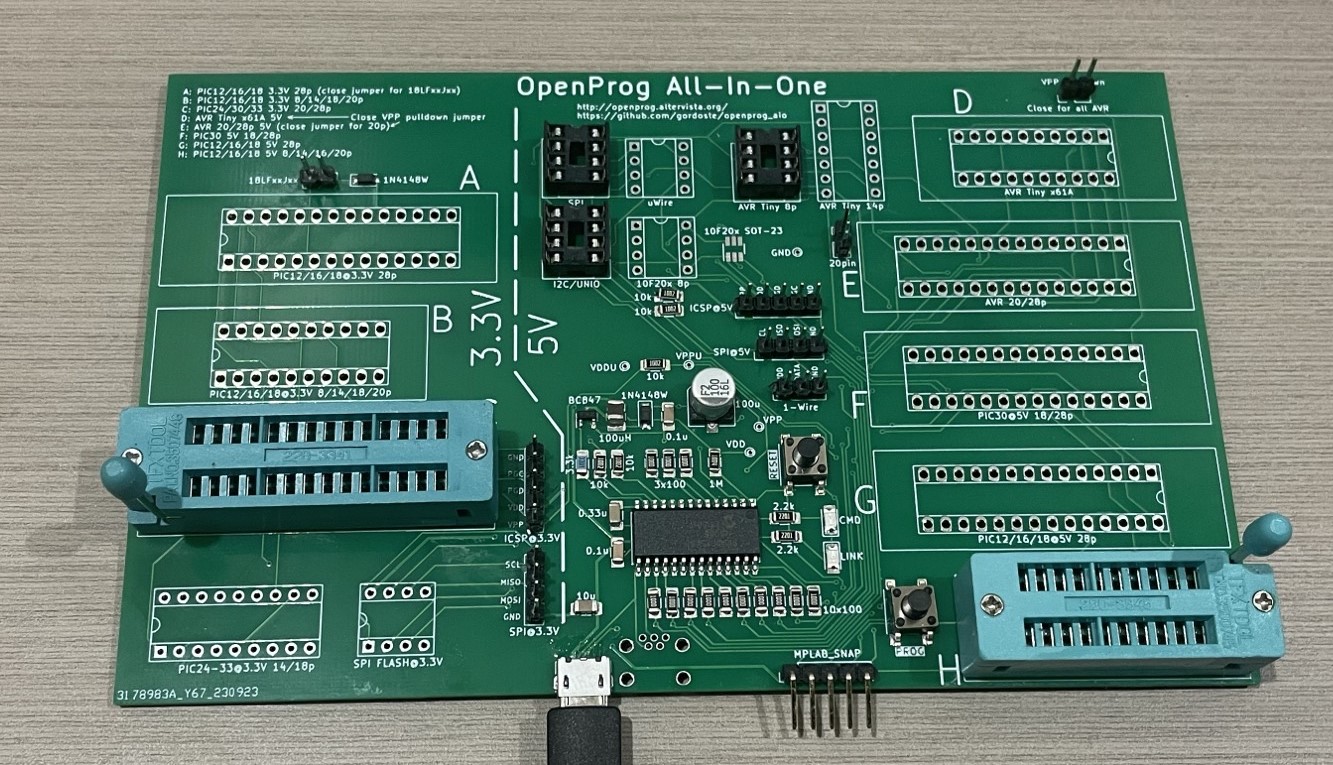
Main components on the Openprog aio
Openprog aio bill of materials (BOM)
110 components, 57 distinct parts.
| Qty | Part | Footprint | Refs |
|---|---|---|---|
| 1 | AMS1117-3.3 | SOT-223-3_TabPin2 | U1 |
| 1 | PIC18F25K50 | SOIC-28W_7.5x17.9mm_P1.27mm | U2 |
| 1 | uWire | DIP-8_W7.62mm_Socket | U3 |
| 1 | 10F20x SOT-23 | SOT-23-6_Handsoldering | U4 |
| 1 | SPI | DIP-8_W7.62mm_Socket | U6 |
| 1 | PIC12/16/18@5V 28p | ZIFSocket_28p_W7.62mm | U7 |
| 1 | I2C/UNIO | DIP-8_W7.62mm_Socket | U8 |
| 1 | PIC12/16/18@5V 8/14/16/20p | ZIFSocket_20p_W7.62mm | U9 |
| 1 | SPI FLASH@3.3V | DIP-8_W7.62mm_Socket | U10 |
| 1 | PIC12/16/18@3.3V 28p | ZIFSocket_28p_W7.62mm | U13 |
| 1 | PIC30@5V 18/28p | ZIFSocket_28p_W7.62mm | U14 |
| 1 | PIC12/16/18@3.3V 8/14/18/20p | ZIFSocket_20p_W7.62mm | U15 |
| 1 | AVR Tiny x61A | ZIFSocket_20p_W7.62mm | U16 |
| 1 | AVR 20/28p | ZIFSocket_28p_W7.62mm | U17 |
| 1 | PIC24-33@3.3V 14/18p | DIP-18_W7.62mm_Socket | U18 |
| 1 | AVR Tiny 8p | DIP-8_W7.62mm_Socket | U19 |
| 1 | AVR Tiny 14p | DIP-14_W7.62mm_Socket | U20 |
| 1 | PIC24-33@3.3V 20/28p | ZIFSocket_28p_W7.62mm | U22 |
| 1 | 10F20x 8p | DIP-8_W7.62mm_Socket | U23 |
| 2 | BC857 | SOT-23 | Q1, Q2 |
Show 37 more
| Qty | Part | Footprint | Refs |
|---|---|---|---|
| 2 | BC847 | SOT-23 | Q3, Q4 |
| 1 | 20pin | PinHeader_1x02_P2.54mm_Vertical | J1 |
| 1 | VPP pulldown | PinHeader_1x02_P2.54mm_Vertical | J2 |
| 1 | 18LFxxJxx | PinHeader_1x02_P2.54mm_Vertical | J3 |
| 1 | 1-Wire | PinHeader_1x03_P2.54mm_Vertical | CONN1 |
| 1 | USB_B_Micro | USB_Micro-B_GCT_USB3076-30-A | CONN1B1 |
| 1 | USB_B_Mini | USB_Mini_Type_B_Aliexpress | CONN1B2 |
| 1 | SPI@3.3V | PinHeader_1x04_P2.54mm_Vertical | CONN2 |
| 1 | MPLAB_SNAP | PinHeader_1x05_P2.54mm_Vertical | CONN3 |
| 1 | ICSP@5V | PinHeader_1x05_P2.54mm_Vertical | CONN4 |
| 1 | ICSP@3.3V | PinHeader_1x05_P2.54mm_Vertical | CONN5 |
| 1 | SPI@5V | PinHeader_1x04_P2.54mm_Vertical | CONN7 |
| 1 | RESET | SW_Push_1P1T_NO_6x6mm_2pads | S1 |
| 1 | PROG | SW_Push_1P1T_NO_6x6mm_4pads | S2 |
| 1 | VPPU | TestPoint_THTPad_D1.0mm_Drill0.5mm | TP1 |
| 1 | GND | TestPoint_THTPad_D1.0mm_Drill0.5mm | TP2 |
| 1 | VDD | TestPoint_THTPad_D1.0mm_Drill0.5mm | TP3 |
| 1 | VPP | TestPoint_THTPad_D1.0mm_Drill0.5mm | TP7 |
| 1 | VDDU | TestPoint_THTPad_D1.0mm_Drill0.5mm | TP8 |
| 9 | 1N4148W | D_SOD-123 | D1, D4, D5, D6, D7, D8, D9, D10 +1 |
| 1 | CMD | LED_1206_3216Metric_Pad1.42x1.75mm_HandSolder | D2 |
| 1 | LINK | LED_1206_3216Metric_Pad1.42x1.75mm_HandSolder | D3 |
| 1 | 100uH | L_1210_3225Metric_Pad1.42x2.65mm_HandSolder | L1 |
| 14 | 0.1u | C_1206_3216Metric_Pad1.33x1.80mm_HandSolder | C1, C3, C5, C6, C8, C9, C10, C11 +6 |
| 1 | 0.33u | C_1206_3216Metric_Pad1.33x1.80mm_HandSolder | C2 |
| 4 | 10u | C_1206_3216Metric_Pad1.33x1.80mm_HandSolder | C4, C16, C17, C19 |
| 1 | 100u | CP_Elec_6.3x5.7 | C7 |
| 2 | 330k | R_1206_3216Metric_Pad1.30x1.75mm_HandSolder | R1, R2 |
| 1 | 100k | R_1206_3216Metric_Pad1.30x1.75mm_HandSolder | R3 |
| 8 | 10k | R_1206_3216Metric_Pad1.30x1.75mm_HandSolder | R4, R23, R24, R26, R27, R28, R34, R37 |
| 1 | 1M | R_1206_3216Metric_Pad1.30x1.75mm_HandSolder | R5 |
| 13 | 100 | R_1206_3216Metric_Pad1.30x1.75mm_HandSolder | R6, R7, R8, R9, R10, R11, R12, R13 +5 |
| 1 | 22k | R_1206_3216Metric_Pad1.30x1.75mm_HandSolder | R14 |
| 1 | 12k | R_1206_3216Metric_Pad1.30x1.75mm_HandSolder | R15 |
| 2 | 2.2k | R_1206_3216Metric_Pad1.30x1.75mm_HandSolder | R21, R25 |
| 1 | 3.3k | R_1206_3216Metric_Pad1.30x1.75mm_HandSolder | R22 |
| 7 | 1k | R_1206_3216Metric_Pad1.30x1.75mm_HandSolder | R29, R30, R31, R32, R33, R35, R36 |
Openprog aio design files
The KiCad project lives in the gordoste/openprog_aio repository on GitHub; these links point at the commit this page was built from.
- Layoutoprog.kicad_pcb
- Schematicoprog.kicad_sch
Openprog aio: common questions
What microcontroller does the Openprog aio use?
The Openprog aio is built around the PIC18F25K50, from the PIC family.
How big is the Openprog aio PCB?
The Openprog aio measures 158 × 100 mm, has 2 copper layers and is 1.6 mm thick.
How many components are on the Openprog aio?
110 components, from 57 distinct parts. The full bill of materials is listed on this page.
Where can I download the Openprog aio design files?
From the gordoste/openprog_aio repository on GitHub, which has the KiCad layout and the schematic; the links under Design files point to each one.
Can I use the Openprog aio design in my own project?
Yes, under the terms of its GPL-3.0 license, which gordoste chose for the repository.
Can I test firmware for the Openprog aio without the hardware?
Yes. HardLabs builds a simulation of the board from its netlist and BOM, so you can run and debug PIC firmware against it before you order a PCB.
Similar boards
 PIC
PICPslab hardware
fossasia
99 × 53.3 mm187 parts4LApache-2.01.7k PIC
PICMicro 8088
skiselev
152.4 × 101.6 mm71 partsGPL-3.0414 PIC
PICGB-CARTPP-DIY
Gekkio
100 × 100 mm22 parts2LCC-BY-4.0376 PIC
PICGB-BENCH-G1
100 × 100 mm98 parts4LCC-BY-4.0376 PIC
PICGB-MBCTEST
51.4 × 61 mm32 parts2LCC-BY-4.0376 PIC
PICGB-LIVE32
51.4 × 61 mm46 parts4LCC-BY-4.0376