
GB-LIVE32

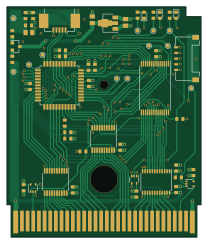
About the GB-LIVE32 PCB
GB-LIVE32 is an open source PIC PCB design by Gekkio, published on GitHub under the CC-BY-4.0 license. It is a 4-layer board measuring 51.4 × 61 mm, with 46 components from 21 distinct parts.
Its main chip is the PIC18LF45K50-I/PT, from the PIC family. Other key parts include the MCP1703T-3302E/MB, IS61LV256AL-10TLI, 74LVC1G32GW,125, 74LVC8T245PW,118 and 74LVC245APW,118. By type, the board carries 18 capacitors, 10 resistors, 9 ICs, 4 diodes, 2 connectors and 2 fuses.
It belongs with the retro computing designs in this gallery.
From the project
Game Boy -related custom hardware by gekkio
Supports both PIC18F45K50 and PIC18LF45K50. If you use the LF version, you must populate the zero-ohm resistor to supply VUSB3V3. If you use the F version, you must not populate the zero-ohm resistor. All bus transceivers should be normal versions (without H in the part name. The GB CPU has pullups on data and address buses so they never float completely. The crude BAT54C-based power source switching probably draws power from the Game Boy even when USB is connected. Indicator LEDs use resistors with high values to minimize power consumption. If the LEDs don't work, use lower values (e.g. 1k).…
Main components on the GB-LIVE32
GB-LIVE32 bill of materials (BOM)
46 components, 21 distinct parts — part numbers from the project's BOM.
| Qty | Part | Footprint | Refs |
|---|---|---|---|
| 1 | MCP1703T-3302E/MB MCP1703A-3302_SOT89 Microchip | SOT-89-3 | U1 |
| 1 | PIC18LF45K50-I/PT PIC18LF45K50_QFP Microchip | TQFP-44_10x10mm_P0.8mm | U2 |
| 1 | IS61LV256AL-10TLI IS61LV256AL-10T ISSI | TSOP-I-28_11.8x8mm_P0.55mm_Pin1Middle | U3 |
| 2 | 74LVC1G32GW,125 74LVC1G32 Nexperia | SOT-353_SC-70-5 | U4, U8 |
| 1 | 74LVC8T245PW,118 74LVC8T245PW Nexperia | TSSOP-24_4.4x7.8mm_P0.65mm | U5 |
| 2 | 74LVC245APW,118 74LVC245APW Nexperia | TSSOP-20_4.4x6.5mm_P0.65mm | U6, U7 |
| 1 | 74LVC1G07GW,125 74LVC1G07 Nexperia | SOT-353_SC-70-5 | U9 |
| 1 | 504050-0591 Conn_01x05 Molex | Molex_Pico-Lock_504050-0591_1x05-1MP_P1.50mm_Horizontal | J1 |
| 1 | UX60SC-MB-5ST(80) USB_B_Mini Hirose | USB_Mini-B_Hirose_UX60SC-MB-5ST80_Horizontal | J2 |
| 2 | C2Q 1.5 Fuse Bel Fuse | Fuse_0603_1608Metric | F1, F2 |
| 1 | BAT54CLT3G BAT54C OnSemi | SOT-23 | D1 |
| 1 | 150060SS75000 LED_R Wurth Electronics | LED_0603_1608Metric | D2 |
| 2 | 150060YS75000 LED_Y Wurth Electronics | LED_0603_1608Metric | D3, D4 |
| 1 | MMZ1608Y601BTD25 Ferrite_Bead TDK | L_0603_1608Metric | L1 |
| 3 | EMK212BJ475MD-T 4.7uF Taiyo Yuden | C_0805_2012Metric | C1, C3, C11 |
| 1 | C0603C474K4PACTU 0.47uF KEMET | C_0603_1608Metric | C2 |
| 14 | C0603C104K3RECTU 0.1uF KEMET | C_0603_1608Metric | C4, C5, C6, C7, C8, C9, C10, C12 +6 |
| 3 | RC0603JR-133K3L 3.3k Yageo | R_0603_1608Metric | R1, R4, R5 |
| 5 | RC0603FR-0710KL 10k Yageo | R_0603_1608Metric | R2, R3, R7, R8, R9 |
| 1 | RC0603FR-10470RL 470 Yageo | R_0603_1608Metric | R6 |
Show 1 more
| Qty | Part | Footprint | Refs |
|---|---|---|---|
| 1 | RC0603JR-070RL 0 Yageo | R_0603_1608Metric | R10 |
GB-LIVE32 design files
The KiCad project lives in the Gekkio/gb-hardware repository on GitHub; these links point at the commit this page was built from.
GB-LIVE32: common questions
What microcontroller does the GB-LIVE32 use?
The GB-LIVE32 is built around the PIC18LF45K50-I/PT, from the PIC family.
How big is the GB-LIVE32 PCB?
The GB-LIVE32 measures 51.4 × 61 mm, has 4 copper layers and is 1 mm thick.
How many components are on the GB-LIVE32?
46 components, from 21 distinct parts, with part numbers taken from the project's own BOM. The full bill of materials is listed on this page.
Where can I download the GB-LIVE32 design files?
From the Gekkio/gb-hardware repository on GitHub, which has the KiCad layout, the schematic and the BOM; the links under Design files point to each one.
Can I use the GB-LIVE32 design in my own project?
Yes, under the terms of its CC-BY-4.0 license, which Gekkio chose for the repository.
Can I test firmware for the GB-LIVE32 without the hardware?
Yes. HardLabs builds a simulation of the board from its netlist and BOM, so you can run and debug PIC firmware against it before you order a PCB.
More boards in gb-hardware
 PIC
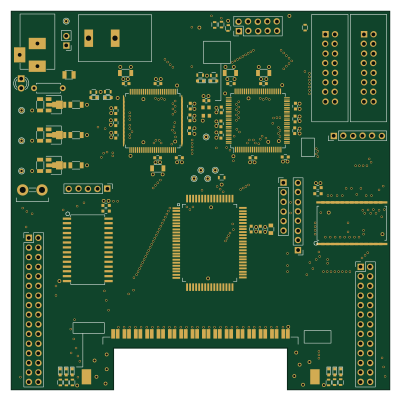
PICGB-BENCH-G1
100 × 100 mm98 parts4LCC-BY-4.0376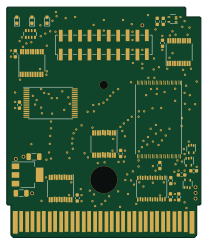 PIC
PICGB-MBCTEST
51.4 × 61 mm32 parts2LCC-BY-4.0376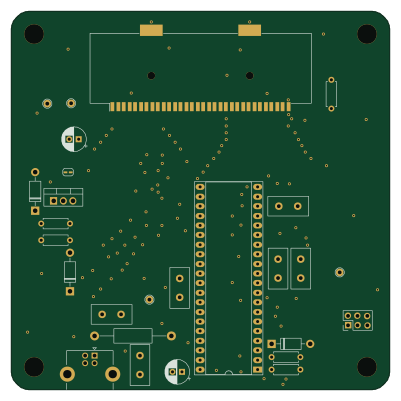 PIC
PICGB-CARTPP-DIY
100 × 100 mm22 parts2LCC-BY-4.0376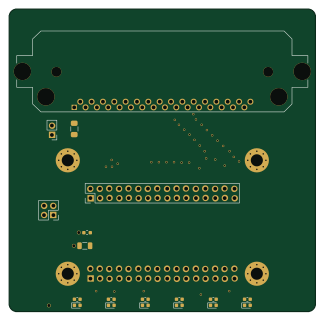
GB-BRK-SLOT-A
81 × 80 mm20 parts2LCC-BY-4.0376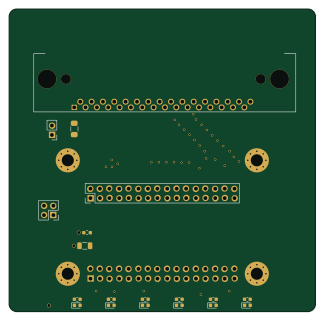
GB-BRK-SLOT-B
81 × 80 mm20 parts2LCC-BY-4.0376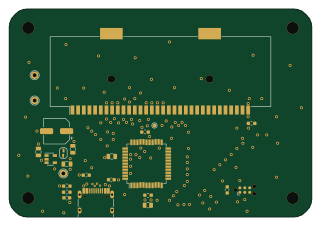 PIC
PICGB-CARTPP-XC
80 × 55 mm19 parts2LCC-BY-4.0376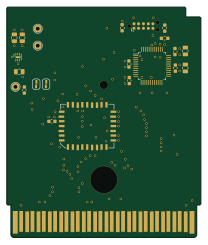 PIC
PICGB-CART256K-A
51.4 × 61 mm17 parts2LCC-BY-4.0376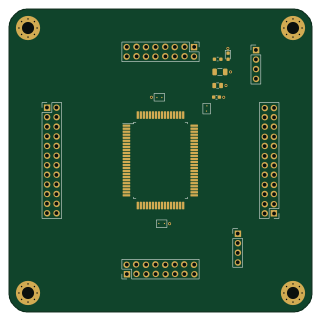
GB-BRK-CPU-G2
80 × 80 mm12 parts2LCC-BY-4.0376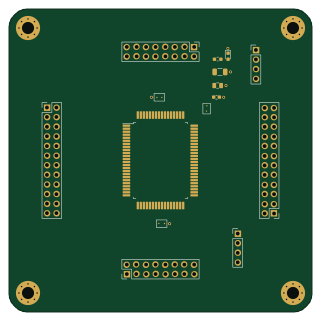
GB-BRK-CPU-G1
80 × 80 mm12 parts2LCC-BY-4.0376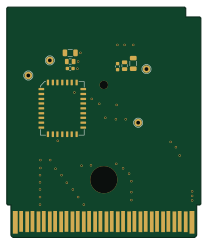
GB-CART32K-A
51.4 × 61 mm7 parts2LCC-BY-4.0376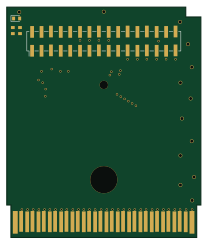
GB-BRK-CART
51.4 × 61 mm4 parts2LCC-BY-4.0376
Similar boards
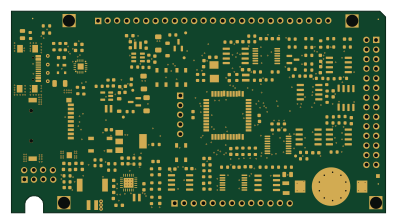 PIC
PICPslab hardware
fossasia
99 × 53.3 mm187 parts4LApache-2.01.7k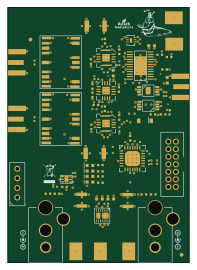 PIC
PICDiffprobe calibrated prototype
azonenberg
48 × 67.5 mm104 parts4LBSD-3-Clause193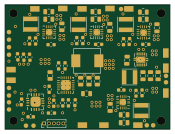 PIC
PICRVL-PMS HW2
Gmanmodz
43.6 × 32.9 mm88 parts4LNo license77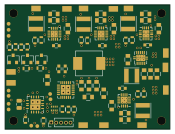 PIC
PICWii reg
43.6 × 32.9 mm82 parts4LNo license77 PIC
PIC12v automatic ups
dilshan
131.8 × 99.9 mm72 parts2LMIT49 PIC
PICADBDB
demik
100 × 50 mm34 parts2LCERN-OHL-P-2.027