
Compact

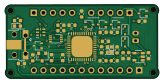
About the Compact PCB
Compact is an open source STM32 PCB design by jgillick, published on GitHub under the MIT license. It is a 2-layer board measuring 40.8 × 19.6 mm, with 54 components from 27 distinct parts.
Its main chip is the STM32F411CEU6, from the STM32 family. Other key parts include the AP2210N-3.3TRG1, MCP73831T-2ACI/OT, ESD7002WTT1G and GD25Q16CEIGR. By type, the board carries 15 capacitors, 13 resistors, 9 diodes, 5 ICs, 5 connectors and 4 transistors.
It belongs with the power & battery designs in this gallery.
From the project
A self-contained microcontroller, battery, and power management system that fits in your pocket.
A kick-ass microcontroller board with everything you need in a tiny package that fits in your pocket. Integrated battery & power management system, fast ARM microcontroller, USB bootloader, 4 high-power PWM outputs, 12 GPIOs, satisfying pushbutton switch, and more.
After years of wiring together portable LED controllers that all consisted of a lithium battery, charge controller, shitty slide power switch, and an Arduino nano (or similar), I wanted something better. I always found those versions to be janky and fragile -- not to mention concerned that damaging the pouch cell battery might…
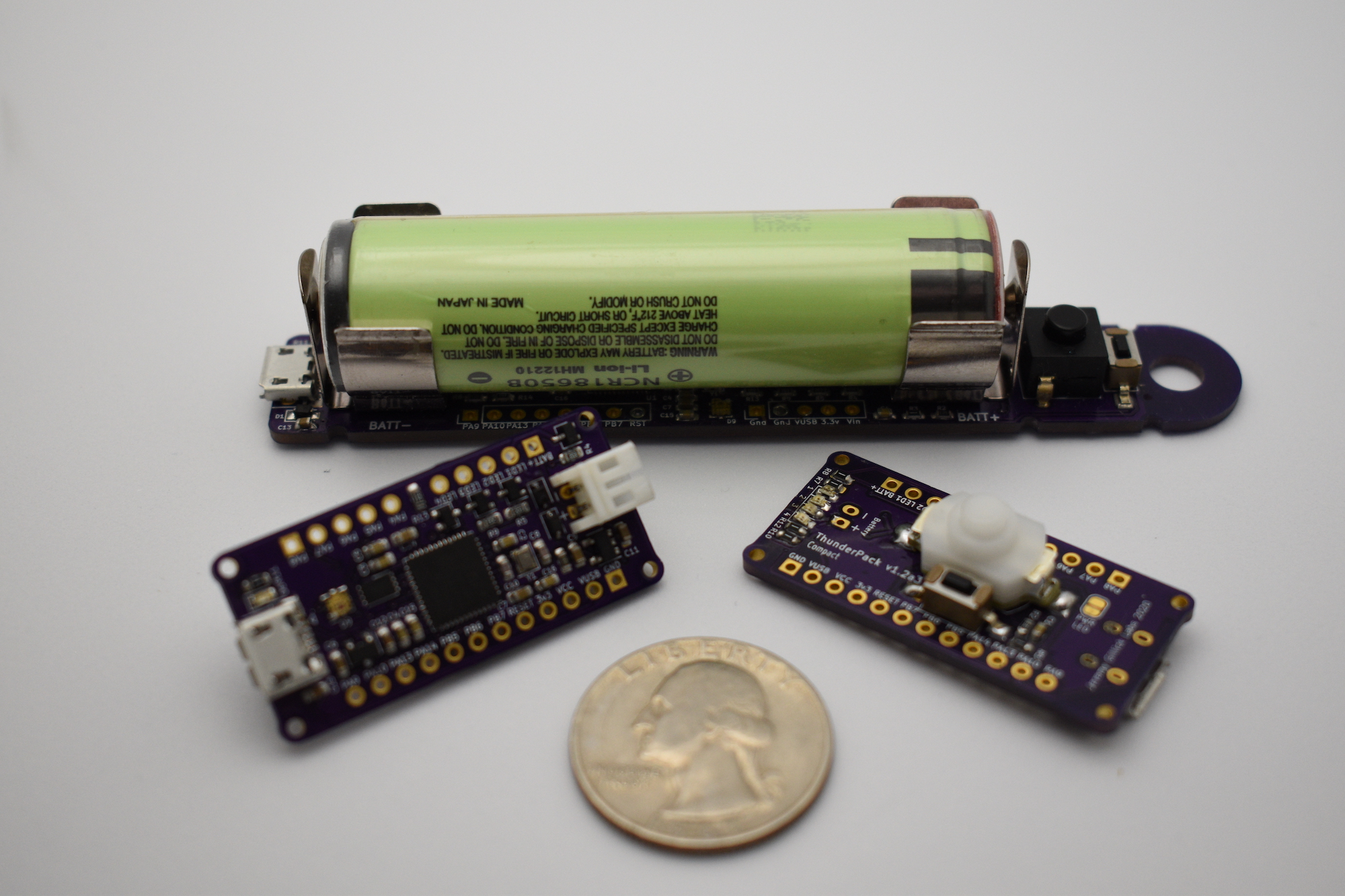
Main components on the Compact
Compact bill of materials (BOM)
54 components, 27 distinct parts — part numbers from the project's BOM.
| Qty | Part | Footprint | Refs |
|---|---|---|---|
| 1 | STM32F411CEU6 STM32F411CE STMicroelectronics | QFN-48-1EP_7x7mm_P0.5mm_EP5.6x5.6mm | U1 |
| 1 | AP2210N-3.3TRG1 Diodes Incorporated | SOT-23 | U2 |
| 1 | MCP73831T-2ACI/OT MCP73831T-2ACI_OT Microchip Technology | SOT-23-5 | U3 |
| 1 | ESD7002WTT1G ON Semiconductor | SOT-323_SC-70 | U4 |
| 1 | GD25Q16CEIGR GigaDevice Semiconductor | DFN-8-1EP_3x2mm_P0.5mm_EP1.3x1.5mm | U5 |
| 4 | BSS816NWH6327XTSA1 BSS806N Infineon Technologies | SOT-323_SC-70 | Q1, Q2, Q3, Q4 |
| 1 | 24MHZ 24Mhz XRCGB24M000F0L00R0 | Crystal_SMD_2016-4Pin_2.0x1.6mm | Y1 |
| 1 | 440055-2 Battery TE Connectivity | JST_PH_S2B-PH-K_1x02_P2.00mm_Horizontal | J2 |
| 1 | GPIO | PinHeader_1x05_P2.54mm_Vertical | J3 |
| 1 | 10103594-0001LF USB_B_Micro Amphenol ICC (FCI) | USB_Micro-B_Amphenol_10103594-0001LF_Horizontal | J4 |
| 1 | LEDs | PinHeader_1x05_P2.54mm_Vertical | J6 |
| 1 | GPIO | PinHeader_1x12_P2.54mm_Vertical | J7 |
| 1 | Mode | SW_SPST_FSMSM | SW1 |
| 1 | Power | SW_KAN-15_SMD | SW2 |
| 2 | SMD22WS-TP 20V2A Micro Commercial Co | D_SOD-323 | D1, D2 |
| 1 | 150060BS55040 LED Würth Elektronik | LED_0603_1608Metric_Castellated | D3 |
| 4 | 150060VS75000 LED Würth Elektronik | LED_0603_1608Metric | D4, D5, D7, D8 |
| 1 | 150060SS75000 LED Würth Elektronik | LED_0603_1608Metric | D6 |
| 1 | APA102-2020 SparkFun Electronics | LED-APA102-2020 | D9 |
| 5 | 100NF 100nF | C_0603_1608Metric | C1, C3, C4, C5, C16 |
Show 7 more
| Qty | Part | Footprint | Refs |
|---|---|---|---|
| 3 | 1UF 1uF | C_0603_1608Metric | C2, C6, C13 |
| 4 | 4.7UF 4.7uF | C_0603_1608Metric | C7, C9, C11, C14 |
| 2 | 6PF 6pF | C_0603_1608Metric | C8, C10 |
| 1 | 2.2UF 2.2uF | C_0603_1608Metric | C12 |
| 7 | 330 | R_0603_1608Metric | R1, R3, R7, R8, R10, R11, R12 |
| 5 | 20K 20k | R_0603_1608Metric | R2, R4, R5, R9, R13 |
| 1 | 2k | R_0603_1608Metric | R6 |
Compact design files
The KiCad project lives in the jgillick/ThunderPack repository on GitHub; these links point at the commit this page was built from.
Compact: common questions
What microcontroller does the Compact use?
The Compact is built around the STM32F411CEU6, from the STM32 family.
How big is the Compact PCB?
The Compact measures 40.8 × 19.6 mm, has 2 copper layers and is 1.6 mm thick.
How many components are on the Compact?
54 components, from 27 distinct parts, with part numbers taken from the project's own BOM. The full bill of materials is listed on this page.
Where can I download the Compact design files?
From the jgillick/ThunderPack repository on GitHub, which has the KiCad layout and the BOM; the links under Design files point to each one.
Can I use the Compact design in my own project?
Yes, under the terms of its MIT license, which jgillick chose for the repository.
Can I test firmware for the Compact without the hardware?
Yes. HardLabs builds a simulation of the board from its netlist and BOM, so you can run and debug STM32 firmware against it before you order a PCB.
More boards in ThunderPack
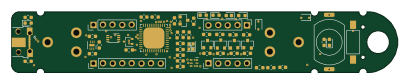
Similar boards
 STM32
STM32LumenPnP Motherboard
opulo-inc
149 × 95 mm296 parts4LCC-BY-SA-4.03.7k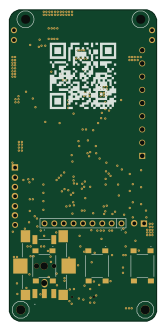 STM32
STM32AxxSolder
AxxAxx
39 × 82.5 mm122 parts2LGPL-3.01.7k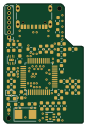 STM32
STM32AIOC
skuep
21 × 31.5 mm47 parts2LMIT1.4k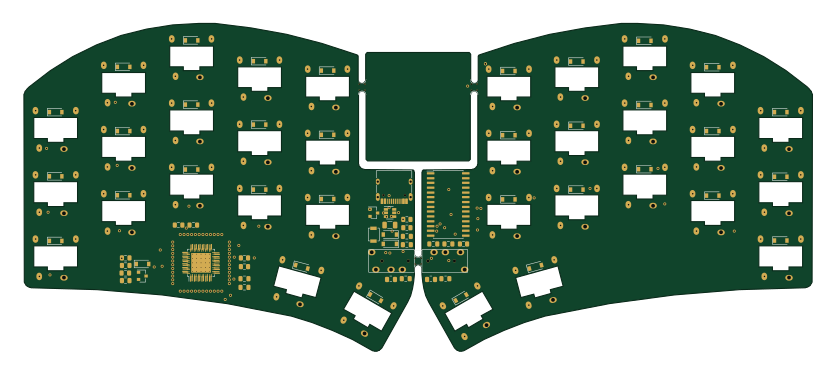 STM32
STM32Ferris
pierrechevalier83
208.8 × 86.8 mm102 parts2LSHL-2.11.3k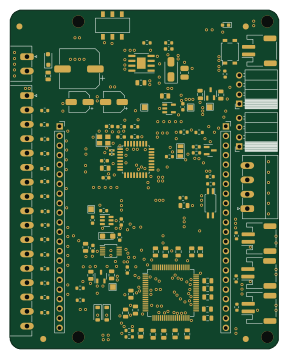 STM32
STM32Module 16S
stuartpittaway
71.1 × 89.6 mm113 parts4LCC-BY-NC-4.01.1k STM32
STM32Djinn
tzarc
192.3 × 150.5 mm216 parts2LCERN-OHL-S-2.0988