
HapticESP32

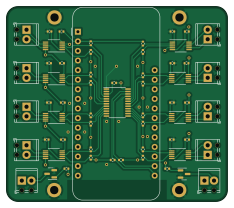
About the HapticESP32 PCB
HapticESP32 is an open source PCB design by MartinWeigel, published on GitHub. It is a 4-layer board measuring 58.4 × 51.5 mm, with 59 components from 17 distinct parts.
Other key parts include the TCA9548APWR, DRV2605LDGS and Feather_HUZZAH32. By type, the board carries 29 resistors, 10 connectors, 9 ICs, 8 capacitors, 2 transistors and 1 module.
From the project
Haptic driver PCB for the Adafruit HUZZAH32 microcontroller
This PCB provides a maximum of eight ERM/LRA drivers and two transistors to control binary actuators. All haptic actuators can be controlled through an Adafruit Feather HUZZAH32 microcontroller.
All SMDs are on one-side of the PCB only to reduce costs for the assembly service.
This board was designed using KiCad 6.0.
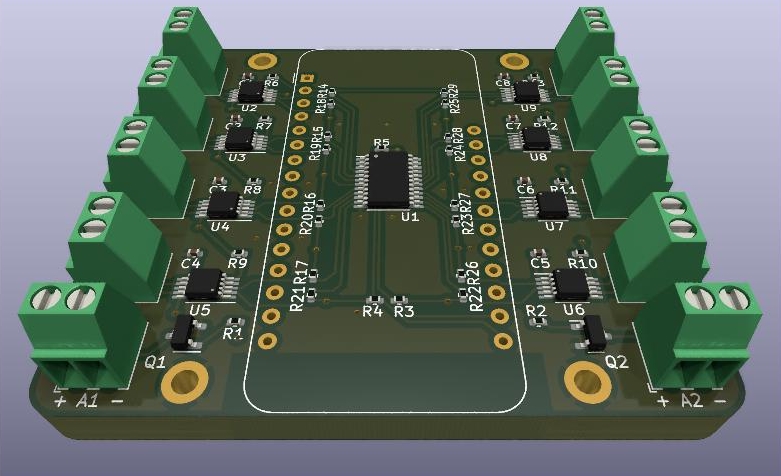
Main components on the HapticESP32
HapticESP32 bill of materials (BOM)
59 components, 17 distinct parts.
| Qty | Part | Footprint | Refs |
|---|---|---|---|
| 1 | TCA9548APWR | TSSOP-24_4.4x7.8mm_P0.65mm | U1 |
| 8 | DRV2605LDGS | VSSOP-10_3x3mm_P0.5mm | U2, U3, U4, U5, U6, U7, U8, U9 |
| 1 | Feather_HUZZAH32 | Adafruit_Feather | A1 |
| 2 | MMBT5550L | SOT-23 | Q1, Q2 |
| 1 | + A1 - | TerminalBlock_Phoenix_MPT-0,5-2-2.54_1x02_P2.54mm_Horizontal | J1 |
| 1 | + A2 - | TerminalBlock_Phoenix_MPT-0,5-2-2.54_1x02_P2.54mm_Horizontal | J2 |
| 1 | V0* | TerminalBlock_Phoenix_MPT-0,5-2-2.54_1x02_P2.54mm_Horizontal | J3 |
| 1 | V1 | TerminalBlock_Phoenix_MPT-0,5-2-2.54_1x02_P2.54mm_Horizontal | J4 |
| 1 | V2 | TerminalBlock_Phoenix_MPT-0,5-2-2.54_1x02_P2.54mm_Horizontal | J5 |
| 1 | V3 | TerminalBlock_Phoenix_MPT-0,5-2-2.54_1x02_P2.54mm_Horizontal | J6 |
| 1 | V4 | TerminalBlock_Phoenix_MPT-0,5-2-2.54_1x02_P2.54mm_Horizontal | J7 |
| 1 | V5 | TerminalBlock_Phoenix_MPT-0,5-2-2.54_1x02_P2.54mm_Horizontal | J8 |
| 1 | V6 | TerminalBlock_Phoenix_MPT-0,5-2-2.54_1x02_P2.54mm_Horizontal | J9 |
| 1 | V7* | TerminalBlock_Phoenix_MPT-0,5-2-2.54_1x02_P2.54mm_Horizontal | J10 |
| 8 | 1uF | C_0402_1005Metric | C1, C2, C3, C4, C5, C6, C7, C8 |
| 2 | 1k | R_0402_1005Metric | R1, R2 |
| 27 | 4.7k | R_0402_1005Metric | R3, R4, R5, R6, R7, R8, R9, R10 +19 |
HapticESP32 design files
The KiCad project lives in the MartinWeigel/HapticESP32 repository on GitHub; these links point at the commit this page was built from.
- LayoutHapticESP32.kicad_pcb
- SchematicHapticESP32.kicad_sch
HapticESP32: common questions
How big is the HapticESP32 PCB?
The HapticESP32 measures 58.4 × 51.5 mm, has 4 copper layers and is 4.69 mm thick.
How many components are on the HapticESP32?
59 components, from 17 distinct parts. The full bill of materials is listed on this page.
Where can I download the HapticESP32 design files?
From the MartinWeigel/HapticESP32 repository on GitHub, which has the KiCad layout and the schematic; the links under Design files point to each one.
Can I use the HapticESP32 design in my own project?
The repository has no license, so all rights stay with MartinWeigel. Use it as a reference, and ask the author before reusing the design.