
GlitchBob-LPC

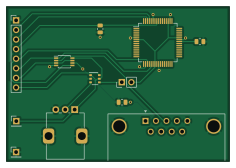
About the GlitchBob-LPC PCB
GlitchBob-LPC is an open source NXP PCB design by parasyte, published on GitHub under the MIT license. It is a 2-layer board measuring 58.9 × 40.9 mm, with 11 components from 8 distinct parts.
Its main chip is the LPC2142FBD64, from the NXP family. Other key parts include the 74LVC2G66 and 74LVC1G3157. By type, the board carries 3 ICs, 3 connectors, 3 resistors and 1 jumper.
It belongs with the test & measurement designs in this gallery.
From the project
Voltage glitching automation tool to break protection on NXP LPC microcontrollers.
Voltage glitching automation tool to break protection on NXP LPC microcontrollers.
The glitch circuit can be controlled by a Raspberry Pi Pico or other low-cost development board.
These are issues identified in the prototype:
- Add bypass caps to all ICs. - Add pull-up resistor to 74LVC1G3157 switch input. - Add pull-down resistors to 74LVC2G66 switch inputs. - Move target closer to I/O header to reduce the trace length for the oscillator I/O. - Shorter traces have lower impedance and will be capable of faster clock frequency (up to target max, e.g. 12 MHz). - The potentiometer polarity is…
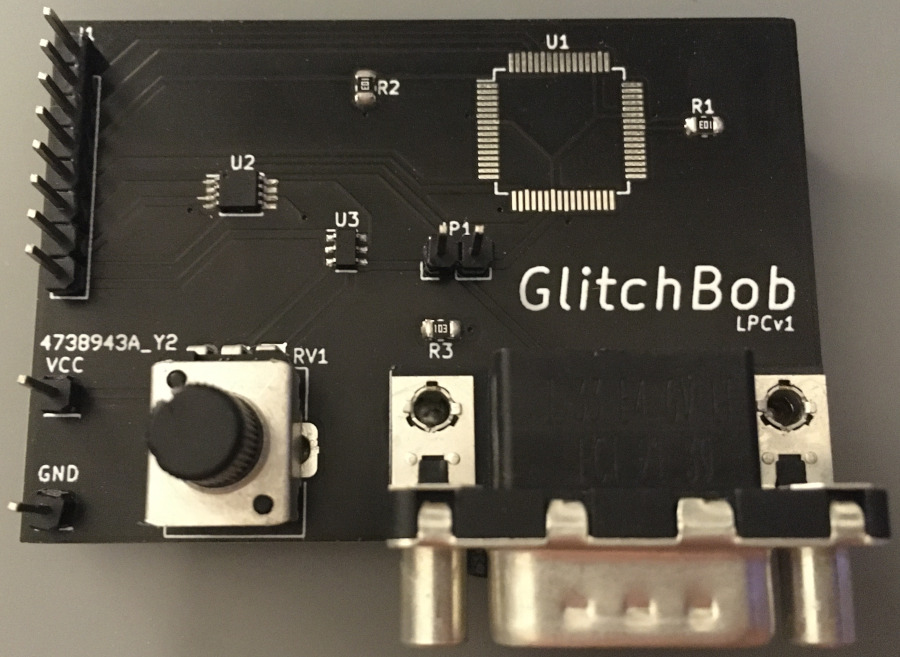
Main components on the GlitchBob-LPC
GlitchBob-LPC bill of materials (BOM)
11 components, 8 distinct parts.
| Qty | Part | Footprint | Refs |
|---|---|---|---|
| 1 | LPC2142FBD64 | LQFP-64_10x10mm_P0.5mm | U1 |
| 1 | 74LVC2G66 | TSSOP-8_3x3mm_P0.65mm | U2 |
| 1 | 74LVC1G3157 | TSOP-6_1.65x3.05mm_P0.95mm | U3 |
| 1 | Conn_02x04_Odd_Even | PinHeader_1x08_P2.54mm_Vertical | J1 |
| 2 | Conn_01x01 | PinHeader_1x01_P2.54mm_Vertical | J3, J4 |
| 1 | Jumper_2_Bridged | PinHeader_1x02_P2.54mm_Vertical | JP1 |
| 1 | 10K Ohm | Potentiometer_Alps_RK09K_Single_Vertical | RV1 |
| 3 | 10K Ohm | R_0805_2012Metric | R1, R2, R3 |
GlitchBob-LPC design files
The KiCad project lives in the parasyte/GlitchBob-LPC repository on GitHub; these links point at the commit this page was built from.
- Layoutboard/GlitchBob LPC.kicad_pcb
- Schematicboard/GlitchBob LPC.kicad_sch
GlitchBob-LPC: common questions
What microcontroller does the GlitchBob-LPC use?
The GlitchBob-LPC is built around the LPC2142FBD64, from the NXP family.
How big is the GlitchBob-LPC PCB?
The GlitchBob-LPC measures 58.9 × 40.9 mm, has 2 copper layers and is 1.6 mm thick.
How many components are on the GlitchBob-LPC?
11 components, from 8 distinct parts. The full bill of materials is listed on this page.
Where can I download the GlitchBob-LPC design files?
From the parasyte/GlitchBob-LPC repository on GitHub, which has the KiCad layout and the schematic; the links under Design files point to each one.
Can I use the GlitchBob-LPC design in my own project?
Yes, under the terms of its MIT license, which parasyte chose for the repository.
Can I test firmware for the GlitchBob-LPC without the hardware?
Yes. HardLabs builds a simulation of the board from its netlist and BOM, so you can run and debug NXP firmware against it before you order a PCB.
Similar boards
 NXP
32Bit shift register
MaltWhiskey
100 × 54 mm56 parts4LNo license763 NXP
Mega-Cube-Board
200 × 54 mm100 parts4LNo license763 NXP
MCL6809
MicroCoreLabs
32.3 × 61 mm7 parts4LNo license532 NXP
MCL68
31.6 × 84.1 mm13 parts4LNo license532 NXP
MCL65+
72.6 × 64.1 mm6 parts2LNo license532 NXP
MCLZ8
37.1 × 61.5 mm6 parts4LNo license532