
Dancing duck

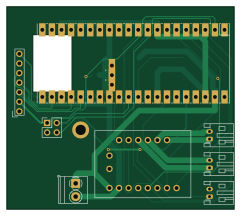
About the Dancing duck PCB
Dancing duck is an open source RP2040/RP2350 PCB design by Ponderosa, published on GitHub under the MIT license. It is a 2-layer board measuring 60.2 × 53.6 mm, with 12 components from 10 distinct parts.
Its main chip is the RPi_Pico_SMD_W, from the RP2040/RP2350 family. By type, the board carries 5 connectors, 3 ICs, 3 resistors and 1 capacitor.
It belongs with the iot & wireless designs in this gallery.
From the project
Bumbershoot 2024
This repo contains all software and tools for the Dancing Duck installation (title subject to change) for the Bumbershoot 2024 Festival.
- Duck Firmware (Foundational work complete - RTOS, WiFi, MQTT Messaging, JSON interpretation, and Motor Control) - Coordinator (Mosquitto is functionally passing motor command messages to duck) - Monitor (No progress)
The design consists of ~20 motorized ducks that can be controlled to perform coordinated dance moves in the water. The ducks are decoys with an RC hobby boat mounted to the bottom. There are two DC brushed motor, each attached to a…
Dancing duck bill of materials (BOM)
12 components, 10 distinct parts.
| Qty | Part | Footprint | Refs |
|---|---|---|---|
| 1 | ~ | RPi_Pico_SMD_W | U1 |
| 1 | ~ | drv8833_breakout | U2 |
| 1 | ~ | lis2mdl_breakout | U3 |
| 3 | Conn_01x02 | JST_PH_S2B-PH-K_1x02_P2.00mm_Horizontal | J1, J2, J4 |
| 1 | Conn_01x02 | TerminalBlock_Phoenix_PT-1,5-2-3.5-H_1x02_P3.50mm_Horizontal | J3 |
| 1 | Conn_02x02_Counter_Clockwise | PinHeader_2x02_P2.54mm_Vertical | J5 |
| 1 | 1000pf | C_1206_3216Metric_Pad1.33x1.80mm_HandSolder | C1 |
| 1 | 220k | R_1206_3216Metric_Pad1.30x1.75mm_HandSolder | R1 |
| 1 | 330k | R_1206_3216Metric_Pad1.30x1.75mm_HandSolder | R2 |
| 1 | 0 DNP | SolderJumper-2_P1.3mm_Open_TrianglePad1.0x1.5mm | R3 |
Dancing duck design files
The KiCad project lives in the Ponderosa/dancing_duck repository on GitHub; these links point at the commit this page was built from.
Dancing duck: common questions
What microcontroller does the Dancing duck use?
The Dancing duck is built around the RPi_Pico_SMD_W, from the RP2040/RP2350 family.
How big is the Dancing duck PCB?
The Dancing duck measures 60.2 × 53.6 mm, has 2 copper layers and is 1.6 mm thick.
How many components are on the Dancing duck?
12 components, from 10 distinct parts. The full bill of materials is listed on this page.
Where can I download the Dancing duck design files?
From the Ponderosa/dancing_duck repository on GitHub, which has the KiCad layout and the schematic; the links under Design files point to each one.
Can I use the Dancing duck design in my own project?
Yes, under the terms of its MIT license, which Ponderosa chose for the repository.
Can I test firmware for the Dancing duck without the hardware?
Yes. HardLabs builds a simulation of the board from its netlist and BOM, so you can run and debug RP2040/RP2350 firmware against it before you order a PCB.
Similar boards
 RP2040/RP2350
Open Book Abridged Edition
joeycastillo
85 × 115 mm29 parts2LCC-BY-SA-4.08.1k RP2040/RP2350
Corne
foostan
277.2 × 107.5 mm164 parts2LCC-BY-4.07.7k RP2040/RP2350
Corne
277.2 × 107.5 mm164 parts2LCC-BY-4.07.7k RP2040/RP2350
Jitx design
gusmanb
55.5 × 65 mm26 parts4LGPL-3.05.0k RP2040/RP2350
LogicAnalyzer
57 × 55.2 mm6 parts2LGPL-3.05.0k RP2040/RP2350
Main
google
98 × 71 mm102 parts2LApache-2.02.9k