
Intelligence factory hardware assessment

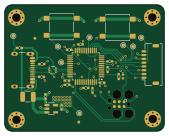
About the Intelligence factory hardware assessment PCB
Intelligence factory hardware assessment is an open source STM32 PCB design by shreyashswarnkar210205, published on GitHub. It is a 4-layer board measuring 42.1 × 33.4 mm, with 26 components from 15 distinct parts.
Its main chip is the STM32H503CBT6, from the STM32 family. Other key parts include the USBLC6-2P6, BMI270 and AP2112K-3.3TRG1. By type, the board carries 12 capacitors, 5 resistors, 4 ICs, 3 connectors, 1 fuse and 1 diode.
It belongs with the sensors designs in this gallery.
From the project
Submission for the Intelligence Factory Hardware Assessment featuring a USB-C STM32H503-based IMU acquisition platform with a remote BMI270 fingertip sensor PCB, along with a complete analog front-end design for a piezoelectric contact microphone, including LTspice verification and engineering documentation.
This repository contains the PCB design for Part 1 of the Intelligence Factory Hardware Assessment.
The objective was to design a compact embedded system capable of acquiring inertial data from a remote fingertip-mounted IMU over SPI while communicating with a host PC through USB-C. The design is split into two PCBs:
- Board A – Main controller board containing the MCU, USB interface, power supply, debug interface and sensor connector. - Board B – Compact fingertip sensor board containing the IMU and JST-SH connector.
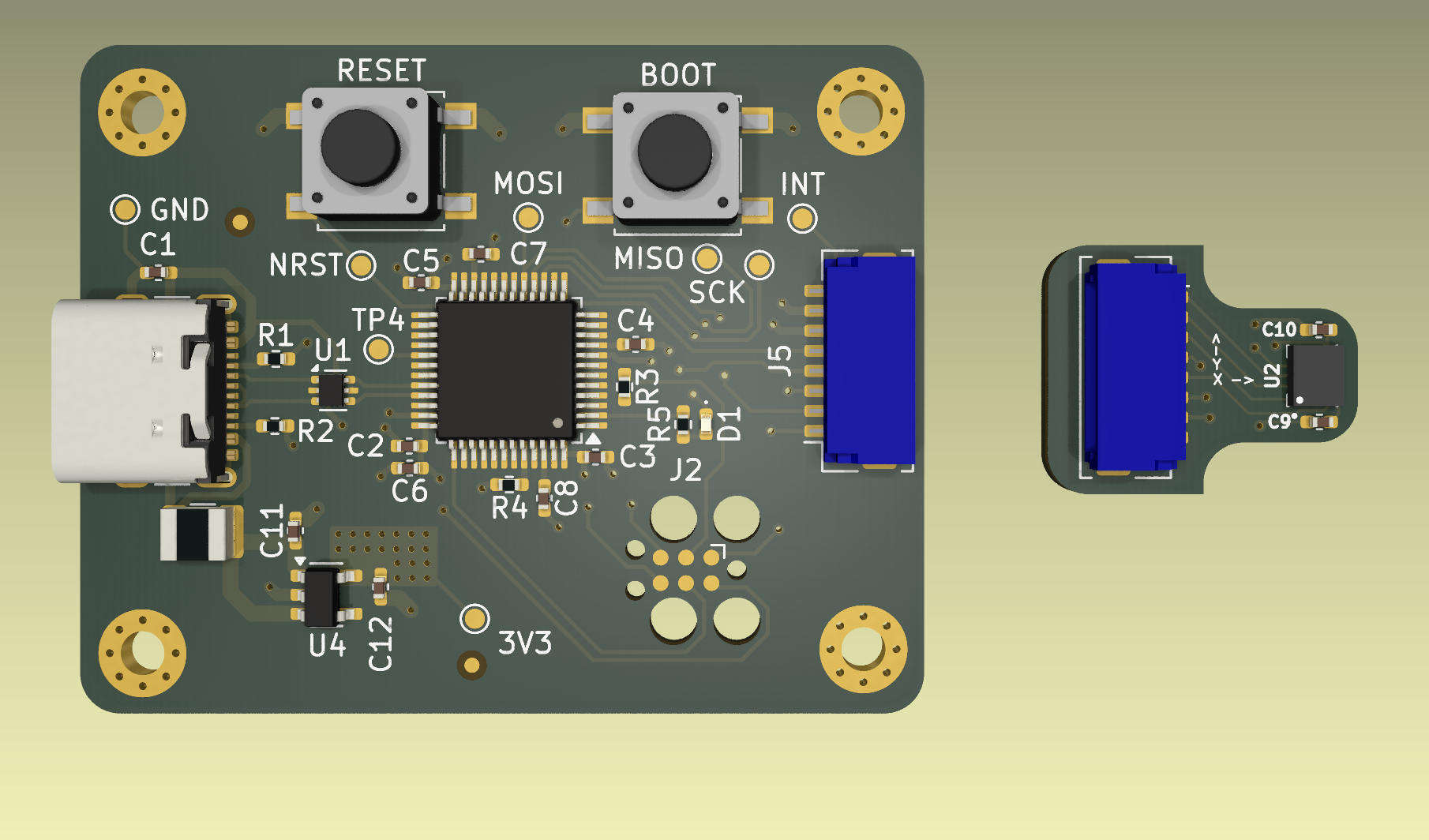
Main components on the Intelligence factory hardware assessment
Intelligence factory hardware assessment bill of materials (BOM)
26 components, 15 distinct parts — part numbers from the project's BOM.
| Qty | Part | Footprint | Refs |
|---|---|---|---|
| 1 | USBLC6-2P6 STMicroelectronics | SOT-666 | U1 |
| 1 | BMI270 Bosch Sensortec | XDCR_BMI270 | U2 |
| 1 | STM32H503CBT6 STM32H503CBTx STMicroelectronics | LQFP-48_7x7mm_P0.5mm | U3 |
| 1 | AP2112K-3.3TRG1 AP2112K-3.3 Diodes Incorporated | SOT-23-5 | U4 |
| 1 | USB4105-GF-A USB_C_Receptacle_USB2.0_16P GCT | USB_C_Receptacle_GCT_USB4105-xx-A_16P_TopMnt_Horizontal | J1 |
| 2 | SM08B-SRSS-TB Conn_01x08_Pin JST Sales America Inc. | JST_SHL_SM08B-SHLS-TF_1x08-1MP_P1.00mm_Horizontal | J4, J5 |
| 1 | NANOSMDC050F/13.2-2 nanoSMD050F-2 Littelfuse Inc. | Fuse_1210_3225Metric | F1 |
| 1 | QBLP595-R Indicator QTB | LED_0402_1005Metric | D1 |
| 2 | GRM155R60J106ME05J 10u Murata Electronics | C_0402_1005Metric_Pad0.74x0.62mm_HandSolder | C1, C2 |
| 6 | GCM155R71H104KE02J 0.1u Murata Electronics | C_0402_1005Metric_Pad0.74x0.62mm_HandSolder | C3, C4, C5, C6, C9, C10 |
| 2 | GRM155R61C225KE44D 2.2u Murata Electronics | C_0402_1005Metric_Pad0.74x0.62mm_HandSolder | C7, C8 |
| 2 | C1005X6S1C105K050EC 1u TDK | C_0402_1005Metric_Pad0.74x0.62mm_HandSolder | C11, C12 |
| 2 | RC0402FR-075K1L 5k1 YAGEO | R_0402_1005Metric_Pad0.72x0.64mm_HandSolder | R1, R2 |
| 2 | RMCF0402FT10K0 10k Stackpole Electronics Inc | R_0402_1005Metric_Pad0.72x0.64mm_HandSolder | R3, R4 |
| 1 | RC0402FR-07330RL 330R YAGEO | R_0402_1005Metric_Pad0.72x0.64mm_HandSolder | R5 |
Intelligence factory hardware assessment design files
The KiCad project lives in the shreyashswarnkar210205/intelligence-factory-hardware-assessment repository on GitHub; these links point at the commit this page was built from.
Intelligence factory hardware assessment: common questions
What microcontroller does the Intelligence factory hardware assessment use?
The Intelligence factory hardware assessment is built around the STM32H503CBT6, from the STM32 family.
How big is the Intelligence factory hardware assessment PCB?
The Intelligence factory hardware assessment measures 42.1 × 33.4 mm, has 4 copper layers and is 1.6 mm thick.
How many components are on the Intelligence factory hardware assessment?
26 components, from 15 distinct parts, with part numbers taken from the project's own BOM. The full bill of materials is listed on this page.
Where can I download the Intelligence factory hardware assessment design files?
From the shreyashswarnkar210205/intelligence-factory-hardware-assessment repository on GitHub, which has the KiCad layout, the schematic and the BOM; the links under Design files point to each one.
Can I use the Intelligence factory hardware assessment design in my own project?
The repository has no license, so all rights stay with shreyashswarnkar210205. Use it as a reference, and ask the author before reusing the design.
Can I test firmware for the Intelligence factory hardware assessment without the hardware?
Yes. HardLabs builds a simulation of the board from its netlist and BOM, so you can run and debug STM32 firmware against it before you order a PCB.
Similar boards
 STM32
STM32LumenPnP Motherboard
opulo-inc
149 × 95 mm296 parts4LCC-BY-SA-4.03.7k STM32
STM32AxxSolder
AxxAxx
39 × 82.5 mm122 parts2LGPL-3.01.7k STM32
STM32LibreVNA
jankae
122 × 98 mm592 parts6LGPL-3.01.6k STM32
STM32AIOC
skuep
21 × 31.5 mm47 parts2LMIT1.4k STM32
STM32Ferris
pierrechevalier83
208.8 × 86.8 mm102 parts2LSHL-2.11.3k STM32
STM32176 pin board
rusefi
61.8 × 73.2 mm76 parts2LGPL-3.01.2k