
Shu poyo

About the Shu poyo PCB
Shu poyo is an open source STM32 PCB design by shu-13, published on GitHub under the MIT license. It is a board, with 98 components from 39 distinct parts.
Its main chip is the STM32F103RBT6, from the STM32 family. Other key parts include the TC74HC00AF, DRV8835, SSM6J808R, PKMCS0909E4000-R1 and TPS562201. By type, the board carries 36 resistors, 23 capacitors, 10 diodes, 9 transistors, 7 ICs and 6 switches.
It belongs with the sensors and robotics & motion designs in this gallery.
From the project
Adventure of me developing STM32 micro on Mac
公式ページより、Homebrewをインストールしましょう 次のコマンドで、GNU Toolsをインストールします
STM32CubeMXはこちらからダウンロードしましょう SetupSTM32CubeMX-X.X.X.appを起動して、インストールしていきます #### うまく起動しない場合 ダブルクリックなどで、SetupSTM32CubeMXが起動しない場合は次のコマンドを実行してみましょう (ダウンロードしたファイルに含まれているREADME.htmlに書かれていました)
"software"ディレクトリにはSTM32CubeMXで生成したソースコードが含まれています。 それらの各ソースコードについては、各ファイルのヘッダーに明記されているライセンスに従います。
Main components on the Shu poyo
Shu poyo bill of materials (BOM)
98 components, 39 distinct parts.
| Qty | Part | Footprint | Refs |
|---|---|---|---|
| 1 | TC74HC00AF | SOP-14_4.55x10.3mm_P1.27mm | IC1 |
| 1 | DRV8835 | WSON-12-1EP_3x2mm_P0.5mm_EP1x2.65_ThermalVias | U1 |
| 1 | SSM6J808R | TSOP-6_1.65x3.05mm_P0.95mm | U2 |
| 1 | PKMCS0909E4000-R1 | Buzzer_CUI_CPT-9019S-SMT | U3 |
| 1 | TPS562201 | SOT-23-6 | U4 |
| 1 | STM32F103RBT6 | LQFP-64_10x10mm_P0.5mm | U5 |
| 1 | LM3940 | SOT-223 | U6 |
| 4 | Q_Photo_NPN | LED_D5.0mm_Horizontal_O1.27mm_Z3.0mm | Q1, Q3, Q5, Q7 |
| 5 | BSS138 | SOT-23 | Q2, Q4, Q6, Q8, Q9 |
| 1 | MotorL | IDC-Header_2x03_P2.54mm_Vertical | J1 |
| 1 | MotorR | IDC-Header_2x03_P2.54mm_Vertical | J2 |
| 1 | TX/RX | PinSocket_1x04_P2.54mm_Vertical | J3 |
| 1 | BT | JST_XH_B2B-XH-AM_1x02_P2.50mm_Vertical | J4 |
| 1 | OTHERS | PinSocket_1x05_P2.54mm_Vertical | J5 |
| 1 | 10k | Potentiometer_Vishay_TS53YL_Vertical | RV1 |
| 1 | SW_BOOT | SW_SPDT_SSAJ-120100 | SW1 |
| 1 | SW_POW | SSSS223202 | SW2 |
| 4 | SW_Push | SW_SPST_PTS645 | SW3, SW4, SW5, SW6 |
| 4 | SFH4550 | LED_D5.0mm_Horizontal_O3.81mm_Z9.0mm | D1, D2, D3, D4 |
| 4 | LED | LED_0603_1608Metric_Pad1.05x0.95mm_HandSolder | D5, D8, D9, D10 |
Show 19 more
| Qty | Part | Footprint | Refs |
|---|---|---|---|
| 1 | D_Low | D_1806_4516Metric_Pad1.57x1.80mm_HandSolder | D6 |
| 1 | D_Hi | D_1806_4516Metric_Pad1.57x1.80mm_HandSolder | D7 |
| 1 | 3.3µH | L_1206_3216Metric_Pad1.42x1.75mm_HandSolder | L1 |
| 5 | 10µ | C_0603_1608Metric_Pad1.05x0.95mm_HandSolder | C1, C2, C7, C9, C12 |
| 12 | 0.1µ | C_0402_1005Metric | C3, C4, C5, C6, C8, C10, C11, C16 +4 |
| 2 | 22µ | C_0603_1608Metric_Pad1.05x0.95mm_HandSolder | C13, C15 |
| 1 | 4.7µ | C_0603_1608Metric_Pad1.05x0.95mm_HandSolder | C14 |
| 1 | 0.47µ | C_0402_1005Metric | C19 |
| 1 | 1µ | C_0402_1005Metric | C22 |
| 1 | 33µ | C_0603_1608Metric_Pad1.05x0.95mm_HandSolder | C23 |
| 5 | 33 | R_0603_1608Metric_Pad1.05x0.95mm_HandSolder | R1, R4, R7, R10, R13 |
| 12 | 10k | R_0603_1608Metric_Pad1.05x0.95mm_HandSolder | R2, R5, R9, R12, R19, R20, R26, R27 +4 |
| 9 | 1k | R_0603_1608Metric_Pad1.05x0.95mm_HandSolder | R3, R6, R8, R11, R16, R17, R21, R22 +1 |
| 4 | 47k | R_0603_1608Metric_Pad1.05x0.95mm_HandSolder | R14, R15, R18, R30 |
| 2 | 39k | R_0603_1608Metric_Pad1.05x0.95mm_HandSolder | R23, R24 |
| 1 | 100 | R_0603_1608Metric_Pad1.05x0.95mm_HandSolder | R25 |
| 1 | 15k | R_0603_1608Metric_Pad1.05x0.95mm_HandSolder | R33 |
| 1 | 1.07k | R_0603_1608Metric_Pad1.05x0.95mm_HandSolder | R35 |
| 1 | 5.9k | R_0603_1608Metric_Pad1.05x0.95mm_HandSolder | R36 |
Shu poyo design files
The KiCad project lives in the shu-13/shu-poyo repository on GitHub; these links point at the commit this page was built from.
Shu poyo: common questions
What microcontroller does the Shu poyo use?
The Shu poyo is built around the STM32F103RBT6, from the STM32 family.
How many components are on the Shu poyo?
98 components, from 39 distinct parts. The full bill of materials is listed on this page.
Where can I download the Shu poyo design files?
From the shu-13/shu-poyo repository on GitHub, which has a netlist; the links under Design files point to each one.
Can I use the Shu poyo design in my own project?
Yes, under the terms of its MIT license, which shu-13 chose for the repository.
Can I test firmware for the Shu poyo without the hardware?
Yes. HardLabs builds a simulation of the board from its netlist and BOM, so you can run and debug STM32 firmware against it before you order a PCB.
Similar boards
 STM32
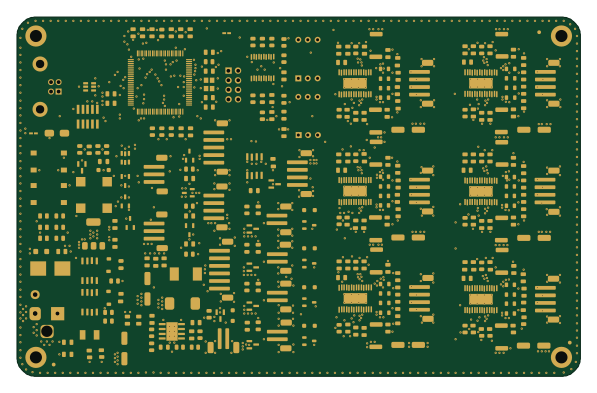
STM32LumenPnP Motherboard
opulo-inc
149 × 95 mm296 parts4LCC-BY-SA-4.03.7k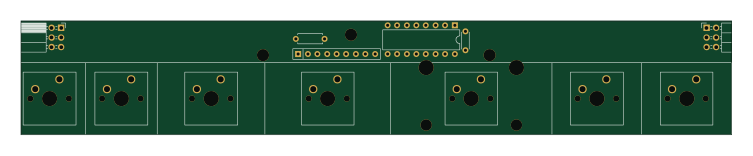 STM32
STM32Type c
google
188 × 30 mm17 parts2LApache-2.02.9k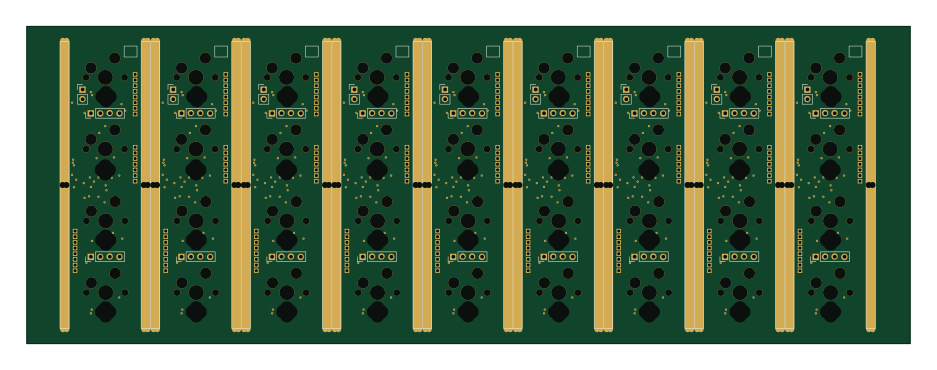 STM32
STM32Main panel
234 × 84 mm26 parts4LApache-2.02.9k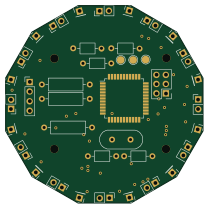 STM32
STM32Base
52.3 × 52.3 mm36 parts2LApache-2.02.9k STM32
STM32Type a
150 × 30 mm14 parts2LApache-2.02.9k STM32
STM32Type e
140.5 × 30 mm13 parts2LApache-2.02.9k