
VibrationDamper

About the VibrationDamper PCB
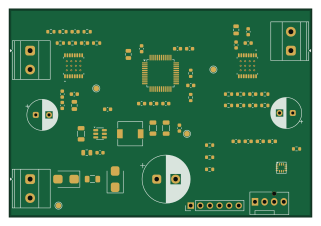
VibrationDamper is an open source STM32 PCB design by starline, published on GitHub under the MIT license. It is a 2-layer board measuring 80 × 55 mm, with 66 components from 36 distinct parts.
Its main chip is the STM32G431CBT6, from the STM32 family. Other key parts include the ICM-42688-P, DRV8874PWP (DRV8876 pin-compatible) and AP63203 (fixed 3.3V). By type, the board carries 32 capacitors, 18 resistors, 5 ICs, 5 connectors, 3 inductors and 2 diodes.
It belongs with the robotics & motion and sensors designs in this gallery.
From the project
Active electronic vibration damper for CNC: STM32 + IMU sensing and dual H-bridge actuators for real-time spindle stabilization
Open HarmonicDamper.kicadpro in KiCad 10, then open PCB Editor.
Board outline: 80 × 55 mm (Edge.Cuts 100,50 → 180,105). Tracks were cleared after re-placement — re-route, then DRC. Component placement is courtyard-clean.
Routing strategy: - F.Cu: high-current actuator outputs, buck switching loop, driver charge-pump/reference networks, filtered analog/IMU power and short SMD fan-outs. - B.Cu: +12 V backbone, +3.3 V distribution and long low-current control/SPI/debug signals. - GND zones are defined on both F.Cu and B.Cu; press B after opening to refill them.
Main components on the VibrationDamper
VibrationDamper bill of materials (BOM)
66 components, 36 distinct parts — part numbers from the project's BOM.
| Qty | Part | Footprint | Refs |
|---|---|---|---|
| 1 | STM32G431CBT6 | LQFP-48_7x7mm_P0.5mm | U1 |
| 1 | ICM-42688-P | ICM42688P_LGA14 | U2 |
| 2 | DRV8874PWP (DRV8876 pin-compatible) | HTSSOP-16-1EP_4.4x5mm_P0.65mm_EP3.4x5mm_Mask2.78x3.37mm_ThermalVias | U3, U4 |
| 1 | AP63203 (fixed 3.3V) | TSOT-23-6 | U5 |
| 1 | 12V INPUT | TerminalBlock_Phoenix_MKDS-1,5-2_1x02_P5.00mm_Horizontal | J1 |
| 1 | ACTUATOR 1 | TerminalBlock_Phoenix_MKDS-1,5-2_1x02_P5.00mm_Horizontal | J2 |
| 1 | ACTUATOR 2 | TerminalBlock_Phoenix_MKDS-1,5-2_1x02_P5.00mm_Horizontal | J3 |
| 1 | SWD | PinHeader_1x06_P2.54mm_Vertical | J4 |
| 1 | UART | FanPinHeader_1x04_P2.54mm_Vertical | J5 |
| 1 | 10A | Fuse_1206_3216Metric | F1 |
| 1 | SMBJ18A | D_SMB | D1 |
| 1 | SS54 | D_SMB | D2 |
| 2 | 600R@100MHz | L_0603_1608Metric | FB1, FB2 |
| 1 | 3.9uH >=3A | L_6.3x6.3_H3 | L1 |
| 1 | 1000uF/25V | CP_Radial_D12.5mm_P5.00mm | C1 |
| 1 | 1uF/50V | C_0805_2012Metric | C2 |
| 3 | 100nF/50V | C_0603_1608Metric | C3, C32, C42 |
| 1 | 10uF/25V | C_1206_3216Metric | C4 |
| 10 | 100nF | C_0603_1608Metric | C5, C8, C9, C10, C11, C14, C15, C17 +2 |
| 2 | 22uF/10V | C_1206_3216Metric | C6, C7 |
Show 16 more
| Qty | Part | Footprint | Refs |
|---|---|---|---|
| 1 | 4.7uF | C_0805_2012Metric | C12 |
| 1 | 1uF | C_0603_1608Metric | C13 |
| 1 | 2.2uF | C_0603_1608Metric | C16 |
| 3 | 10nF | C_0603_1608Metric | C18, C36, C46 |
| 2 | 100uF/25V | CP_Radial_D8.0mm_P3.50mm | C30, C40 |
| 2 | 1uF/25V | C_0805_2012Metric | C31, C41 |
| 2 | 100nF/16V | C_0603_1608Metric | C33, C43 |
| 2 | 22nF/50V | C_0603_1608Metric | C34, C44 |
| 4 | 10k | R_0603_1608Metric | R1, R6, R15, R21 |
| 1 | 100k | R_0603_1608Metric | R2 |
| 3 | 22R | R_0603_1608Metric | R3, R4, R5 |
| 2 | 1k 1% | R_0603_1608Metric | R10, R16 |
| 2 | 10k 1% | R_0603_1608Metric | R11, R17 |
| 2 | 1.37k 1% | R_0603_1608Metric | R12, R18 |
| 2 | 0R | R_0603_1608Metric | R13, R19 |
| 2 | 20k | R_0603_1608Metric | R14, R20 |
VibrationDamper design files
The KiCad project lives in the starline/VibrationDamper repository on GitHub; these links point at the commit this page was built from.
VibrationDamper: common questions
What microcontroller does the VibrationDamper use?
The VibrationDamper is built around the STM32G431CBT6, from the STM32 family.
How big is the VibrationDamper PCB?
The VibrationDamper measures 80 × 55 mm, has 2 copper layers and is 1.6 mm thick.
How many components are on the VibrationDamper?
66 components, from 36 distinct parts, with part numbers taken from the project's own BOM. The full bill of materials is listed on this page.
Where can I download the VibrationDamper design files?
From the starline/VibrationDamper repository on GitHub, which has the KiCad layout, the schematic and the BOM; the links under Design files point to each one.
Can I use the VibrationDamper design in my own project?
Yes, under the terms of its MIT license, which starline chose for the repository.
Can I test firmware for the VibrationDamper without the hardware?
Yes. HardLabs builds a simulation of the board from its netlist and BOM, so you can run and debug STM32 firmware against it before you order a PCB.
Similar boards
 STM32
STM32LumenPnP Motherboard
opulo-inc
149 × 95 mm296 parts4LCC-BY-SA-4.03.7k STM32
STM32AxxSolder
AxxAxx
39 × 82.5 mm122 parts2LGPL-3.01.7k STM32
STM32LibreVNA
jankae
122 × 98 mm592 parts6LGPL-3.01.6k STM32
STM32AIOC
skuep
21 × 31.5 mm47 parts2LMIT1.4k STM32
STM32Ferris
pierrechevalier83
208.8 × 86.8 mm102 parts2LSHL-2.11.3k STM32
STM32176 pin board
rusefi
61.8 × 73.2 mm76 parts2LGPL-3.01.2k