
USBcablecracker

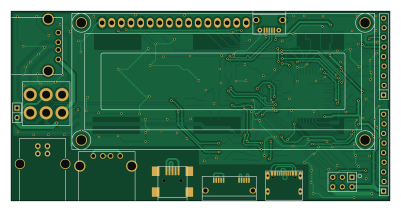
About the USBcablecracker PCB
USBcablecracker is an open source AVR/Arduino PCB design by szdiy, published on GitHub under the CC-BY-SA-4.0 license. It is a 2-layer board measuring 100 × 50 mm, with 56 components from 32 distinct parts.
Its main chip is the ATmega32U4-AU, from the AVR/Arduino family. Other key parts include the LMV358 and AD623. By type, the board carries 22 resistors, 13 capacitors, 10 connectors, 4 diodes, 3 ICs and 1 crystal.
From the project
USBcablecracker ============ USB Cable Cracker is a device that measures the resistance of USB cable. It measures the serial resistance of VCC + GND or D+ or D-. And if you are not satisfy with the resistance, you can crack the cable by yourself. It is a Arduino Leonardo compatib
USBcablecracker ============ USB Cable Cracker is a device that measures the resistance of USB cable. It measures the serial resistance of VCC + GND or D+ or D-. And if you are not satisfy with the resistance, you can crack the cable by yourself. It is a Arduino Leonardo compatible board, with some extend pins.
[schem]:https://github.com/szdiy/USBcablecracker/raw/master/hardware/USBcablecracker.pdf [bom]:https://github.com/szdiy/USBcablecracker/raw/master/hardware/manufature/USBcablecracker_bom.csv
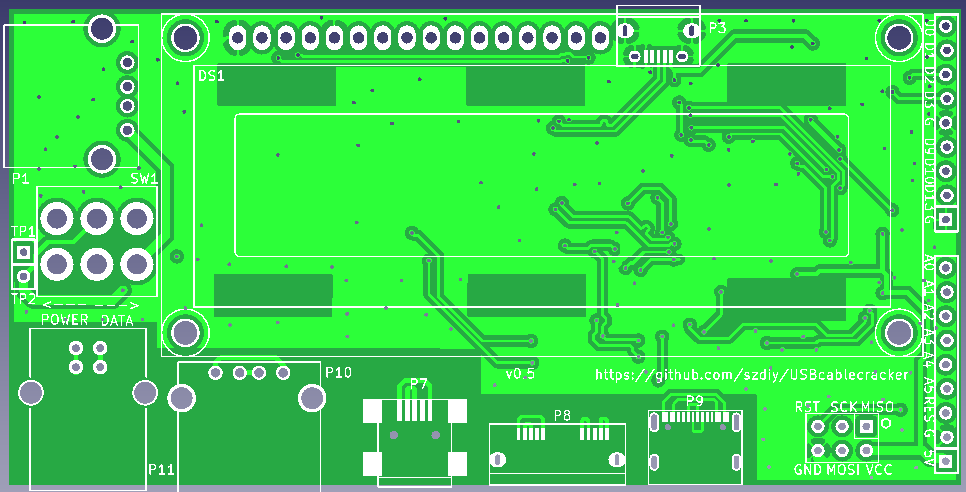
Main components on the USBcablecracker
USBcablecracker bill of materials (BOM)
56 components, 32 distinct parts — part numbers from the project's BOM.
| Qty | Part | Footprint | Refs |
|---|---|---|---|
| 1 | ATmega32U4-AU | TQFP-44_10x10mm_Pitch0.8mm | U1 |
| 1 | LMV358 | SOIC-8_3.9x4.9mm_Pitch1.27mm | U2 |
| 1 | AD623 | SOIC-8_3.9x4.9mm_Pitch1.27mm | U3 |
| 1 | 16MHZ 16MHz | crystal_FA238-TSX3225 | Y1 |
| 2 | USB_A | USB_A | P1, P10 |
| 1 | CONN_01X02 | CONN_2.54mm_1x2 | P2 |
| 1 | USB_B-Micro | USB_Micro-B | P3 |
| 2 | CONN_01X09 | CONN_2.54mm_1x9 | P6, P12 |
| 1 | USB_B-Mini | USB_Mini-B | P7 |
| 1 | USB_B-Micro-3.0 | USB_Micro-30 | P8 |
| 1 | USB_TYPEC-S | USBtypeC | P9 |
| 1 | USB_B | USB_B | P11 |
| 1 | ICSP | CONN_2.54mm_2x3 | CONN1 |
| 1 | LCD16X2 | WC1602A | DS1 |
| 1 | Switch_SPDT_x2 | DPDT | SW1 |
| 1 | RX | LED_0603 | D1 |
| 1 | TX | LED_0603 | D2 |
| 1 | L | LED_0603 | D3 |
| 1 | ON | LED_0603 | D4 |
| 2 | 15PF 15P | C_0603_HandSoldering | C1, C5 |
Show 12 more
| Qty | Part | Footprint | Refs |
|---|---|---|---|
| 4 | 1NF 1nF | C_0603_HandSoldering | C2, C3, C4, C13 |
| 5 | 100NF/10V 100nF | C_0603_HandSoldering | C6, C9, C10, C11, C12 |
| 1 | 1UF 1uF | C_0603_HandSoldering | C7 |
| 1 | 22UF/10V 22uF | Tantalum_Case-A_EIA-3216-18_Wave | C8 |
| 9 | 10K | R_0603_HandSoldering | R1, R9, R11, R13, R15, R16, R20, R21 +1 |
| 5 | 1K | R_0603_HandSoldering | R2, R3, R4, R5, R6 |
| 2 | 22R | R_0603_HandSoldering | R7, R8 |
| 1 | 91R | R_0603_HandSoldering | R10 |
| 2 | 100K | R_0603_HandSoldering | R12, R14 |
| 1 | 68 | R_0603_HandSoldering | R17 |
| 1 | 33 | R_0603_HandSoldering | R18 |
| 1 | 11k | R_0603_HandSoldering | R19 |
USBcablecracker design files
The KiCad project lives in the szdiy/USBcablecracker repository on GitHub; these links point at the commit this page was built from.
USBcablecracker: common questions
What microcontroller does the USBcablecracker use?
The USBcablecracker is built around the ATmega32U4-AU, from the AVR/Arduino family.
How big is the USBcablecracker PCB?
The USBcablecracker measures 100 × 50 mm, has 2 copper layers and is 1.6 mm thick.
How many components are on the USBcablecracker?
56 components, from 32 distinct parts, with part numbers taken from the project's own BOM. The full bill of materials is listed on this page.
Where can I download the USBcablecracker design files?
From the szdiy/USBcablecracker repository on GitHub, which has the KiCad layout and the BOM; the links under Design files point to each one.
Can I use the USBcablecracker design in my own project?
Yes, under the terms of its CC-BY-SA-4.0 license, which szdiy chose for the repository.
Can I test firmware for the USBcablecracker without the hardware?
Yes. HardLabs builds a simulation of the board from its netlist and BOM, so you can run and debug AVR/Arduino firmware against it before you order a PCB.
Similar boards
 AVR/Arduino
V4
stuartpittaway
30 × 50 mm38 parts2LCC-BY-NC-4.01.1k AVR/Arduino
ModuleV450
30 × 61.4 mm39 parts2LCC-BY-NC-4.01.1k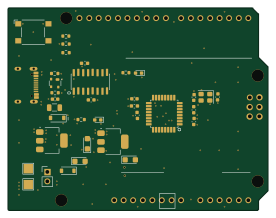 AVR/Arduino
Easyduino Atmega
Hanqaqa
68.8 × 53.6 mm35 parts4LCERN-OHL-P-2.0746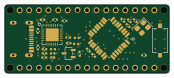 AVR/Arduino
Easyduino Atmega Nano
43.4 × 18 mm30 parts4LCERN-OHL-P-2.0746 AVR/Arduino
UsbGpib
xyphro
54 × 15 mm21 parts2LMIT683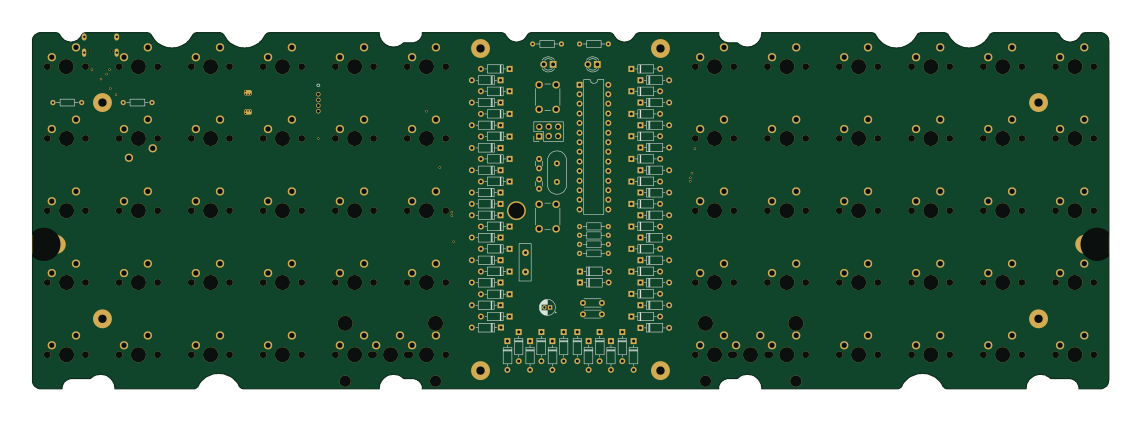 AVR/Arduino
Lumberjack
peej
284.7 × 94.2 mm149 parts2LMIT402