
Dormouse

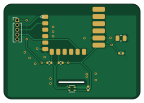
About the Dormouse PCB
Dormouse is an open source Silicon Labs PCB design by temonuv, published on GitHub under the MIT license. It is a 2-layer board measuring 36 × 25.1 mm, with 9 components from 7 distinct parts.
Its main chip is the MGM210LA22JNF, from the Silicon Labs family. Other key parts include the SHT40. By type, the board carries 3 capacitors, 2 ICs, 2 resistors, 1 connector and 1 battery holder.
It belongs with the sensors, iot & wireless and power & battery designs in this gallery.
From the project
🐭 Dormouse — a coin-cell (CR2032) Zigbee 3.0 temperature + humidity sensor on the Silicon Labs MGM210L (EFR32MG21). Firmware + KiCad hardware + Home Assistant integration.
KiCad 8/9 design for Dormouse, the MGM210L CR2032 temperature + humidity sensor. The schematic (electrical connectivity) and the routed PCB are both here. (File basenames stay mgm210lsensor.*` — renaming a finalized, already-ordered KiCad project risks breaking internal references for no functional gain.)
The PCB is not regenerated by a script — it is built from the schematic with KiCad's "Update PCB from Schematic" (F8) and then edited. Do not expect gen.py` to touch it.
Main components on the Dormouse
Dormouse bill of materials (BOM)
9 components, 7 distinct parts — part numbers from the project's BOM.
| Qty | Part | Footprint | Refs |
|---|---|---|---|
| 1 | MGM210LA22JNF | MGM210LA22JNF | U1 |
| 1 | SHT40 | Sensirion_DFN-4_1.5x1.5mm_P0.8mm_SHT4x_NoCentralPad | U2 |
| 1 | GND RES DIO CLK VDD | PinHeader_1x05_P1.27mm_Vertical | J1 |
| 1 | CR2032 | BatteryHolder_Renata_SMTU2032-LF_1x2032 | BT1 |
| 1 | 10uF | C_0805_2012Metric | C1 |
| 2 | 100nF | C_0402_1005Metric | C2, C3 |
| 2 | 4.7k | R_0402_1005Metric | R1, R2 |
Dormouse design files
The KiCad project lives in the temonuv/dormouse repository on GitHub; these links point at the commit this page was built from.
Dormouse: common questions
What microcontroller does the Dormouse use?
The Dormouse is built around the MGM210LA22JNF, from the Silicon Labs family.
How big is the Dormouse PCB?
The Dormouse measures 36 × 25.1 mm, has 2 copper layers and is 1.6 mm thick.
How many components are on the Dormouse?
9 components, from 7 distinct parts, with part numbers taken from the project's own BOM. The full bill of materials is listed on this page.
Where can I download the Dormouse design files?
From the temonuv/dormouse repository on GitHub, which has the KiCad layout, the schematic and the BOM; the links under Design files point to each one.
Can I use the Dormouse design in my own project?
Yes, under the terms of its MIT license, which temonuv chose for the repository.
Can I test firmware for the Dormouse without the hardware?
Yes. HardLabs builds a simulation of the board from its netlist and BOM, so you can run and debug Silicon Labs firmware against it before you order a PCB.
Similar boards
 Silicon Labs
Tomu hardware
im-tomu
13 × 9.4 mm11 parts2LCC-BY-SA-4.0365 ESP32
ESP32Open Book Abridged Edition
joeycastillo
85 × 115 mm65 parts2LCC-BY-SA-4.08.1k ESP32
ESP32Badge
atopile
56.3 × 39 mm239 parts4LMIT4.0k ESP32
ESP32Racer
StuckAtPrototype
36 × 50.2 mm70 parts4LApache-2.03.8k
Sensors
15.2 × 9 mm14 parts4LApache-2.03.8k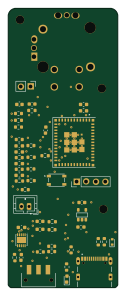 ESP32
ESP32Controller
29 × 74 mm58 parts4LApache-2.03.8k