
SG-3

About the SG-3 PCB
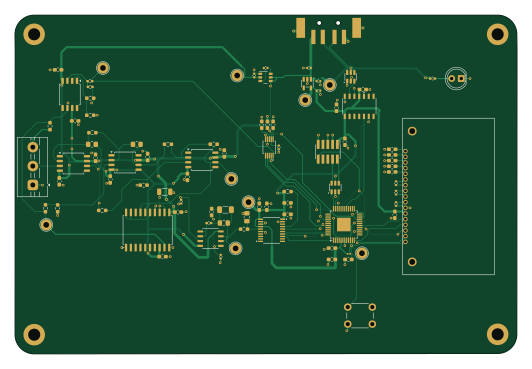
SG-3 is an open source STM32 PCB design by ttosu25, published on GitHub. It is a 4-layer board measuring 132.7 × 89.6 mm, with 93 components from 33 distinct parts.
Its main chip is the STM32C091CBT6, from the STM32 family. Other key parts include the MCP3561-E/ST, OP177GPZ, AD630ARZ, OPA2187IDR and AD9833BRMZ. By type, the board carries 43 capacitors, 21 resistors, 12 ICs, 9 test points, 3 connectors and 1 switch.
It belongs with the sensors designs in this gallery, and the repository also holds 1 earlier revision of it.
From the project
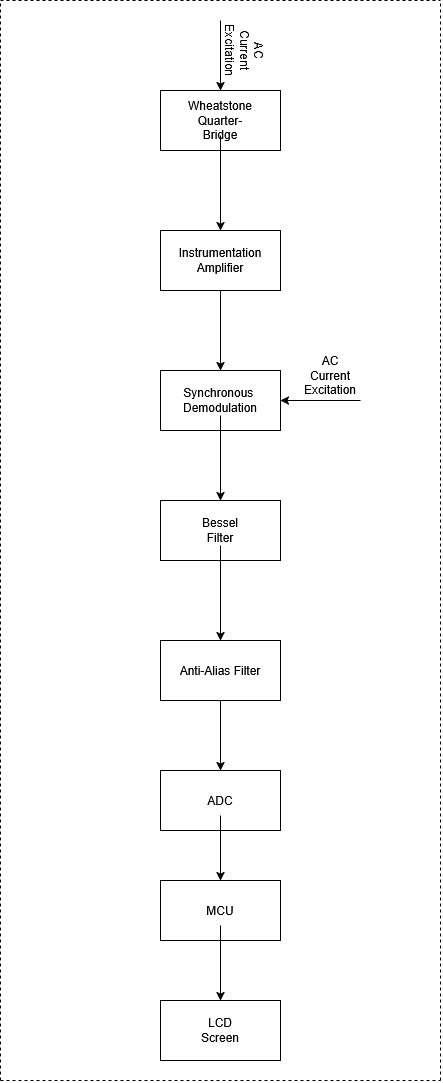
Hardware design for a mixed-signal strain-data acquisition system, incorporating sensor excitation, analogue signal conditioning, ADC, and MCU interface
Strain gauges produce very small differential voltage signals that encode information about mechanical strain. Precise and accurate measurement requires careful analogue signal conditioning before digitisation, followed by digital signal processing to extract the desired measurement. This project explores the design of a complete measurement device, from sensor excitation and analogue front-end conditioning through to digital acquisition, processing, and display output.
Main components on the SG-3
SG-3 bill of materials (BOM)
93 components, 33 distinct parts — part numbers from the project's BOM.
| Qty | Part | Footprint | Refs |
|---|---|---|---|
| 1 | STM32C091CBT6 | LQFP-48-1EP_7x7mm_P0.5mm_EP3.6x3.6mm | IC1 |
| 1 | MCP3561-E/ST | TSSOP20_ST_MCH | U1 |
| 4 | OP177GPZ ADI | SOIC-8_5.3x5.3mm_P1.27mm | U2, U3, U4, U7 |
| 1 | AD630ARZ | SOIC-20W_7.5x12.8mm_P1.27mm | U5 |
| 1 | OPA2187IDR | D8_TEX | U6 |
| 1 | AD9833BRMZ | RM_10_ADI | U8 |
| 1 | MIC5365-3.3YC5-TR | TSOT-23-5 | U9 |
| 1 | MCP2221A-I/SL | SOIC14_SL_MCH | U10 |
| 1 | LM2664M6X/NOPB | DBV0006A_N | U11 |
| 1 | ~ | BX-TYPE-A-MWT4P | J1 |
| 1 | Conn_02x05_Odd_Even Samtec Inc | PinHeader_2x05_P1.27mm_Vertical_SMD | J2 |
| 1 | Screw_Terminal_01x03 | TerminalBlock_MaiXu_MX126-5.0-03P_1x03_P5.00mm | J3 |
| 1 | NHD-C12832A1Z-FSW-FBW-3V3 | NHDC12832A1ZFSWFBW3V3 | DS1 |
| 1 | SW_Push MULTICOMP PRO | SW_PUSH_6mm | SW1 |
| 9 | TestPoint | TestPoint_Loop_D2.54mm_Drill1.5mm_Beaded | TP1, TP2, TP3, TP4, TP5, TP6, TP7, TP8 +1 |
| 2 | USBLC6-2SC6 | SOT-23-6 | USBLC1, USBLC2 |
| 1 | LED | LED_D5.0mm | D1 |
| 1 | 33n YAGEO KEMET | C_0805_2012Metric_Pad1.18x1.45mm_HandSolder | C1 |
| 6 | 1u TDK | C_0402_1005Metric | C2, C3, C9, C18, C19, C20 |
| 29 | 100n YAGEO KEMET | C_0603_1608Metric_Pad1.08x0.95mm_HandSolder | C4, C5, C6, C10, C13, C14, C15, C16 +21 |
Show 13 more
| Qty | Part | Footprint | Refs |
|---|---|---|---|
| 1 | 1.5u TDK | C_0805_2012Metric_Pad1.18x1.45mm_HandSolder | C7 |
| 1 | 470n KEMET | C_1206_3216Metric_Pad1.33x1.80mm_HandSolder | C8 |
| 5 | 10u Murata Electronics | C_0402_1005Metric | C11, C12, C26, C41, C43 |
| 6 | 1k MULTICOMP PRO | R_0603_1608Metric_Pad0.98x0.95mm_HandSolder | R1, R5, R8, R9, R10, R11 |
| 3 | 350 VPG FOIL RESISTORS | R_0603_1608Metric_Pad0.98x0.95mm_HandSolder | R2, R3, R4 |
| 2 | 100k KOA | R_0805_2012Metric_Pad1.20x1.40mm_HandSolder | R6, R7 |
| 1 | 1.5k VISHAY | R_1206_3216Metric | R12 |
| 1 | 825 VISHAY | C_0402_1005Metric_Pad0.74x0.62mm_HandSolder | R13 |
| 1 | 1.15k YAGEO | C_0603_1608Metric_Pad1.08x0.95mm_HandSolder | R14 |
| 2 | 50 VISHAY DALE | R_0603_1608Metric_Pad0.98x0.95mm_HandSolder | R15, R16 |
| 3 | 200 PANASONIC INDUSTRY | R_0402_1005Metric_Pad0.72x0.64mm_HandSolder | R17, R18, R23 |
| 1 | 10k VISHAY | R_0603_1608Metric_Pad0.98x0.95mm_HandSolder | R21 |
| 1 | 5.1k MULTICOMP PRO | R_0201_0603Metric | R22 |
SG-3 design files
The KiCad project lives in the ttosu25/SG-3 repository on GitHub; these links point at the commit this page was built from.
SG-3: common questions
What microcontroller does the SG-3 use?
The SG-3 is built around the STM32C091CBT6, from the STM32 family.
How big is the SG-3 PCB?
The SG-3 measures 132.7 × 89.6 mm, has 4 copper layers and is 1.6 mm thick.
How many components are on the SG-3?
93 components, from 33 distinct parts, with part numbers taken from the project's own BOM. The full bill of materials is listed on this page.
Where can I download the SG-3 design files?
From the ttosu25/SG-3 repository on GitHub, which has the KiCad layout and the BOM; the links under Design files point to each one.
Can I use the SG-3 design in my own project?
The repository has no license, so all rights stay with ttosu25. Use it as a reference, and ask the author before reusing the design.
Can I test firmware for the SG-3 without the hardware?
Yes. HardLabs builds a simulation of the board from its netlist and BOM, so you can run and debug STM32 firmware against it before you order a PCB.
Earlier revisions in the repo: strain_guage
Similar boards
 STM32
LumenPnP Motherboard
opulo-inc
149 × 95 mm296 parts4LCC-BY-SA-4.03.7k STM32
Base
google
52.3 × 52.3 mm36 parts2LApache-2.02.9k STM32
Main panel
234 × 84 mm26 parts4LApache-2.02.9k STM32
Type a
150 × 30 mm14 parts2LApache-2.02.9k STM32
Type g
169 × 30 mm24 parts2LApache-2.02.9k STM32
Type c
188 × 30 mm17 parts2LApache-2.02.9k