
Power carrier

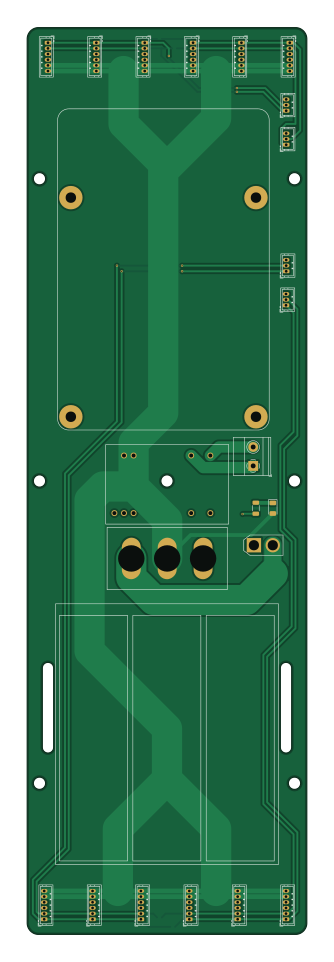
About the Power carrier PCB
Power carrier is an open source Raspberry Pi PCB design by akshatbansaltech, published on GitHub under the MIT license. It is a 2-layer board measuring 74 × 240 mm, with 24 components from 10 distinct parts.
Its main chip is the RASPBERRY_PI_4B - Footprint Only, from the Raspberry Pi family. Other key parts include the SCW12B-05. By type, the board carries 18 connectors, 1 IC, 1 switch, 1 diode and 1 resistor.
From the project
- Add voltage/current sensor such as a INA228 - Add revision number to silkscreen - Optional: Add motor tags (ex, FLA, FLH, FLK) to silkscreen - Move 5vDC terminal away from RPi as this blocks the power switch if a RPi 5 is used. - Some of the PCB may be removed to save weight, p
- Add voltage/current sensor such as a INA228 - Add revision number to silkscreen - Optional: Add motor tags (ex, FLA, FLH, FLK) to silkscreen - Move 5vDC terminal away from RPi as this blocks the power switch if a RPi 5 is used. - Some of the PCB may be removed to save weight, perhaps under the battery.
Main components on the Power carrier
Power carrier bill of materials (BOM)
24 components, 10 distinct parts — part numbers from the project's BOM.
| Qty | Part | Footprint | Refs |
|---|---|---|---|
| 1 | SCW12B-05 | SCW12B-05_MWU | U1 |
| 4 | Conn_01x03 | JST_ZH_B3B-ZR_1x03_P1.50mm_Vertical | J1, J2, J20, J21 |
| 1 | Conn_01x02 | TerminalBlock_Phoenix_MKDS-1,5-2_1x02_P5.00mm_Horizontal | J3 |
| 1 | AMASS Connector | AMASS_XT30U-M_1x02_P5.0mm_Vertical | J4 |
| 12 | Conn_01x06 | JST_ZH_B6B-ZR_1x06_P1.50mm_Vertical | J5, J6, J7, J8, J9, J10, J11, J12 +4 |
| 1 | ~ | 18650 6S Battery Pack - Footprint Only | BATT1 |
| 1 | ~ | RASPBERRY_PI_4B - Footprint Only | SBC1 |
| 1 | SW_SPST | CRE22F4DBBNE | SW1 |
| 1 | LED | LED_1206_3216Metric | D1 |
| 1 | R_Small_US | R_1206_3216Metric | R1 |
Power carrier design files
The KiCad project lives in the akshatbansaltech/Light-Doggo repository on GitHub; these links point at the commit this page was built from.
Power carrier: common questions
What microcontroller does the Power carrier use?
The Power carrier is built around the RASPBERRY_PI_4B - Footprint Only, from the Raspberry Pi family.
How big is the Power carrier PCB?
The Power carrier measures 74 × 240 mm, has 2 copper layers and is 1.6 mm thick.
How many components are on the Power carrier?
24 components, from 10 distinct parts, with part numbers taken from the project's own BOM. The full bill of materials is listed on this page.
Where can I download the Power carrier design files?
From the akshatbansaltech/Light-Doggo repository on GitHub, which has the KiCad layout, the schematic and the BOM; the links under Design files point to each one.
Can I use the Power carrier design in my own project?
Yes, under the terms of its MIT license, which akshatbansaltech chose for the repository.
Can I test firmware for the Power carrier without the hardware?
Yes. HardLabs builds a simulation of the board from its netlist and BOM, so you can run and debug Raspberry Pi firmware against it before you order a PCB.
More boards in Light-Doggo
Similar boards
 Raspberry Pi
Haxo hw
cardonabits
102.4 × 211.3 mm38 parts2LCustom license672 Raspberry Pi
PowerBook
BlueSCSI
74.5 × 56.3 mm78 parts2LGPL-3.0449 Raspberry Pi
Desktop 50 Pin TopConn
89.2 × 82.6 mm103 parts2LGPL-3.0449 Raspberry Pi
BitDogLab 5.4
BitDogLab
87.9 × 123.9 mm56 parts2LCERN-OHL-S-2.0201 Raspberry Pi
BitDogLab Main SMD version
87.9 × 98.7 mm124 parts2LCERN-OHL-S-2.0201 Raspberry Pi
Zynthian mini v2 20 buttons short
zynthian
163 × 120 mm87 parts2LNo license154