
Power

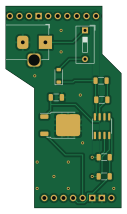
About the Power PCB
Power is an open source AVR/Arduino PCB design by ARTS-Laboratory, published on GitHub under the CC-BY-SA-4.0 license. It is a 2-layer board measuring 30.5 × 53.3 mm, with 11 components from 9 distinct parts.
Its main chip is the Arduino_Mega2560_Shield, from the AVR/Arduino family. Other key parts include the LF15_TO252 and INA219A. By type, the board carries 3 resistors, 2 ICs, 2 capacitors, 1 connector, 1 switch and 1 diode.
It belongs with the iot & wireless and sensors designs in this gallery.
From the project
A low-cost, IOT water level sensor package alternative to traditional gauging equipment.
These are the KiCad files used to create the power PCB.
Main components on the Power
Power bill of materials (BOM)
11 components, 9 distinct parts.
| Qty | Part | Footprint | Refs |
|---|---|---|---|
| 1 | LF15_TO252 | TO-252-2 | U1 |
| 1 | INA219A | SOIC-8_3.9x4.9mm_P1.27mm | U2 |
| 1 | Barrel_Jack | BarrelJack_Horizontal | J1 |
| 1 | SW_DIP_x01 | SW_DIP_SPSTx01_Slide_9.78x4.72mm_W7.62mm_P2.54mm | SW1 |
| 1 | Arduino_Mega2560_Shield | Arduino_Mega2560_R3_Shield | XA1 |
| 1 | 16-7 | D_SOD-123 | D1 |
| 2 | 0.1 μF | C_1206_3216Metric | C1, C2 |
| 1 | 0.1 | R_1206_3216Metric | R1 |
| 2 | 4.7k | R_1206_3216Metric | R3, R4 |
Power design files
The KiCad project lives in the ARTS-Laboratory/IoT-Water-Level-Sensor repository on GitHub; these links point at the commit this page was built from.
Power: common questions
What microcontroller does the Power use?
The Power is built around the Arduino_Mega2560_Shield, from the AVR/Arduino family.
How big is the Power PCB?
The Power measures 30.5 × 53.3 mm, has 2 copper layers and is 1.6 mm thick.
How many components are on the Power?
11 components, from 9 distinct parts. The full bill of materials is listed on this page.
Where can I download the Power design files?
From the ARTS-Laboratory/IoT-Water-Level-Sensor repository on GitHub, which has the KiCad layout and the schematic; the links under Design files point to each one.
Can I use the Power design in my own project?
Yes, under the terms of its CC-BY-SA-4.0 license, which ARTS-Laboratory chose for the repository.
Can I test firmware for the Power without the hardware?
Yes. HardLabs builds a simulation of the board from its netlist and BOM, so you can run and debug AVR/Arduino firmware against it before you order a PCB.
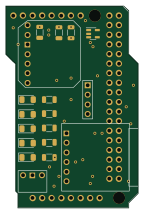
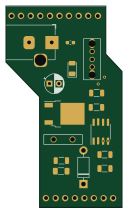
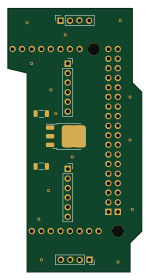
More boards in IoT-Water-Level-Sensor
Similar boards
 AVR/Arduino
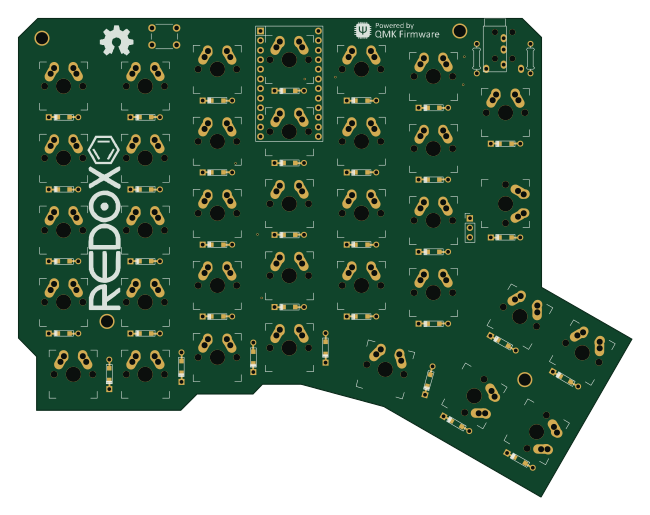
Redox keyboard
mattdibi
162.2 × 126.5 mm77 parts2LMIT2.0k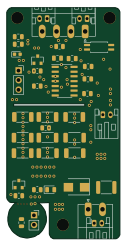 AVR/Arduino
ModuleV450
stuartpittaway
30 × 61.4 mm39 parts2LCC-BY-NC-4.01.1k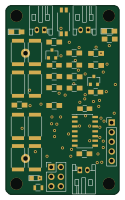 AVR/Arduino
V4
30 × 50 mm38 parts2LCC-BY-NC-4.01.1k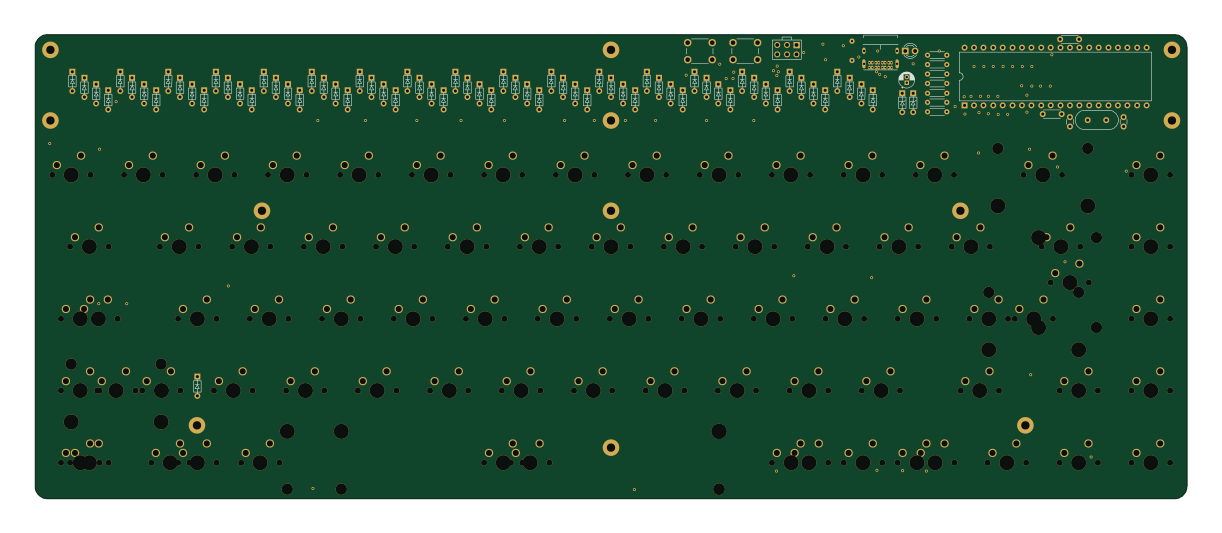 AVR/Arduino
Discipline
coseyfannitutti
304.9 × 122.8 mm170 parts2LCC-BY-NC-4.01.0k AVR/Arduino
Megadesk
gcormier
41.7 × 32.2 mm23 parts2LGPL-3.0818 AVR/Arduino
Easyduino Atmega
Hanqaqa
68.8 × 53.6 mm35 parts4LCERN-OHL-P-2.0746