
Fug

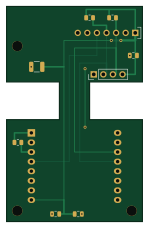
About the Fug PCB
Fug is an open source ESP8266 PCB design by bboe, published on GitHub under the CC-BY-SA-4.0 license. It is a 2-layer board measuring 36 × 57 mm, with 10 components from 8 distinct parts.
Its main chip is the WEMOS_D1_mini, from the ESP8266 family. Other key parts include the 1-101625-10. By type, the board carries 4 capacitors, 3 resistors, 2 ICs and 1 test point.
It belongs with the sensors designs in this gallery.
From the project
Carrier PCB joining a WEMOS D1 Mini (ESP8266) to a Sensirion SCD30 CO2/RH/T sensor. Script-generated KiCad.
A small carrier PCB that joins a WEMOS/LOLIN D1 Mini (ESP8266) to a Sensirion SCD30 CO₂ / humidity / temperature sensor over I²C. Both modules socket in and lift out. 36 × 57 mm, two layers.
Fug is British English for the stale, stuffy, close air of a room that's been shut up too long with too many people in it.
That's precisely what this board detects. Rising CO₂ is the thing you feel as a headache and a fading attention span an hour before you think to open a window — outdoor air sits near 420 ppm, a closed meeting room reaches 1500 ppm easily, and somewhere past that you stop thinking…
Main components on the Fug
Fug bill of materials (BOM)
10 components, 8 distinct parts — part numbers from the project's BOM.
| Qty | Part | Footprint | Refs |
|---|---|---|---|
| 1 | 1-101625-10 SCD30 | SCD30_Module_1x07_P2.54mm | U1 |
| 1 | WEMOS_D1_mini | WEMOS_D1_mini_light | U2 |
| 1 | TestPoints | PinHeader_1x04_P2.54mm_Vertical | TP1 |
| 1 | 100uF | C_1210_3225Metric | C1 |
| 2 | 100nF | C_0805_2012Metric | C2, C4 |
| 1 | 10uF | C_0805_2012Metric | C3 |
| 2 | 10k | R_0805_2012Metric | R1, R2 |
| 1 | 470 | R_0805_2012Metric | R3 |
Fug design files
The KiCad project lives in the bboe/fug repository on GitHub; these links point at the commit this page was built from.
- Layoutfug.kicad_pcb
- Schematicfug.kicad_sch
- BOMfab/fug-bom.csv
Fug: common questions
What microcontroller does the Fug use?
The Fug is built around the WEMOS_D1_mini, from the ESP8266 family.
How big is the Fug PCB?
The Fug measures 36 × 57 mm, has 2 copper layers and is 1.6 mm thick.
How many components are on the Fug?
10 components, from 8 distinct parts, with part numbers taken from the project's own BOM. The full bill of materials is listed on this page.
Where can I download the Fug design files?
From the bboe/fug repository on GitHub, which has the KiCad layout, the schematic and the BOM; the links under Design files point to each one.
Can I use the Fug design in my own project?
Yes, under the terms of its CC-BY-SA-4.0 license, which bboe chose for the repository.
Can I test firmware for the Fug without the hardware?
Yes. HardLabs builds a simulation of the board from its netlist and BOM, so you can run and debug ESP8266 firmware against it before you order a PCB.
Similar boards
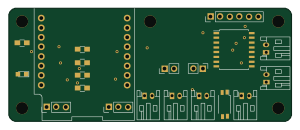 ESP8266
ESP8266ControllerCircuit
stuartpittaway
75 × 30 mm20 parts2LCC-BY-NC-4.01.1k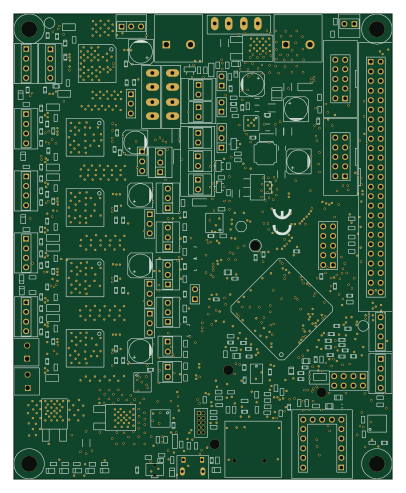 ESP8266
Duet WIFI
Duet3D
100 × 123 mm345 partsCERN-OHL-1.2257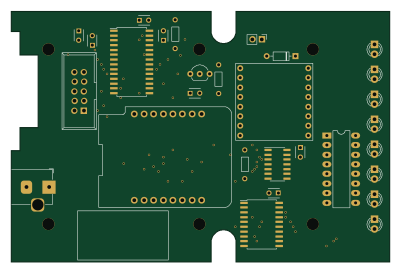 ESP8266
RetroWiFiModem
mecparts
100 × 66.1 mm29 parts2LGPL-3.0256 ESP8266
Mideahvac dongle
reneklootwijk
20 × 48.5 mm19 parts2LNo license74 ESP8266
Single radio
AnyLeaf
37.7 × 37.7 mm43 parts4LMIT63 ESP8266
Esp8266-for uppatvind
horvathgergo
70 × 36 mm27 parts2LGPL-3.060